I thought I would talk about an experience that I had, but I didn’t know how to - it was so complex, and I felt it would be impossible to spontaneously recount the entire story. I decided to write it down to try to hold all the strings together. I am now reading what I wrote.
I recently became part of a community health program along the Andhra–Odisha border with an NGO called Rural Development Service Society, which has been working with the Kondh communities in that region for several years. Some of the Kondhs speak Telugu — my mother tongue — so I was able to speak with them directly.
At the outset, I want us to recognize the gravity of the moment we are living in. We live in the aftermath of the Epstein files — a moment that exposed the vulgar class solidarities of the privileged and the ugly concentration of wealth in the hands of a microscopic elite, whose seemingly invincible power makes much of our geopolitical talk and high-level conversations about poverty sound faintly absurd.
The experience I want to recount lies on the other horizon of this same world.
A few weeks ago, while I was visiting hamlets and speaking to people in the region where I had begun working, I met a very young woman. Her face was swollen. Her entire body was swollen. She said she had a severe headache and was hyperventilating.
I checked her blood pressure. It was extremely high — a hypertensive emergency.
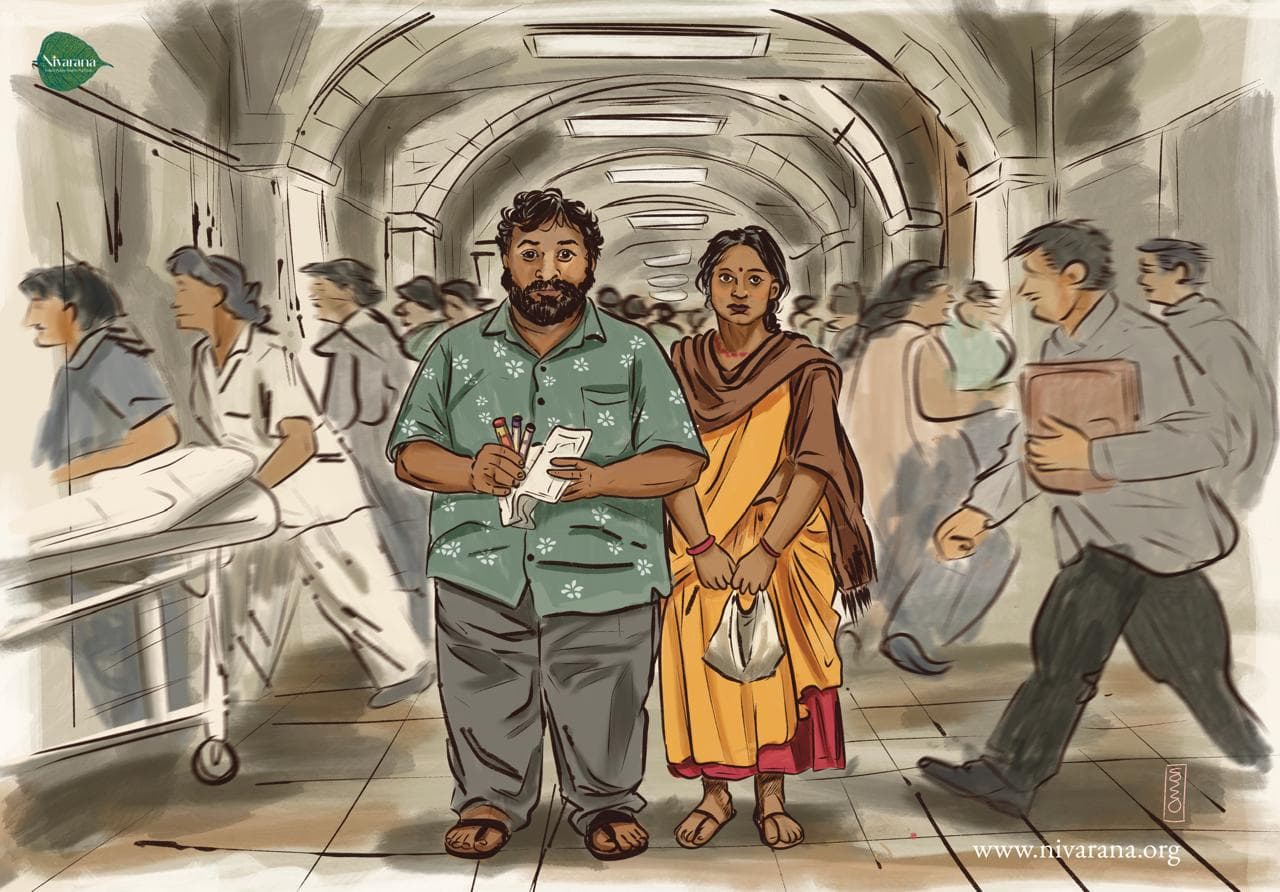
From that moment, two of us accompanied her through the Kafkaesque labyrinth of the healthcare system: her mother, who was the primary caregiver, and I.
Reaching the PHC (primary health centre) meant walking across a hill, then travelling nearly seven kilometres on mud roads by bike, followed by another stretch along the highway. The PHC doctor gave initial treatment and said they did not have the facilities to manage such intensive cases, and referred her to the CHC (community health centre), another twenty kilometres away.
The journey itself was exhausting. But it was the routine.
At the CHC, we went to the casualty. A doctor took her history. She seemed to be on night duty and appeared tense. Her questions were curt, and if the patient dared ask her to repeat something, she would give an earful.
The patient’s first language was Kui. Telugu was her second language — and not textbook Telugu. It carried Kui words and different rhythms. To understand her required attention. The doctor spoke in fluent coastal Telugu, mixed with medical jargon.
I remember standing there, translating in small ways — not formally, but by slowing the exchange, rephrasing, trying to make meaning travel between two registers of speech.
The imbalance in that space was palpable. One person’s language carried institutional power. The others had a whole history of marginalisation and oppression as footnotes.
All this took another two hours. It was then decided that the patient had to be shifted to a higher centre.
We dialled 108 to call an ambulance. They said they can only take her to the designated regional hospital according to protocol, not directly to Visakhapatnam, where facilities were more appropriate. In no time, I was talking to multiple ambulance drivers, electronic voices that suggested typing 1, 2, 3, and some personnel mechanically connecting me to different drivers - I realised how cumbersome this entire system is.
While I was thinking through options, a security guard told us there was a separate ambulance for tribal patients, run by ITDA.
The ITDA ambulance carries multiple patients at a time. Along with the patients and caregivers, I was squeezed into the back. I asked the driver if I could sit beside him since the front seat was empty and the back was cramped. He replied, “This place is not for everyone.” The remark was revealing. One could sense the layers of caste, class, and power impinging on that seemingly protocol-like statement.
After another three hours, we reached King George Hospital in Visakhapatnam. The ambulance driver led us to the casualty and left.
The casualty was chaotic and overcrowded. An intern was shouting very loudly. Our patient was placed on a bed already occupied by two others. There was no space to lie down. She could only sit — and even that felt like a privilege.
The intern took a brief history and wrote slips for an X-ray and an ultrasound. We went to the radiology department, located some distance away in that maze-like hospital building. By the time we arrived, there was a long queue. I stood there with our patient in hypertensive emergency, possibly with heart failure, waiting for an X-ray of the chest and an ultrasound of the abdomen. There was nowhere to sit. We could not leave the queue because it only grew longer. I was also afraid to leave her alone inside the scanning rooms, worried she might be shouted at for not following instructions given by overworked technicians.
After the scans, we returned to the casualty. Blood samples were drawn. At least ten tests were ordered — (CBC, RFT, LFT, blood grouping, urine microscopy, blood gas, troponin, urine albumin, electrolytes, etc.) We were handed multiple sample containers with corresponding tokens to be submitted at different counters. Long queues at each counter.
I remembered writing such investigations without hesitation - when I was an intern. That night, I was carrying multiple samples between fingers, matching tokens to counters, and standing in queues.
It struck me how much coordination this requires — literacy, familiarity with hospital layout, stamina, and confidence to ask questions. Even for me, it felt immense.
I kept thinking: if her caregiver had been sent alone to distribute these samples, would she have managed? Perhaps. Many do. But the system assumes certain capacities as default, and those capacities are socially uneven. Inequally exercised.
After handing over all the samples — which itself took hours — we returned to the casualty. A first-year postgraduate began writing the case sheet. He seemed anxious, cautious. He asked about urine output, fever, headache — in English - the language an urban, educated middle-class person would understand. The first-year PG had no clue how far away our people came from, and how deeply invisibilised their lives are.
The patient answered as best as she could. He wrote what he understood.
It was past 1 AM. None of us had eaten. No pause in the system acknowledged that fact. The process moved forward irrespective of hunger, fatigue, or comprehension.
By the time she was shifted to the ward, it was around 3 AM.
From the moment I first saw her in the village at 9 in the morning to admission in the ward, eighteen hours had passed.
Accompanying her through that system was deeply unsettling for me. In some sense, I occupied a unique position in that context: I was both an outsider and an insider. At once, I was a naïve and passive observer; yet, because I had experienced the system from the other side, I was also an active observer — able to understand the rationale behind the tests that were ordered and the drugs that were prescribed.
It was from that space that I understood that violence can be distributed across distance, delay, language, administrative complexity, overcrowding, and hierarchies.
Violence accumulates.
As doctors, we often see fragments — a case sheet, a test result, a referral note. But patients experience the system as one continuous journey.
From that vantage point, dehumanisation does not appear dramatic. It appears procedural. It is not one incident. It is the system.
I include myself in this. I have written investigation slips. I have referred patients. I have assumed that people will manage.
Accompanying her, I saw what this ‘managing’ entails.
There was one point when I was shouted at by a senior nurse when I was trying to explain that the people I was accompanying come from very far - deep inside the hills - and that they don’t understand the language you and I speak - she screamed, ‘Thousands of people come here, and they all adjust. No one gets special treatment’ - the special treatment here was ‘basic dignity’.
Perhaps violence in healthcare is not all explicit. Perhaps violence in healthcare is about accumulation — the slow wearing down of dignity through perfectly routine processes.
Thank you.
Edited by Christianez Ratna Kiruba
Image by Gayatri
This piece was initially read out by the author in the 52nd Medico Friend Circle (MFC) meet conducted in Raipur, Chhattisgarh