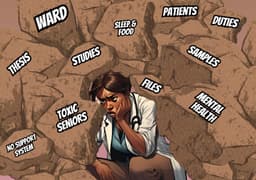
Rashit, a 35 year old corporate professional in a formal, tucked in shirt, entered a pharmacy, wiping sweat from his forehead with a handkerchief. He found his parents’ prescriptions in his laptop bag and approached the pharmacist at the counter with a smile.
The pharmacist checked the stock levels on the computer, signalled that all medicines were available, and asked whether any other medicines were required. Then he remembered he had to buy medicines for his pregnant wife as well. Luckily, he had the prescription in his mobile phone, and he quickly showed it to the pharmacist.
The counter boy arranged all the medicines and handed them over to Rashit. "How much?" Rashit asked. "It's Rs 14,345, sir, after the discount." A few seconds of awkward silence. Rashit mentally converted the bill into nearly 20% of his monthly salary, and he had to pay for the gynaecologist appointment for his pregnant wife with the ultrasonography and other tests just after two weeks. He handed over his credit card, wondering how long these expenses would continue.
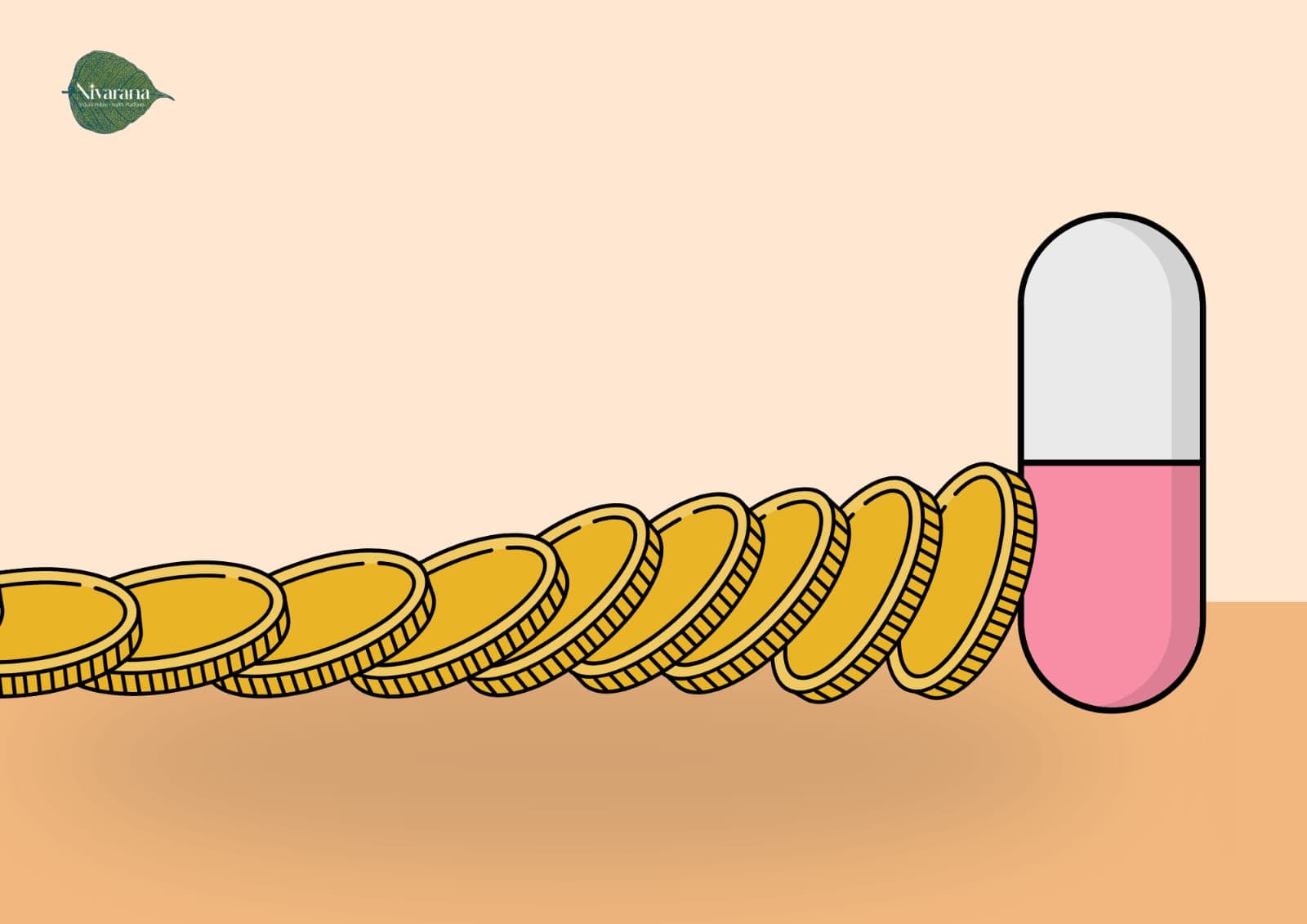
This is a common story among many Indian households. Sometimes, medicines compete with other essential household expenses. The worst part is that the medicine expense is a regular monthly expense if there is anyone in the family having chronic conditions, and the cost keeps on increasing year on year.
These consequences extend beyond individual health to the broader goals of equity, financial protection, and universal health coverage. The NPPA (National Pharmaceutical Pricing Authority) fixed ceiling prices for 930 formulations, including 131 anti cancer, 11 anti diabetic and 66 cardio vascular formulations. Unfortunately, this price ceiling does not become handy for an average middle class Indian household because of various reasons..
Who Really Chooses Our Medicines
Unlike other commodities, medicines are not chosen by the patients who consume them. It is consumed only after thorough consultation with a registered medical practitioner and in accordance with the prescribed dosage. The practitioner decides on the drug and its dose based on the patient's condition. The practitioner must then choose from the thousands of drugs marketed in India. It is practically impossible to remember the specific indications, counterindications, patient safety and toxicity data for each and every drug. Nevertheless, hundreds of brands may exist in the market for a single drug, which makes it more complicated.
The choice of a medicine or a particular brand is primarily determined by the prescribing practitioner based on clinical judgment, experience, and patient-specific considerations.
Since pharmacists are generally not authorised to substitute a prescribed brand independently, pharmaceutical companies focus their marketing efforts on influencing prescribing decisions through medical representatives (MRs). MRs serve as the primary interface between pharmaceutical companies and healthcare practitioners by promoting their company's brands, providing product information, and encouraging brand-specific prescribing.
Why are Medicines Still Expensive in India
These endorsed medicines are commonly marketed as branded medicines in India. As these medicines reach the patient through multiple stakeholders, each intermediary adds a price margin, which is usually priced higher and ultimately paid by patients themselves. Sometimes, medicines prescribed by clinicians are dispensed preferentially through attached pharmacies, limiting patients' ability to compare prices or seek lower-cost alternatives.
Conversely, if the prescription only lists the drug names/generic names, there is a very high chance the pharmacist or the shop attendant will dispense only those brands that give them the highest margin. In practice, only a few pharmacies dispense medicines under a pharmacist's supervision, which further increases the risk of push selling by the shop owner.
Irrespective of who decides the brand, the doctor or the dispensing outlet, the financial burden is eventually borne by the patient. An empirical assessment study on out of pocket expenditure on medicines in India revealed that medicine costs roughly around 28% and 33% of the total OPD expenditures at public and private facilities, respectively.
How Generic Medicines Enter the Market
In the United States and Europe, medicines are generally classified as originator (innovator) products and generic products. Originator medicines are typically protected by patents and, in some cases, regulators grant the innovator company exclusive marketing rights for a specified period. Following the expiry of these protections, other manufacturers may seek regulatory approval to market generic versions of the medicine.
Generic products are generally required to demonstrate bioequivalence to the reference (innovator) product, ensuring comparable quality, safety, and therapeutic performance. The Draft Pharmaceutical Policy 2017 also addressed this by emphasizing that bio availability and bioequivalence(BA/BE) tests should be mandatory for all manufacturing permissions granted by both central and state regulatory authorities.
These generics are expected to offer the same therapeutic benefits as the innovator product but at a much lower cost because multiple manufacturers compete in the market. Semaglutide provides a recent example. After the expiry of Novo Nordisk's patent in India in March 2026, several Indian companies introduced generic versions of the drug, leading to a significant reduction in prices and making this important therapy more affordable for patients.
In India, the vast majority of medicines available in the market are off-patent products and are therefore, in technical terms, generic medicines.
However, unlike in many Western countries where generic medicines are typically marketed under their nonproprietary name, most generic medicines in India are marketed under proprietary brand names, commonly referred to as branded generics.
As a result, the market remains highly brand-driven despite the availability of multiple manufacturers producing the same active pharmaceutical ingredient. Several studies have shown that both patients and healthcare providers often perceive higher-priced medicines as being of superior quality, while lower-priced medicines are viewed as "generic" and potentially less effective.
Nevertheless, the Government of India has clarified that all medicines manufactured and marketed in the country, whether branded or generic, are required to comply with the same quality standards prescribed under the Drugs and Cosmetics Act, 1940 and the Drugs and Cosmetics Rules, 1945.
How the World Makes Medicines Affordable
In many countries, pharmacists are authorised to substitute a generic medicine unless the prescribing physician explicitly prohibits substitution for clinical reasons or the medicine belongs to categories where substitution requires additional caution, such as certain narrow therapeutic index drugs or biological products.
Countries including the United Kingdom, Germany, Canada, Australia, the Netherlands, New Zealand, and many U.S. states actively encourage generic substitution through legislation, reimbursement policies, and financial incentives for physicians, pharmacists, and patients.
In several healthcare systems, reimbursement is based on a reference pricing model, whereby insurers or national health services reimburse only up to the cost of the lowest-priced equivalent medicine, allowing patients to choose a higher-priced brand if they are willing to pay the difference. This policy has contributed substantially to reducing medicine expenditure without compromising clinical outcomes and has become an integral component of rational medicine use and universal health coverage strategies in many countries.
Where India Stands Today
In India, a Registered Pharmacist can dispense only those medicines prescribed by a Registered Medical Practitioner and shall not substitute the prescription in accordance with the Pharmacy Practice Regulations, 2015. But the government has already introduced Janaushadhi stores to offer quality generic medicines at 50%-80% lower prices than branded medicines. A total of 17610 Janaushadhi stores, offering 2110 types of medicines across different categories, are operating across the country as of 30th November 2025.
In a similar line, many private retail pharmacy chains have emerged since COVID and are offering generic medicines from their thousands of outlets across the country. This is a promising development in improving access to medicine. But there are no such guidelines or clear direction for generic substitution.
Can India do Better?
India has a list of drugs approved by the Central Drugs Standard Control Organization (CDSCO), but it does not publish any national therapeutic equivalence list in the public domain.
Imagine a government-approved list that tells every pharmacist exactly which generic medicines can safely replace a branded medicine. That is precisely what the FDA's Orange Book does in the United States. It has the updated list of therapeutically equivalent drugs to a branded drug. This list helps the pharmacist to check the therapeutic equivalence (TE) rating of the drug and can therefore be substituted without consulting the prescriber.
Another important step is to strictly enforce the regulatory parameters for generic drugs, so that trust can be built over time. Indian companies are already supplying generic medicines to almost all of the developed nations by complying with their regulatory guidelines. The same mechanism can be implemented in India as well.
A recent positive development in this aspect is the growing awareness of generic medicines through digital media among the young population. As a result, in recent years, many new private players have emerged as generic medicine providers, with a wide range of retail stores across the country, mainly in tier 1 and tier 2 cities. They are aggressively promoting their products as a cheaper, smarter alternative, sometimes backed by celebrity endorsements.
India has earned global recognition as the ‘Pharmacy of the World’ by making medicines affordable for millions of people beyond its borders. The next challenge is ensuring that every Indian benefits from the same affordability. True leadership will not be measured only by how many medicines we export, but by whether every Indian can obtain the medicines they need without any financial hardship. Only then can we truly call ourselves the Pharmacy of the World.
Edited by Christianez Ratna Kiruba
Image by Janvi Bokoliya