For years, antimicrobial resistance (AMR) has been the focus of extensive biomedical and public health research. I have attended a few conferences in 2026 on AMR and, with Sarah, have done certain action projects on this topic. Co-learned with the South Asian Sanitation Labor Network (SASLN), we all now understand many of the biological and social processes through which resistance develops.
We know that inappropriate use of antibiotics in human health, agriculture, and animal husbandry contributes to the problem. Every year, new surveillance reports, systematic reviews, and policy recommendations reinforce the urgency of the challenge. Yet antimicrobial resistance continues to grow.
The question, at least for many of its central drivers, is no longer whether we have enough evidence to tackle this problem. It is why so much evidence has produced so little structural change.
This puzzle extends far beyond antimicrobial resistance. Many biomedical scientists are trained and conditioned to believe that better evidence leads to better health. Scientists are taught that if they ask the right research questions, generate robust data, and communicate their findings effectively, policies and practices will improve. This belief is shaped by what we as health researchers have witnessed throughout the history of medicine. Vaccines, antibiotics, imaging technologies, genomics, and countless public health interventions demonstrate the extraordinary power of rigorous science.
Yet, despite producing more evidence than ever before, many of our greatest health challenges, such as maternal mortality, malnutrition, climate-related illnesses, and widening health inequities, continue to persist. This made me wonder whether the problem is really the absence of evidence.
Our instinct, understandably, is to produce more evidence. We build larger cohorts, strengthen surveillance systems, develop more sophisticated analytical methods, and improve the quality of our data. None of these efforts is unnecessary. They remain the foundation of good biomedical science. But over time, I realised that we, as researchers, have paid far less attention to another question: What happens to evidence after it is produced?
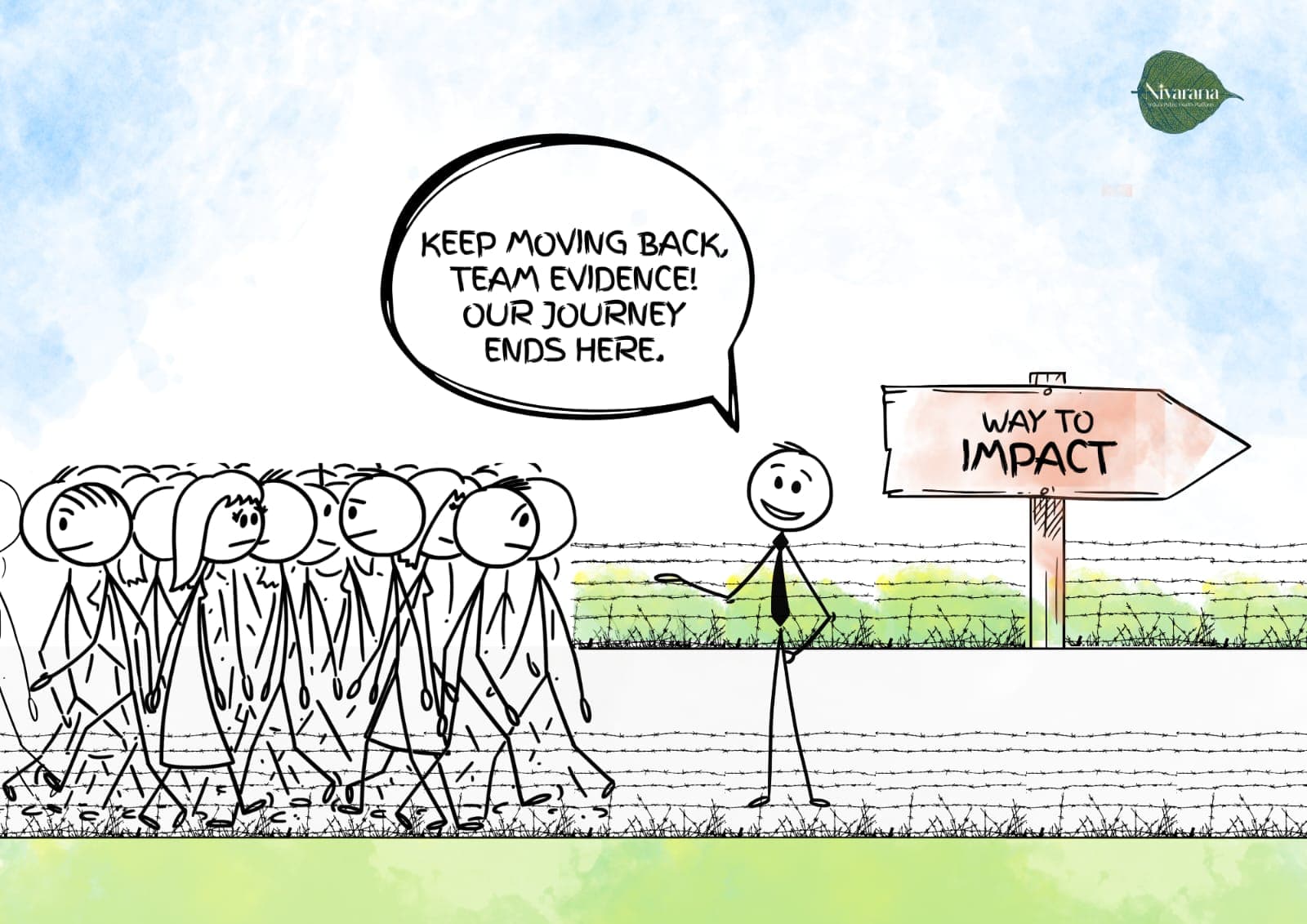
As health researchers, we often assume, or are sometimes expected to assume, that the pathway from Evidence to Impact is straightforward. Produce evidence, communicate it, and change will follow. At the back of our mind, we know that the journey from publication to transformation is neither automatic nor neutral. Evidence passes through institutions, governments, funding agencies, professional norms, commercial interests, and political priorities before it shapes people’s lives.
Don’t you think that it is this journey, rather than evidence itself, that deserves much closer attention?
As I searched beyond the biomedical literature, I realised that scholars from political theory, philosophy, and critical social science had long been grappling with a similar question. They seem to be worried about not how evidence is produced, but why evidence so often fails to transform society.
For example, a Gramsci’s lens says that research questions are never entirely neutral; institutions shape what is recognised as an important problem worthy of investigation. Foucault indicates that medicine does more than diagnose disease; it also shapes how disease becomes visible. Fanon shows that illness cannot always be separated from the histories of violence, exclusion, and inequality that produce it. Paulo Freire encourages us to think of research not simply as the production of knowledge but as a process that should strengthen people’s capacity to transform their own realities. Mbembe confronts us: if we now know so much about suffering, why does so much of it continue unchanged?
Reading an essay by Abdaljawad Omar titled, Gaza and the Problem of Moral Stupidity, gave me a language for something I had been struggling to articulate. What struck me was not simply his analysis of Palestine, but his observation that contemporary institutions have become remarkably adept at acknowledging evidence without allowing that evidence to disturb existing structures of power.
Reports are commissioned, findings are accepted, suffering is publicly recognised, and yet the systems producing that suffering remain largely intact. Omar calls this moral stupidity. It is not an absence of intelligence or information. It is a failure to act upon what is already known. He argues that this is sustained through what he describes as a structure of disavowal.
I find this idea particularly useful for thinking about biomedical research. A structure of disavowal does not reject evidence. On the contrary, it welcomes it. Data are collected, reports are published, dashboards are updated, indicators are monitored, and recommendations are produced. Institutions then point to these activities as evidence of responsiveness. Yet the deeper political, economic, and social arrangements that generate illness or disease often remain stable. Evidence is not ignored; it is absorbed. Its disruptive potential is ‘translated’ into administrative routine.
The more I reflected on biomedical research through this lens, the more familiar this pattern began to feel. We know that antimicrobial resistance cannot be understood through prescribing practices alone; agricultural policy, pharmaceutical markets, and unequal health systems also shape its emergence.
We know that maternal mortality cannot be reduced through clinical care alone when women continue to face poverty, caste and racial discrimination, and inadequate public services. We know that climate change is becoming one of the greatest health threats, yet much of our response remains focused on documenting its consequences rather than transforming the conditions driving it. In each of these cases, evidence continues to grow while structural change struggles to keep pace.
If this diagnosis of our problems with health research is correct, then perhaps biomedical research needs to think about rigour in a broader way. Methodological rigour will always remain fundamental. Without credible evidence, there can be no trustworthy science. But alongside methodological rigour, we may also need reflexive rigour, a Sindhanai, the discipline of asking how research questions are framed, whose realities become visible, how evidence travels through institutions, and whether it ultimately contributes to changing the conditions that produce illness.
This is not an argument against evidence-centred rigour in biomedical science. It is an argument for expanding its ambition, passion, and appetite to bring transformation. The future of health research may depend on understanding the systems into which that evidence enters.
Alongside asking whether our findings are scientifically robust, perhaps we should also ask what happens to those findings after they are produced. Do they help transform the structures that sustain ill health, or do they become part of a structure of disavowal that measures injustice with ever greater precision while allowing it to persist? In an era overflowing with evidence, this is significant.
Edited by Parth Sharma
Image by Janvi Bokoliya