
A few months back, I wrote a reported story in The Hindu on how intimate partner violence is an underrecognised public health crisis. I wrote that story in the wake of a Lancet publication estimating that nearly one billion women and children worldwide were exposed to intimate partner violence and sexual violence in 2023—at levels severe enough to cause clinically significant illness and disability.
The numbers were staggering. The implications were sobering. And yet, as I revisit both the study and my own reporting, I am struck by something else entirely—an absence so familiar that it has been normalised.
Across health systems, policy documents, academic papers, and even public conversations, there is a careful, almost ritualistic avoidance of naming perpetrators.
The Lancet analysis meticulously maps how intimate partner violence translates into disease: post-traumatic stress disorder, depression, anxiety, chronic pain, cardiovascular illness, gastrointestinal disorders, and reproductive ill-health. It quantifies the burden in disability-adjusted life years. It compares violence to other major risk factors such as obesity, smoking, and high blood glucose.
What it does not do, and what medicine and policy more broadly struggle to do, is confront the uncomfortable truth that this burden is not accidental. It is produced, repeatedly and predictably, by men’s violence.
The Male Violence Epidemic
In recent years, there has been much public anxiety about what is being described as a “male loneliness epidemic.” From opinion columns to podcasts, men’s social isolation, declining friendships, and emotional distress are increasingly framed as a crisis demanding urgent attention.
What receives far less scrutiny is a parallel and far more lethal reality: the male violence epidemic.
In India, violence follows a consistent and deeply gendered pattern across contexts. Nearly one in three ever-married women report experiencing intimate partner violence, physical, sexual, or emotional, most often at the hands of husbands, according to the National Family Health Survey-5.
Violence also begins early. Official crime data under the Protection of Children from Sexual Offences (POCSO) Act records tens of thousands of cases of child sexual abuse each year, with girls disproportionately affected and perpetrators most commonly known to the child, often adult men within families or communities. Other violent crimes against children also have this exact gendered context.
According to National Crime Records Bureau data, around 96-97% times, the person arrested for crimes against children are men. This includes 98% male offenders in POCSO cases, 95% in kidnapping or abduction of children, 92-94% in murder of children and 96% in grievous hurt or assault of children. Even given the 30-40% conviction rates, a reasonable estimate stands that of the people convicted, around 90% or more are men.
Beyond homes, violence in public spaces follows a similar logic. National Crime Records Bureau data show that men constitute the majority of both perpetrators and victims of serious violent crimes such as murder and grievous assault, reflecting the central role of men in acts of physical aggression.
According to the data, in murder cases registered in 2023, approximately 70–75 % of murder victims were male, while those arrested for murder were overwhelmingly male, around 95–97 %. A similar pattern holds for other major violent offences: for grievous hurt and assault, roughly 75–80 % of victims were male, yet about 95–96 % of persons arrested were men; in robbery, men made up the vast majority of victims, and roughly 97–98 % of those arrested were male.
Taken together, these patterns point to a stark conclusion: whether the victims are women, children, or other men, the overwhelming share of violence in India is perpetrated by men. This is a reality that remains inadequately acknowledged in public discourse, policy, and health systems.
Male Violence is Highly Celebrated
In India, as in every country in the world, male violence is celebrated. All kinds of media, including films, TV shows and music, portray aspirational masculinity as that of brute force, cultivating power and minimal emotional expression.
While movies like Kabir Singh and songs of artists like Guru Randhawa and Honey Singh have come under fire for objectifying and treating women badly, every other movie and TV show using male-on-male violence plot devices fly under the radar and are even appreciated and applauded. “Belt treatment” of wives and children is also celebrated as a way that a man could keep their unruly family members in check.
There are very few media examples of vulnerable emotional expression and dialogue as a means of conflict resolution.
This form of masculinity is often socially rewarded. Men who are perceived as “strong” and “assertive” tend to receive greater access to opportunities, resources, and positions of decision-making power within social and institutional structures..This rewarding of aggressive self-expression as strength is also further fuelled by the demonisation of any other form of self-expression as weak and feminine.
All of this boils down to a culture of men who do not know how to resolve conflicts other than resorting to violence.
Furthermore, there is little to no accountability for men who perpetrate sexual violence against children and other women within families, further encouraging such violence.
Speaking to Women, Ignoring Men: A Gender Blind Spot
The moment we introduce gender as a topic, male engagement plummets.
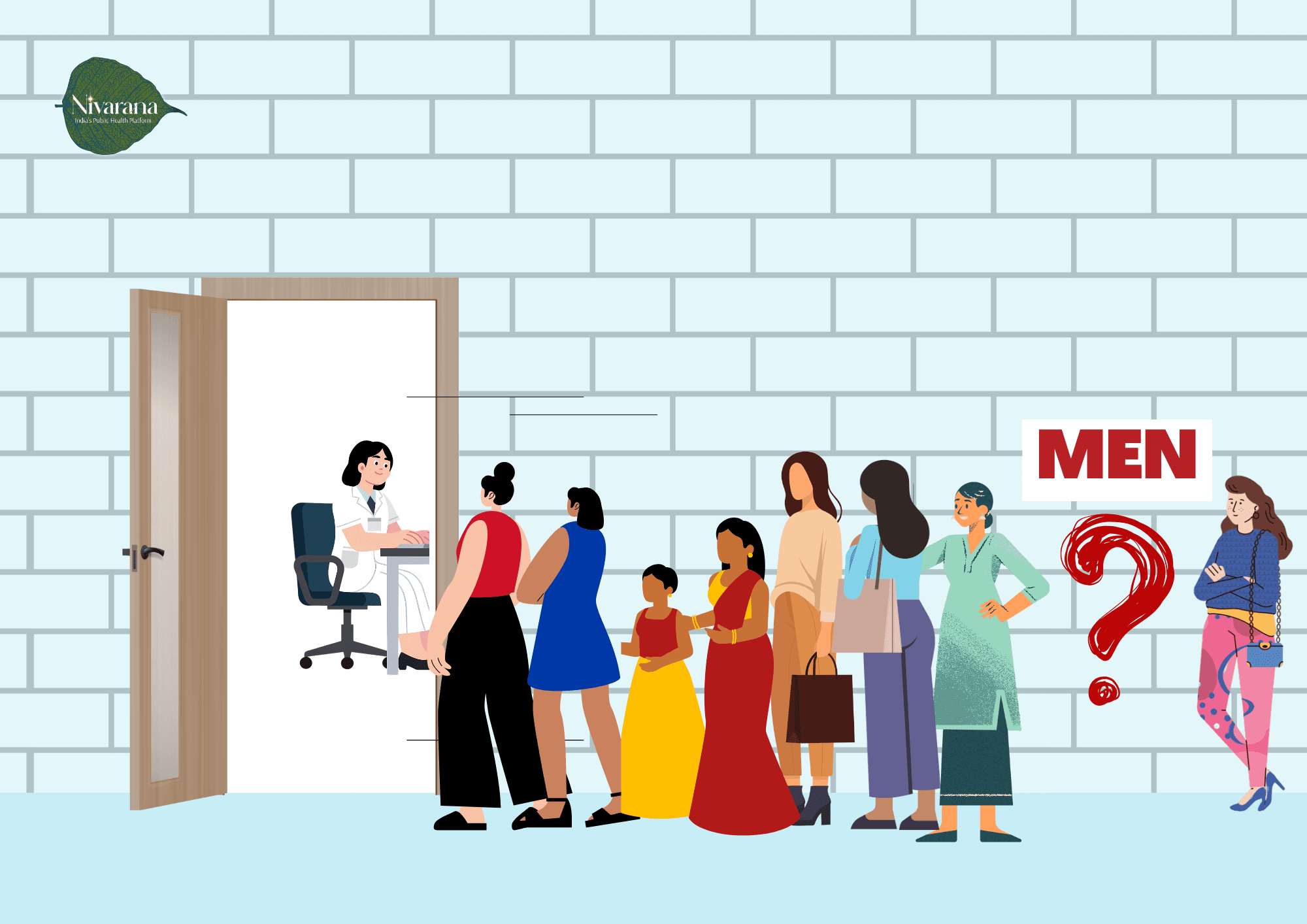
In nearly every workshop, conference, or panel discussion on gender that I have participated in, the audience is overwhelmingly female. The men who stay are listening. But the men who dominate public discourse are often nowhere to be found. This absence is mirrored in how health systems respond to violence: they attend to women’s suffering while rarely asking men why they cause it.
Interventions addressing intimate partner violence and sexual abuse are overwhelmingly designed to support women survivors, as they must be, but they rarely involve men as participants, learners, or targets of behaviour change.
In clinical settings, most doctors do not ask male partners why they hit their wives or speak to them about consent, emotional regulation, or control. Counsellors in gender-based violence clinics are predominantly women, and their work focuses almost entirely on women victims. Male perpetrators are seldom part of structured intervention, education, or accountability pathways.
This selective engagement reinforces the idea that gender inequality and violence are “women’s issues,” rather than shared social problems that require confronting male behaviour and male socialisation directly.
Research supports this gap. Studies on gender norms and violence prevention globally show that programmes which explicitly include men and boys—across schools, communities, and health services—are significantly more effective at reducing violence than those focused only on women. Such interventions can substantially reduce men’s likelihood of perpetrating violence. Yet male-inclusive approaches remain the exception rather than the rule.
Reframing Accountability for Men
If intimate partner violence is to be taken seriously as a public health issue, accountability must be understood differently from how it is currently framed. Accountability does not mean only police complaints, arrests, or incarceration. It means naming male violence as a modifiable risk factor, much like tobacco use or drunk driving, something shaped by social norms, entitlement, and impunity, and therefore something that can be prevented.
Yet most public health responses continue to treat violence as a private pathology that women must manage, rather than a behavioural and structural problem that requires engaging men directly.
This failure is most evident in how the health system conceives of “solutions.” Support services are overwhelmingly designed around helping women leave violent relationships. But most women do not want to leave. Many cannot. Some know that leaving may escalate the violence. What they seek instead is safety, relief, and an end to harm without the collapse of their families or livelihoods.
A health system that only knows how to respond when women are ready to exit violence is ill-equipped to care for the much larger population of women who are forced to survive within it.
Accountability, in this context, does not mean forced confession or punishment within clinics. It means structured, evidence-based interventions that engage men around emotion regulation, consent, alcohol use, jealousy, control, and entitlement—factors consistently linked to intimate partner violence.
Crucially, this reimagined accountability demands institutional courage. Doctors must be trained to speak to male partners, not only women. Counsellors must be supported to work with perpetrators, not just survivors. Public health messaging must stop implying that violence is something women must escape, and instead name it as something men must unlearn.
Without this shift, violence will continue to be managed downstream, as depression, heart disease, anxiety, and disability, while its origins remain untouched.
Treating male violence as a public health issue does not absolve men of responsibility; it deepens it. It insists that accountability is not only about punishment after harm, but about prevention before it becomes inevitable. Naming male violence is not an act of hostility. It is a prerequisite for prevention.
Edited by Parth Sharma
Image by Janvi Bokoliya