Menstruation is a significant aspect of women's lives, the meanings and practices of which are deeply embedded in cultural and societal norms. This poem is an articulation of how women from the Banjara community express what they feel about the episodes of isolation, along with their material, emotional, and social connotations.
This is a critical reflection on menstruation being regulated not only by the body, but also by silence, stigma, taboos, tradition, and the moral discourse of "purity" and "impurity". Justified in the name of culture and belongingness in samaj (community), practices are not only rooted in loneliness and restriction, but also reveal themselves in their emotional and psychological implications.
It is an important expression, as menstruation is often unspoken and unseen. The women in this poem belong to the Banjara community in the Yavatmal district of Maharashtra. This community, which was historically labelled as criminal tribes and later was accorded different statuses (in this part of India they are considered as Other Backward Classes) in different states, continues to be excluded and marginalised. Within this larger context, women face the burden of multiple exclusions.
My observations from eight weeks of fieldwork with the Banjara women across ages reveal this gendered phenomenon, which is rarely spoken about. While menstrual huts practiced in Maharashtra are widely studied as a visible implication of their belief system, menstrual isolation within the space of one’s home is rarely visible to an external eye.
Rooted in field experiences, the poem challenges the normalisation of practices hidden within the household that greatly influence women's lives. It speaks for the unsaid: loneliness, obedience, and a sense of discomfort and contradiction. The poem is not only an articulation of the women’s experience but also questions the status quo.
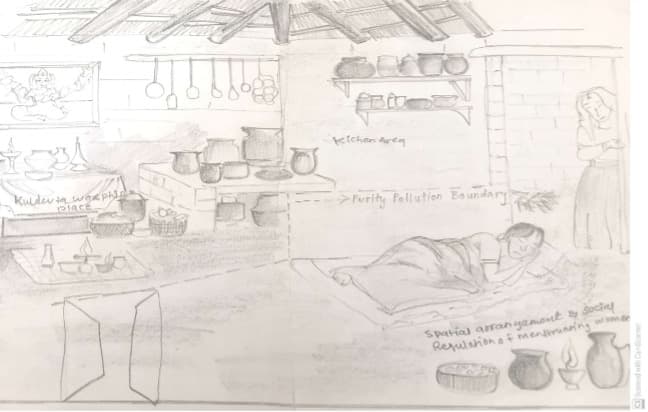
The author’s sketch of menstrual isolation within a family space as practiced among the Banjara community in Maharashtra. The isolation has physical, emotional, and social elements, redrawing familial roles and obligations.
इन रस्मों और परंपराओं का
सितम ही कम नहीं कुछ, ये नया नियम न इजाद कर,
यूँ जुल्म न कर, बेदाद न कर।
ये प्रथाएँ हमें बर्बाद न कर, बर्बाद न कर।
रातों को उठ-उठ कर रोते हैं, रो-रो के दुआ ये करते हैं,
आँखों में विश्वास और दिल में खलिश, सर धुनते हैं, आहें भरते हैं।
ये रीति - रिवाज़, ये कैसा रोग लगा, जीते हैं न, ज़ालिम मरते हैं।
इन ख्वाबों से यूँ तू आज़ाद कर,
ये प्रथाएँ हमें बर्बाद न कर, बर्बाद न कर।
जिस दिन से बंधा है ये मासिक धर्म का सितम,
घबराए हुए से रहते हैं।
हर वक्त मन में कल्पनाएँ करके शर्माए हुए से रहते हैं।
कुम्हलाए हुए फूलों की तरह,
कुम्हलाए हुए से रहते हैं।
यूँ ज़ुल्म न कर, तू सितम न कर,
ये प्रथाएँ हमें बर्बाद न कर,
बर्बाद न कर...
The Banjara community is also known as Lambani or Lambadi. It is a semi-nomadic tribe, recognised under different categories in different states, such as a de-notified tribe (Vimukt Jati) in Maharashtra, listed as (OBC) in Gujarat and Madhya Pradesh, (ST) in Andhra Pradesh and Odisha, (SC) in Karnataka. Their village settlements are called Tanda, which maintain a distance from non-Banjara communities.
Historically, this community has faced exclusion through their migration struggles, colonial criminalisation, and continued segregation in tandas. Because of this, the isolation limited their access to health and education, with a direct impact on women’s well-being. Menstrual practices among Banjara women remain shaped by cultural taboos, poverty, and stigma.
The community began following traditions - kurma ghar (period huts), which force women not to enter their home temple, restrictions on food handling, and limited mobility during menstruation that continue to dominate. Even as awareness and access to hygiene products have slowly increased, the stigma and taboos still restrict women from participating in community rituals during menstruation, or even speaking openly about it.
These changes, as I found out, are deeply implicated in everyday lives and have not been considered, and this invisibility around women’s practices impacts how rural women live and work in their homes and communities.
My work looks into menstrual practices, specifically in the context of invisible seclusion, among the Banjara Community in Rural Maharashtra. Research literature focuses on visible isolation, yet there is a distinct gap in terms of how this unfolds and its implications in specific communities, such as the Banjara communities.
I focused on invisible historical, cultural, and socio-economic factors, which intersect in shaping well-being practices, as well as the experiences and barriers to safe menstrual practices among adolescent girls and women.
The findings reveal that ideas of sacred and profane in terms of space within a home, material objects, social events, and familial relations guide the lives of women during menstruation. Explanations for the normalisation of such practices are attributed to tradition and Kuldevta (every house has a dedicated space for Kuldevta, or the clan god). These need to be upheld as markers of belongingness to this community/samaj.
Women shared, along with their menstrual practice, feelings of isolation and loneliness within restricted space and time, which interlinked with family, faith and community. Until this invisibility is recognised, the isolation these women describe will remain a private burden mistaken for a private matter.
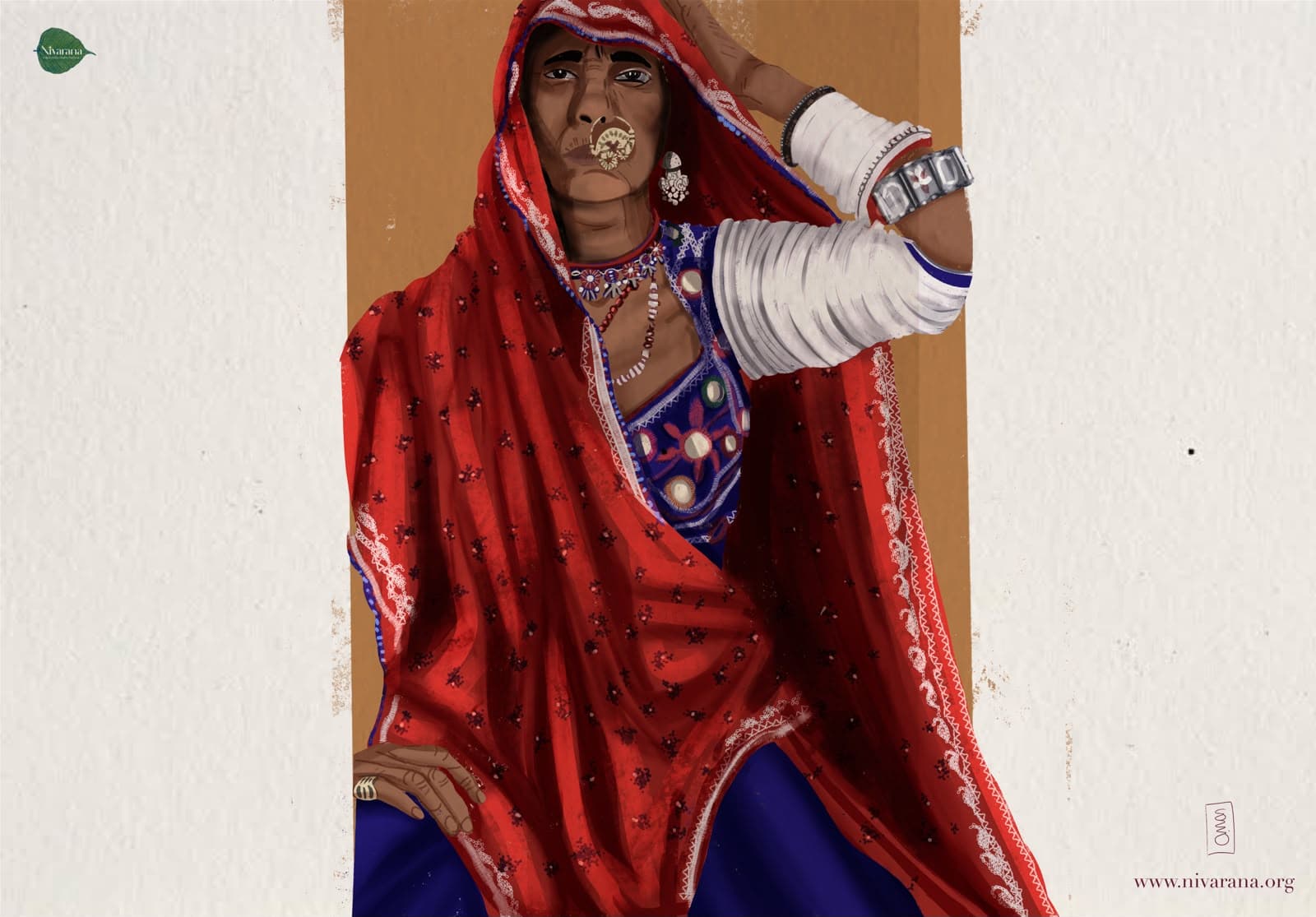
Image by Gayatri
In-text sketch by Ranjana Vijay Rathod
Edited by Radhikaa Sharma