A Cyclone in Jatani and the Search for India's Missing Urban Menstrual Policy
A case study of three premier public institutes reveals the gaps in India's vast but flawed menstrual policy—leaving women in urban spaces struggling for access. This neglect is also found in higher education institutes, forcing students to navigate stigma, scarcity, and systemic indifference.
Part Two of a Series on the Normalised Neglect of Women's Health in Indian Public Institutes
About 20 km from Bhubaneswar, in the small town of Jatani, lies the quiet, 300-acre National Institute of Science Education & Research (NISER) campus. Founded and funded by the Department of Atomic Energy, it is a legacy project of the Homi Bhabha National Institute.
Every student who clears the entrance test receives a 100% scholarship. The institute also has a low-functioning supercomputer. These features earn it a reputation as a "premier" public institute.
NISER’s earth-fond buildings are scattered across its sprawling campus. Located near the East Coast, it is no stranger to cyclones, and students are well-acquainted with lockdowns.
Construction finished in July 2015, eight years after Dr. Manmohan Singh laid its first brick. Since then, the campus has weathered a global pandemic and multiple cyclones, including Cyclone Fani, which directly tore through the campus in 2019.
In October 2024, Cyclone Dana put the town under precautionary lockdown until the storm subsided. But even with winds reaching 120 Km per hour, students had to slip through the main gate’s bars, venturing deep into town for some luxury items, namely cigarettes and sanitary napkins.
India’s Overlooked Urban Menstrual Gap
In the 50th session of the UNHRC in 2022, the World Health Organisation made a statement during a panel discussion on menstrual hygiene management, human rights, and gender equality. The statement included many calls to action.
The foremost was to recognize and frame menstruation as a health issue, not a hygiene issue, as a necessity, and not a matter of preference.
“WHO calls for three actions: Firstly, to recognize and frame menstruation as a health issue, not a hygiene issue, [from] before menarche to after menopause.
Secondly, to recognize that menstrual health means that women and girls and other people who menstruate have access to information and education about it; to the menstrual products they need, water, sanitation, and disposal facilities; and to fully participate in work and social activities.
Thirdly, ensure that these activities are included in the relevant sectoral work plans and budgets and that their performance is measured.”
—WHO statement on menstrual health and rights at the 50th session of the Human Rights Council Panel discussion on menstrual hygiene management, human rights, and gender equality.
However, there is a glaring gap in the way India currently approaches menstruation - it is that a significant portion of the population is left out.
The horrors faced by rural women without access to disposable menstrual products are Every year, countless, charities, and philanthropic efforts are launched to address this issue.
These initiatives—including WHO panel discussions—aim to eradicate "period poverty" and shift the narrative. They seek to reframe menstruation from an issue of hygiene and commerce to one of human rights and health.
However, the urban population, 49% of whom live in slums, as of 2020 data, is not covered by a robust menstrual policy. This is because most research, charities, and government schemes promoting menstrual accessibility focus only on rural teenagers.
This gap then has detrimental effects on women’s higher education - leading to them dropping out.
To combat this, the University Grants Commission provides some basic guidelines to promote menstrual accessibility in public institutes for women. However, this detailed analysis of the implementation of these initiatives across three central institutes—NISER, University of Delhi, and Jamia Millia Islamia—reveals a stark hollow within India's menstrual policy, which exists not even in name in urban spaces and for adult women.
Kalindi College Infirmary’s Paid Sanitary Pads
“My friend was on her period, so I went to get her a pad from the infirmary. They charged me five rupees,” said Shruti, a recent graduate of Delhi University’s all-women’s Kalindi College. “It’s not just about the amount but the fact that you must pay at all that bothers me.”
Last year, Kalindi went viral for its poor sanitation facilities and declining attendance due to menstrual inaccessibility. “You don’t expect to pay for a pad in a college medical room,” Shruti added. Another student called it "degrading."
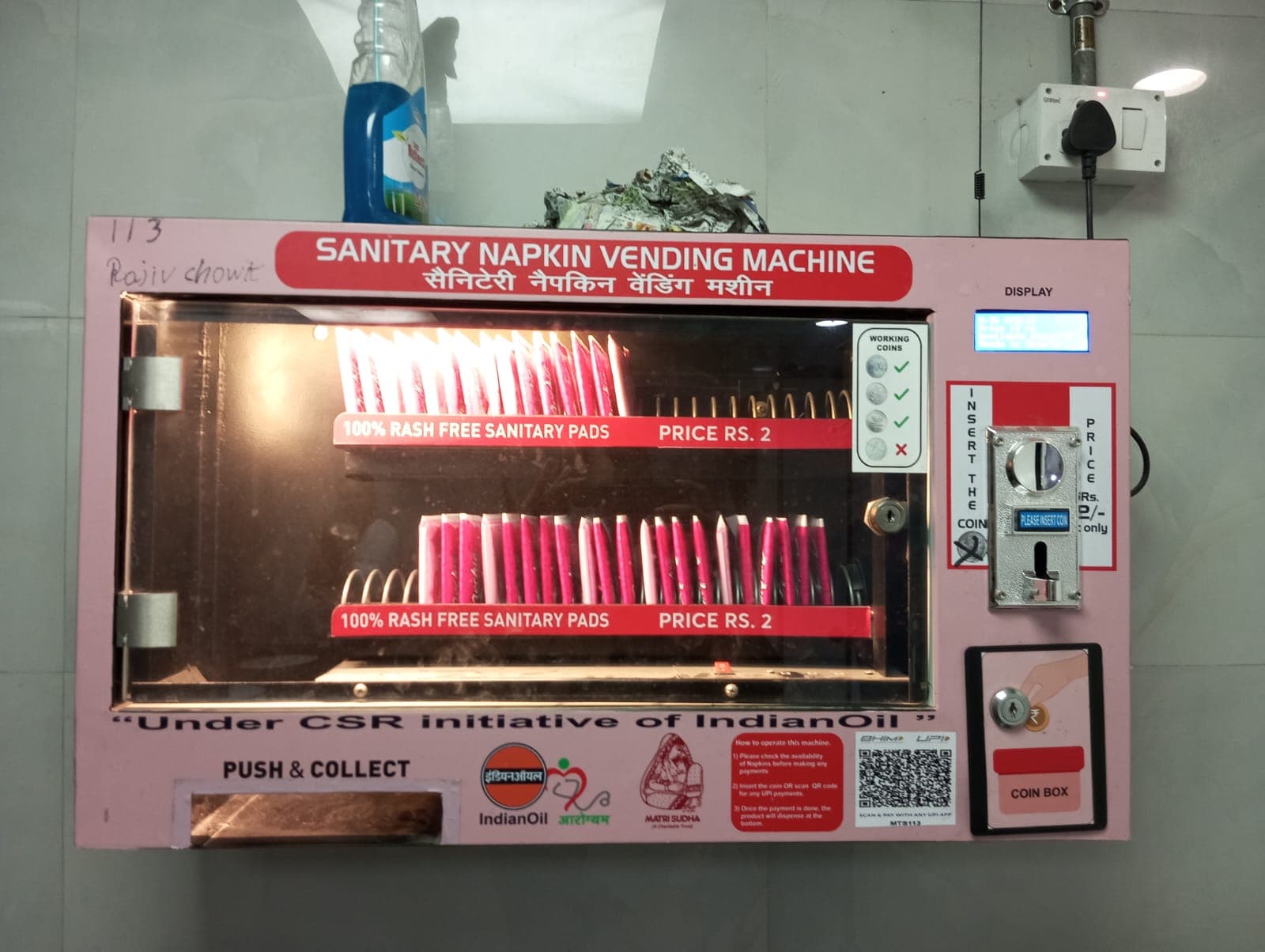
UGC guidelines mandate vending machines in women’s washrooms at higher education institutes (HEIs). These machines, also found in public restrooms, typically charge two rupees per pad—the subsidized state rate for a pack of six. At Kalindi, they are placed outside restrooms, don’t work, and would charge five times the amount if they did.
Sanitary pad vending machines at Rajiv Chowk metro station, 7th February 2025. Image Courtesy: Mouli Sharma
As Shruti pointed out, the issue isn’t just the sale of pads but that it happens in an infirmary where all other medical services are free—as if menstrual products aren’t a medical necessity.
In a country where over 88% of women cannot afford sanitary products—said to cost as little as one rupee per pad under state distribution—it is unacceptable for public colleges to charge more than the non-subsidized rate. There should be no fee in a women’s college infirmary.
Worse, most students surveyed by the author for Nivarana were unaware of these charges. Across campuses like Kalindi, Jamia Millia Islamia, and NISER, students remain clueless about available facilities—partly because universities don’t inform them and partly because they have given up on using them.
“I’d rather stay home than risk an infection if I can’t access a clean washroom,” said Kalindi's Jia, reflecting the fears worsened by viral reports in March. Kashish, another student, admitted she had used the college toilets only 3–5 times in three years. “They were filthy, lacked locks, had no hand wash, and smelled awful.”
Those who knew about the charges had learned the hard way. Meenakshi recalled, “The machines charged 10 rupees but never worked. The infirmary was usually closed; even when open, they didn’t provide napkins for free.”
Manasvi had a similar experience in her first year. Shocked by the poor facilities, she either avoided college during her period or used metro station washrooms a kilometer away. “I was in pain, the washrooms were filthy, and then I was charged five rupees for a single pad. I just wanted to go home.”
Trapped Between Incompetence & Hostility
Jamia and NISER have far larger campuses than Kalindi’s modest 8.25 acres. As buildings become blocks and canteens multiply, their infirmaries evolve into high-end health centres—too advanced to stock sanitary napkins or address menstrual cramps.
Jamia’s well-funded healthcare system was evident during the COVID-19 pandemic. In 2021, as the virus surged, then-Vice-Chancellor Najma Akhtar set up a 50-bed COVID care centre in the Dr. MA Ansari Healthcare Centre for their staff.
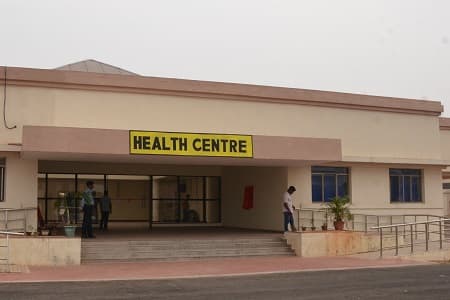
NISER has a similarly well-equipped facility that functions like a small on-campus clinic. It is permanently staffed with two doctors, five nurses, a lab technician, a radiographer, a pharmacist, and a physiotherapist.
Yet, these centres highlight a paradox. Unlike Kalindi’s underfunded infirmary, which struggles with minor complaints, Jamia and NISER’s clinics seem too advanced for "small" issues such as menstruation but unqualified for serious medical concerns.
"I've never been to the health centre when ill," said Sara, a second-degree student. "I'd just go home. If it were serious, I'd go to the hospital." A NISER student said, "It's easier to get an X-ray than a pad."
This is not just neglect of women’s health but a broader cultural failure in primary healthcare. Institutional clinics, funded for students' benefit, leave them feeling neither encouraged nor welcome to seek care.
Absence of Urban Menstrual Policy and its Impact on Women's Higher Education
A long stretch of road in NISER runs from the National Centre for Animal Research (‘animal house’) to the science buildings. Despite the campus’s radial layout, this area feels like a "back road"—barren, deserted, and lined with power boxes. The only washrooms here are in the Humanities building, an outlier in a science institute. The women’s washrooms remain permanently locked.
NISER is not alone in this. Across institutions—from courts to gas stations and army cantonments—women’s washrooms are often neglected or shut down, especially in spaces where women are not expected to be or stay for long.
This disconnect creates a cultural implication: urban girls and adult women are assumed to be unaffected by menstrual hygiene issues. This subtly reinforces traditional gender roles and expectations. Before March, Kalindi—a women’s institute—had more functional washrooms for men than for women. This is the case in most urban public spaces.
Despite a large number of schemes and philanthropic efforts over the past decades undertaken to target period poverty and menstrual health, most of which fall under the umbrella of the subsidy regime and corporate humanitarianism, the permanent dropout rate for post-pubescent girls (14-18 years of age) has remained stagnant at 23% for over a decade. A large proportion of this is because of a lack of clean toilets and sanitation that would allow a menstruating child to attend school.
Even more troubling, there is no recorded dropout rate for women in graduate and postgraduate education due to menstruation or sanitation-related issues. This statistic simply doesn’t exist, as though the challenges of periods and attendance somehow cease once a girl turns 18—because the policies certainly do. In the transition between school and college, when rural becomes urban, educating girls stops being a priority.
When asked about the institute's curious habit of locking women's washrooms, a NISER respondent said, “I don't know what the assumption is. Either women don't use washrooms, or women don’t exist.”
Perhaps the assumption is that they shouldn't.
How Institutes Punish Periods as Personal Failure
NISER is among the country’s better institutes in terms of academic and toilet facilities. As a fully residential campus on Bhubaneswar’s outskirts, it has abundant toilets, and hostels are always within reach.
Gargi, a PhD scholar at Oxford and a NISER graduate, noted that while its washrooms don’t compare to Oxford’s, they are far better than those at her school in a small Bengal town. The proximity of her hostel to lectures ensured she could always attend class. However, the same cannot be said for the institute’s attention to menstrual health.
Despite students relying entirely on campus infrastructure, there is no dispensary for menstrual hygiene products. The infirmary does not stock them, forcing students to buy from outside.
A shopping complex once sold sanitary napkins but shut down in August 2024. The college keeps no stock, not even for emergencies.
When a cyclone alert led to a town-wide lockdown in October 2024, local pharmacies closed. Female students were left stranded—an unacceptable failure for a premier institute.
"I walked to the Martha Complex (a local hub of small shops within a kilometer of NISER’s main gate) after going to the Health Centre," said Supriya*. "Just to find it closed. I was bleeding profusely by the time I got back. I just stayed in my room for the rest of the cyclone."
The humiliation, pain, and exclusion women face during their periods in unequipped spaces take both a psychological and physical toll. Even in women’s spaces, they often encounter ostracization and hostility. This is why Supriya felt too uncomfortable in her hostel to even ask for a napkin.
Growing up, I was often blamed and chastised for failing to "conceal" my period, especially by women in authority. Stained skirts, needing napkins, or being unprepared for a period was seen as a failure—either at femininity or personhood itself. Over time, many internalize this disdain, turning it both inward and outward.
Menstrual needs, from menarche to menopause, are treated as an inconvenience. Institutions fail to meet even the UGC’s minimum sanitation criteria and normalization of inaccessibility to menstrual products, leave, and medical care, making this not just apathy but systemic hostility.
The burden should not be on women but on the system. Until menstrual care is treated as essential public infrastructure, women in higher education will continue to face unnecessary barriers to dignity, mobility, and participation.
*Names changed at request.
We contacted Kalindi College, Jamia Millia Islamia, and NISER for comment but have not received a response.