The First Cut: How India’s Medical System is Failing Intersex Children
Across hospitals in India, infants and children with intersex variations are subjected to irreversible surgeries to “normalize” their bodies, without medical need, without consent, and with lifelong consequences.
“We want to convert this child into a full-fledged boy to safeguard our family honour. Until now, we have told people that we have 3 sons - so, we must ensure that no one knows our second child is neither a boy or a girl”, the father of a 7-year old child with intersex variants, from a small town in northern Karnataka, told me when I (Ritash) met him and his wife at a government hospital in Bangalore a few years ago.
Incidentally, the psychiatrist they were consulting had requested me (Ritash) to meet the parents in the presence of themselves and their team, to cajole them to not subject the child to a “sex assignment surgery.”
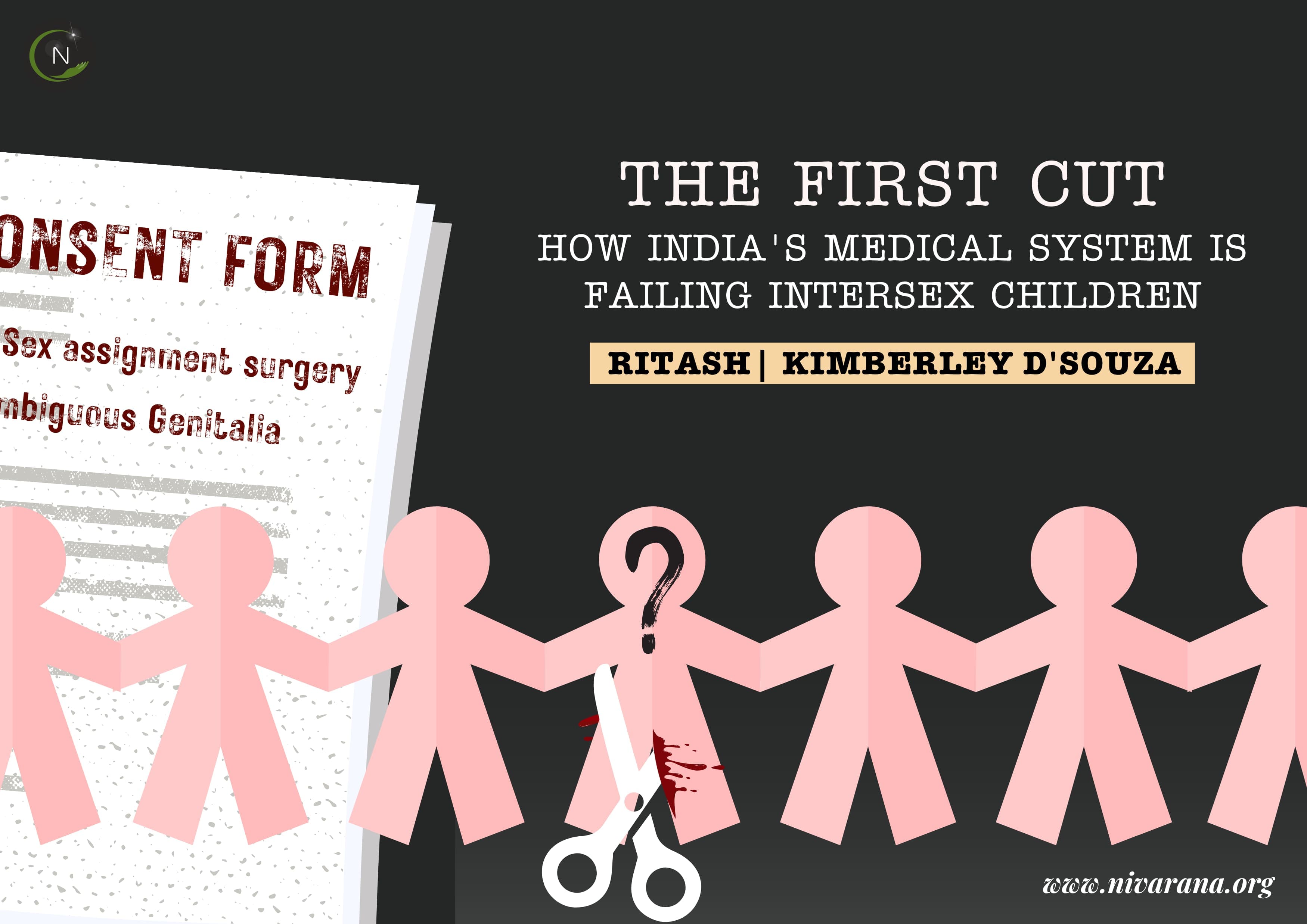
“Sex-assignment surgery” (or sex-reassignment surgery in paediatric practice) is a set of operations performed on babies and young children born with intersex variations to make their bodies look and function in ways that doctors think are typically male or female. Common procedures include clitoral “reduction”, construction of a vagina or a penis, closure or relocation of the urethra and removal of internal gonadal tissue.
These procedures rarely have any health benefits and are not needed to save a child’s life; their purpose is social, so that the child can be raised unambiguously as a boy or a girl. However, these often unnecessary procedures and surgical interventions usually introduce irreversible health issues (gastrointestinal, urological, orthopaedic, psychological, endocrinological, et al) as intersex adults in India and elsewhere, who have had such surgeries in their teenage or earlier, have told Ritash over the last few years.
Considering these complications, sex (re)assignment surgery in non-life threatening situations for children with intersex variations, is globally termed Intersex Genital Mutilation (IGM) and has been recognised by the United Nations, World Health Organization (WHO) and UN Special Rapporteur on Torture to describe non-consensual, medically unnecessary genital surgeries on intersex children.
Unwarranted medical procedures that can cause lifelong complications are a very common problem that intersex individuals face in the Indian Healthcare System, perpetuated by the belief that only binary genders are normal and a gross misinformation about intersex bodies.
Intersex variants are normal
In India as well as globally, there is a pervasive myth that intersex people are rare anomalies or "abnormalities" in the mainstream discourse and the medical community. But statistics show that this is far from normal. Global surveys have estimated that of the global population is born with intersex variants, a number comparable to people born with red hair (though these numbers are understated because foeticide, infanticide, and under-reporting still exist).
Intersex people are born with physical sex characteristics such as chromosomes, gonads, or genitalia that do not fit typical definitions of male or female. These differences may be visible at birth, arise during puberty, or remain unnoticed throughout life. However, the pervasive perception of gender as a binary of male and female leads to people perceiving intersex variants as abnormal.
However, in nature, we see that intersex variants are not unique to humans. Among animals as well, intersex variations occur in species from fish and frogs to mammals. Clownfish can change sex based on social hierarchies; goats can be born with both ovarian and testicular tissue. These examples challenge the rigid male-female binary, revealing it not only as biologically limiting but also as a human-centric assumption rather than a universal truth of nature.
Intersex is an umbrella term for over 30 recognized variations, many of whom do not require any medical correction of their sex to live a normal life. These people who are intersex variants are not anomalies; they are human, natural, and deserve dignity.
Pathologization and misinformation in the medical community
Furthermore, the myths surrounding intersex people are so widespread that they lead to them being misunderstood.
One of the most harmful is the notion that intersex bodies constitute a disorder in urgent need of correction.
This notion is fuelled by a strong belief in the gender binary and the medical labels that pathologize the intersex experience.
Even today, many of the normal intersex variants and differences are placed under the medical label "Disorders of Sex Development" (DSDs), a term many intersex activists reject due to its stigma. While some clinicians prefer "Differences in Sex Development" as a more neutral term, the reality is that language shapes perception, and many textbooks continue to present intersex variations as abnormal or dangerous.
Medical textbooks, even to this day, continue to use outdated and dehumanizing terms such as "ambiguous genitalia" or “hermaphroditism” to refer to intersex individuals. As Juleigh Mayfield, an intersex woman and one of the biggest intersex advocates in the US, in her article with an LGBTQIA media outlet, once said, “A lot of people… will say, ‘Oh, you’re a hermaphrodite,’ but that doesn’t exist in human form. It ends up becoming a pejorative.”
Often, medical students are also taught to memorize intersex conditions for exams, but not to question the ethics of interventions performed on intersex individuals without knowledge or consent.
A second misconception conflates intersex status with being transgender. Intersex refers to natural variations in sex characteristics-chromosomes, hormones, gonads, or genitalia, whereas transgender identity concerns a person’s internal sense of gender. Although an intersex individual may also identify as trans, the two categories are not interchangeable. Intersex people can identify as male, female, both, or neither, and their sexual orientation may be heterosexual, homosexual, bisexual, asexual, pansexual, or otherwise. This confusion of sex with gender and sexuality is widespread among the general population and medical communities alike, signifying a poor understanding of the SOGIESC.
Treating intersex variants as synonymous with transgender identity obscures the distinct medical, social, and legal challenges that each group faces.
Severe consequences - both physical and mental
Because of the double bind caused by this invisibilisation and medical misinformation, intersex individuals end up suffering severe consequences.
The first and most harmful consequence is when infants and children frequently undergo invasive procedures whose sole purpose is to make their anatomy appear more typically male or female. These surgeries are rarely medically necessary and often leave irreversible scars-physical and psychological alike.
Long-term outcomes include repeat operations, chronic pain, diminished or absent sexual sensation, infertility, incontinence, and, in some cases, orthopaedic or neurological complications. Survivors commonly describe lasting trauma, identity confusion, and low self-esteem, all rooted in the fact that consent to these life-altering interventions was never theirs to give.
A paediatrician from a private hospital in Bangalore recalled how they had encountered several children born with atypical genitalia. In their practice, they have seen that the immediate response of the treating team at most hospitals typically involves extensive medical screenings to rule out underlying conditions. Following this, parents are counselled about potential treatment options, which often culminate in paediatric surgeons performing genital reconstruction surgeries. In many instances, parents are given the power to decide the child’s sex.
However, as these children grow older, their gender identity may not align with the sex assigned to them at birth. This mismatch can lead to significant psychological distress, including gender dysphoria. Tragically, some even face ridicule from their own families—the very people who made these irreversible decisions on their behalf.
Intersex children then tend to internalize a sense of being "wrong" or "abnormal", especially when not supported by their family or community. Families often keep the diagnosis a secret due to stigma or fear of social exclusion. This silence can lead to shame, isolation, and mistrust within the family unit. The children may grow up unaware of their own medical history or the decisions made on their behalf.
Furthermore, the misinformation and invisibilisation have led to a lack of data and quality information on intersex variants, which will empower medical personnel to provide appropriate healthcare to the individuals. There is no standardized approach to care, and medical protocols vary widely across hospitals in India. Most paediatricians, OB/GYNs, and shockingly even pediatric surgeons receive little to no formal education on intersex variations or the ethical debates surrounding them.
Lived experiences of intersex individuals
Sakthi SriMaya, a Dalit intersex woman with disabilities from Andhra Pradesh, who has lived in Karnataka and Tamil Nadu and experienced the extreme inadequacies of the healthcare system in various parts of India, says, “Many healthcare professionals lack the experience and knowledge to treat us intersex persons. Yet they experiment on us and then often become unreachable and unaccountable for the ensuing fallout on our health.”
While battling personal health and financial challenges and social ostracism, Boni Paul, a socio-economically marginalized intersex person from West Bengal and former footballer and sports coach, has educated government physicians and social workers (in children’s care homes that have temporarily housed abandoned children with intersex variations from India, Bangladesh and other border countries) about handling children with intersex variants. Boni has also successfully counselled parents of some children with intersex variations against having sex (re)assignment surgeries performed on their wards.
Maya and Boni are among the co-founders of Intersex Human Rights India (IHRI, launched in 2019), a grassroots pan-India network of and for intersex persons and their families/caregivers offering peer emotional support and healthcare referrals. As a gender fluid, asexual LGBTIQAP+ peer counsellor, writer, and IHRI supporting co-founder, who has been closely associated with intersex persons since 2017 and trans persons since 2006, I (Ritash) consider IGM also as sex assignment surgery, as I have heard from intersex adults that it is rarely gender affirming.
The Indian reality: Between law and lived experience
In India, intersex people often face a paradox: invisibility on one hand and societal control on the other. From forced surgical interventions in childhood to being mislabeled as "hijra" or "transgender," their identities are continuously overwritten.
A landmark 2019 judgment by the Madras High Court (Madurai bench), in response to a PIL by intersex activist Gopi Shankar from Madurai, banned sex reassignment surgeries on infants and children except in life-threatening situations. This order directed the Tamil Nadu government to uphold the bodily autonomy of intersex children, marking a major legal victory.
In a pioneering move, Tamil Nadu also recently (January 2025) became the first Indian state to officially count intersex births, recording 40 across 38 districts, a milestone achieved through coordinated government and activist efforts, particularly by Mx Vinodhan a disabled Dalit intersex activist from Coimbatore and founder of VoIS India, an intersex and intersectionality support group.
This data collection marks a critical shift toward visibility and recognition, enabling more informed policies and protections for intersex individuals. By treating intersex births as a measurable public health and human rights concern, Tamil Nadu is setting a precedent for other regions to follow in centering intersex lives in policy and planning.
The August 2023 Kerala HC judgement requiring expert medical opinion regarding medical interventions on children with intersex variations is essential. Nevertheless, it is an incomplete requirement as relying solely on medical opinion is harmful, considering healthcare professionals may be uninformed, under-informed, or misinformed about intersex variations or pressured by personal or social heteropatriarchal gender norms.
However, the enforcement remains uneven. According to human rights reports, medical interventions often proceed due to pressure from extended families and communities, inadequate counselling and informed consent processes and gender expectations rooted in patriarchy, religious fundamentalism, caste and heteronormativity.
The state must counter these forces. As Amnesty International and the United Nations have emphasized, forced medical procedures on intersex children are a human rights violation. WHO guidelines now oppose such surgeries without informed consent, yet the practice continues due to stigma, ignorance, and a deep-seated fear of difference.
Recommendations for change
To ensure justice, dignity, and autonomy for intersex individuals in India, a multi-pronged approach must be adopted, beginning with comprehensive public awareness campaigns that explicitly include intersex realities within the broader LGBTQIA+ discourse.
Intersex people are often rendered invisible due to entrenched binaries and misinformation; educational media, inclusive curricula, and community outreach must actively work to undo this erasure.
Crucially, medical curriculum reform is needed at both undergraduate and postgraduate levels. This includes removing pathologizing language like “ambiguous genitalia,” updating clinical protocols to prioritize informed consent, and re-framing intersex variations not as disorders but as natural expressions of human diversity. Teaching materials must reflect evidence-based, trauma-informed care principles and integrate lived experiences to promote empathy.
Beyond curricular change, there must be interdisciplinary integration across all relevant departments, be it obstetricians, paediatricians, neonatologists, surgeons, endocrinologists, nurses, auxiliary nurse midwives (ANMs), and mental health professionals, so that every health worker encountering intersex infants or children is equipped with unified, rights-affirming guidelines. Current fragmented and siloed training allows personal biases and clinical ignorance to guide irreversible decisions.
Many healthcare providers in the country still perform irreversible surgeries on intersex children without long-term outcome data, sometimes treating them as subjects of experimentation rather than as persons deserving bodily autonomy. Therefore, strong laws must explicitly prohibit forced surgeries and infanticide and ensure strict enforcement. Tamil Nadu’s precedent-setting ban must be codified into national legislation with effective implementation and accountability mechanisms.
Additionally, policy reforms must include intersex protections in national health policies, anti-discrimination laws, and data collection systems. The move by Tamil Nadu to officially count intersex births is a pivotal example of state accountability and must be scaled up nationally. In parallel, mental health support services led by trained professionals who understand intersex identities must be made widely accessible for individuals and their families to navigate decisions without coercion, shame, or secrecy. These services must also dismantle stigma and challenge binary gender frameworks that dominate medical and social institutions.
Finally, we must undertake a philosophical and ethical re-evaluation: Why does society deny gender-affirming surgeries to consenting transgender adults while subjecting intersex infants, who cannot speak for themselves, to irreversible procedures? This double standard does not stem from medical necessity, but from a deep-rooted discomfort with queerness, nonconformity, and bodily diversity.
The denial of bodily autonomy to intersex people exposes how systems of power regulate which identities are deemed "acceptable" and which must be corrected. True progress does not lie in surgical conformity, but rather in societal transformation, aimed at a future where all bodies are respected, all identities are protected, and no child's right to self-determination is compromised in the name of binary ideals.
Edited by Christianez Ratna Kiruba Image by Janvi Bokoliya