Protests broke out across the country since tens of thousands of people (nearing a lakh by some estimates)—including school-going children—took to the streets of Central Delhi on 20 July 2026 to demand the resignation of Union Education Minister Dharmendra Pradhan. The State responded with chemical ordnance and mass beatings, despite being part of a convention to ‘permanently eliminate’ chemical weapons and having won an award for the same two years ago.
2-chlorobenzylidene malononitrile, oleoresin capsicum, and chloroacetophenone are chemical compounds few in India’s general populace would be able to identify by name– but for the last decade or so, they may as well be household celebrities. These are the three most common variants of Demonstration or Riot Control Agents (DCA/RCA) employed in domestic policing by governments the world over, by some more than others, popularly clubbed under an unassuming umbrella-term: tear gas.
This generic name, ostensibly a misnomer, comes from the lachrymatory nature of the substances—the ability to induce tears. The irony of lachrymatory being used as a characteristic of ‘mild force’ must not be lost upon the Indian reader, whose country fell prey to what remains arguably the most famous tear-inducing chemical in the world, methyl-isocyanate (MIC), a highly toxic gas whose leak from a Union Carbide factory in 1984 Bhopal killed 16,000 people, and is widely regarded as the world’s worst industrial disaster till date.
In reality, tears are the tamest of symptoms belonging to this class of weapons, which were created during the First World War with the intent to “kill or severely disable” enemy troops.
The health effects of tear gases
DCAs cause severe eye, skin, and respiratory symptoms upon immediate contact, rendering victims unable to breathe or see clearly and experience a burning sensation throughout the eyes, skin, and exposed internal areas like the nasal and respiratory pathways. The chemical reaction with one’s lungs triggers an immediate overproduction of mucus, which is what causes the choking feeling and triggers coughing fits, technically called a ‘bronchospasm’. The Turkish Thoracic Society puts it bluntly:
“Tear gases cause incapacitating inflammatory responses in various tissues and organs, including the lungs, eyes, nose, throat, skin and others. The final results on the pulmonary system are toxic pneumonitis, asthma aggravation, bronchitis, and rhinitis. Long term effects are irritant induced asthma and chronic obstructive pulmonary disorders. The best way to reduce the hazardous effects of these gases is not to use them at all.”
The short-term symptoms of tear gas go away within 15 to 30 minutes. Perhaps even a little sooner, if someone notices the release of tear gas immediately, gets out of the immediate area, and limits the dose by washing themselves, removing exposed clothing, etc. It’s very, very dose dependent, and the study above assumes the subjects are healthy, adult, and exposed to a single canister in an open area for 20-60 seconds (for people with pre-existing conditions, the risks are exponentially higher). 25 times the concentration found in the centre of a tear gas cloud of a single canister in an open space, for context, means instant death.
The Delhi police on 20 July launched at least 25 in less than an hour at a single site with school-aged children present. The indirect effects of the tear gas—the widespread panic in a crowd hemmed in with no exit routes available—can lead to stampede-like conditions, which can be immediately and devastatingly life-threatening.
Banned in warfare, used for crowd control
Fittingly christened “poison gas” when it was invented, all forms of tear gas today are a Geneva Protocol-violating tool of chemical warfare, and their use in international conflict has long been banned. India is an original signatory of the Geneva Protocol, having signed it on 17 June 1925, three years before it came into effect. Furthermore, India is also proudly an original signatory of the Chemical Weapons Convention (CWC) of 1993, which came into effect four years later and not only prohibits the use of chemical warfare, but seeks to “permanently and verifiably eliminate chemical weapons” in its entirety.
Throughout these years, successive studies have repeatedly proven that there is no scientific evidence to support claims that the effects of tear gas are temporary or insignificant. On the contrary, it has consistently been demonstrated that even brief exposure to the gases over successive incidents can cause lifelong lung damage, and in some cases, even death. The most damning evidence came in a 2026 study by the American Thoracic Society, which found that even a single interaction with the substances can permanently damage respiratory function.
Chloroacetophenone, in particular, has a severe respiratory impact and has been proven to be life-threatening. This is among the oldest of the agents, and scientists in America were recruited to discover alternatives for it due to “dissatisfaction with its potency” in 1928 (the same year the Geneva Protocol came into force).
The Organization for the Prohibition of Chemical Weapons (OPCW) is the implementing body of the CWC. They were awarded the 2013 Nobel Peace Prize for “extensive efforts in eliminating chemical weapons”. In 2024, they named India a co-recipient of their own laurel, the Hague Award, for its “role in promoting chemical safety, compliance with the CWC, and enhancing industry-wide security practices.”
A year ago, between 1-3 July 2025, the OPCW held its 23rd regional meeting in Asia. This meeting took place in New Delhi, India, on the same ground that is now bathed in acid rain from trucks full of DCA shells being tossed into crowds of unarmed men, women, and children above it, minutes away from the Parliament.
A convenient loophole of such international treaties as the Geneva Protocol and the CWC, of course—quickly discovered and exploited by the 196 and 193 States that signed them respectively—was that they did not, and do not, apply to domestic operations. In other words, the invention of late 19th century French scientists that is now associated with a caricaturish image of the ‘evil Nazi lab-coat’ in popular fiction and children’s media was, somewhere between 1928 and 2026, quietly rebranded as a ‘sublethal technique’ of crowd control and handed over by the Indian government, like so many others, to local police for use against its own citizens.
The government's use of tear gas in the nation’s capital
Over the last decade, domestic tear-gas use has become increasingly normalised.
In December 2012’s Delhi protests, where people defied prohibitory orders to gather at India Gate in outrage over physiotherapy student Jyoti Singh’s brutal gang-rape and murder, police action was initiated against them in the form of water cannons, lathi charges, and, indeed, tear-gas.
In 2019, after Narendra Modi came to power for a second consecutive term, this time with a full majority of the Bharatiya Janata Party (BJP), came Delhi’s first acquaintance with the liberal and brutal use of tear-gas for alleged “demonstration control”: in a university campus where police forced their way into classrooms and libraries, creating makeshift gas chambers and trapping students within, and eventually confessing to following it all up with open fire—the brutal Jamia Millia Islamia attack of 15 December 2019.
However, deterrence of mob violence by tear gas was not considered a priority the following year. When armed Hindu mobs attacked people, including journalists, the police stood by, later describing the attackers as "volatile young men”.
Just the previous month, though, as per a report by The London Story, on 24 February 2020, when a large armed mob carrying Hindu symbols and flags, shouting Hindu supremacist slogans tore through Karawal Nagar and Chand Bagh, killing four people including a police officer, the Delhi police was filmed lobbing tear-gas shells– not at the armed mob, but towards the Muslim residents being attacked.
It follows, then, that tear gas has become one of the first weapons in the police arsenal, a method to intimidate and break the resolve of protests and the people within them.
The dangers of indiscriminate chemical discharge
Tear-gas usage has certainly been a penchant of governments, not just in India but also internationally, to suppress dissenting gatherings. The term ‘demonstration control agent’, after all, does not leave much to the imagination.
“Tear gas cannot distinguish between the young and the elderly, the healthy and the sick, the peaceful and the violent; it cannot tell whether a person is an unarmed rallygoer or a curious bystander,” says the American Civil Liberties Union, specifically on the use of tear gas in civil demonstrations.
“That is why it is rarely appropriate to use against protesters, and why its use should be regulated,” concluded the ACLU. However, for crowd control, this indiscriminate action seems to be a feature and not a bug.
This is a fact often forgotten or omitted from the conversation around the Modi government’s alleged abetment of police violence and criminalisation of dissent: policing is the violence, by definition and design, across territory, time, and ideology, for Nirbhaya as it is for the termination of Dharmendra Pradhan.
But 2019 marked the beginning of a new era, one where chloroacetophenone and 2-chlorobenzylidene malononitrile have exited the public vocabulary along with the possibly fatal pulmonary damage they were designed to inflict, and the usage of tear-gas has lost all element of controversy.
During the 2020-21 Farmers’ Protests, visuals and narratives surrounding police excess and indiscreet usage of tear-gas led to limited international criticism. By 2024, even these questions were gone, and the conversation shifted largely to the use of expired tear-gas shells, which are likely to malfunction and even explode, similar to what has been alleged in the protests against the Union Education Minister in New Delhi.
In early 2026, tear gas was used by the Delhi police on what they claimed was a crowd of fewer than thirty people during an allegedly illegal demolition drive in the dead of night in Turkman Gate. Residents deep in the lanes of the Jama Masjid area had tear-gas shells lobbed into their homes, some of whom I interviewed for Frontline Magazine in an in-depth investigation.
In Manipur, which has remained torn by strife and militant ethnic conflict for three years, tear gas has become a sight and sensation of routine, with massive quantities of the toxic chemicals being used liberally and regularly with reckless abandon. These are a few isolated cases amidst what has become a staple of the police guard, now a first resort rather than a last.
Chalo sansad: a student protest, interrupted
As I am bespectacled and severely myopic, I have both an advantage and a morbid professional disadvantage when it comes to tear gas. Masks and other nasal coverings tend to fog up my glasses, making it difficult to pull focus or take clear photographs. On the other hand, losing the glasses means losing the little protection that they offer, if only in spirit.
As I have previously mentioned, the use of the ordnance on the 20th was particularly liberal. Throughout the Connaught Place circle, even away from visible or audible targets, a fog had settled into the air, and being out on the streets meant constant irritation in the eyes, skin, and throat. Up close, though, is an entirely different story.
At the prime sites of bombardment at the Charkha Museum and the LIC building, breathing without a face covering was impossible. Tears began streaming down my face instantaneously, and then the coughing began, which lasted even after I was more than 50m away, which is when the RAF began targeting that site.
The shops in the area that were open– which were few– quickly realised what was happening and began shuttering their doors. The shops at the Charkha Museum crossroads, several banks, and offices refused entry to protesters after the area turned into a veritable gas chamber.
A word about closed doors: One of three medics who had arrived at the protest site late at night with bags full of first-aid and electrolytes, who did not wish to be named, said, “The Bangla Sahib Gurudwara and local mosques became the sites of sanctuary for people injured in lathi charges and trying to escape tear gas clouds. These people, who get labelled ‘Pakistanis’ and ‘Khalistanis’, were the ones who stepped up to lathi/stampede inflicted wounds and tear-gas related inflammation, while the police attacked those who provided medical relief,” they alleged. “I was in my doctor’s coat with a stethoscope around my neck when the first lathi hit my shoulder, attacked from behind while treating a man who had fallen to the ground in a previous charge.”
One pharmacy, too, thankfully, kept its doors open. This is a good time to mention the dermal devastation of the poison, which often gets lost in the focus on its respiratory symptoms. Just before the first lathi charge began at the LIC building around 5 PM, a man near me attempted to cover up one of the canisters, and his hands were severely burnt.
A few protesters managed to carry him away from the lathi charge, and he coincidentally ended up in the very pharmacy where I sought shelter. I am ashamed to admit that at the time, having lost one of my own friends in the crowd—this had been her first protest—I did not have the presence of mind to take a photograph or interview. But I recall his hands covered in red skin under yellow ointment, which the employees at the pharmacy and other protesters in the room provided him with.
A group of young, protest-virgins (one of them had previously attended the RG Kar ‘Reclaim the Night’ marches, but nothing of this scale) who ended up getting caught in the crossfire described it as the most terrifying thing they'd experienced. “I think till then, it hadn't hit us. The risk of it all. We were quite far away from the protest site, so it was also shocking. Even though we were quite far away when it started, the effect was immediate. My eyes, face, and throat felt as if they were on fire,” said Nikita, a 24-year-old marketing professional.
Those who got closest to the Parliament experienced the worst of the attacks: eyes bloodshot, skin inflamed, throats clogged for days afterward. “When they lathi-charge you, you have to keep moving forward. That’s the only way to break a blockade. But when they started gassing us, it was impossible. There is no option but to retreat. It’s unlike anything you can imagine,” said a protester who had faced one of the more brutal attacks in the march near Krishi Bhawan.
“I don't think it was just tear gas,” said Simran, a 23-year-old artist. “The tears were just one part of it. But my entire skin was burning, I couldn't breathe– it felt like being maced.” When I told her that that is in fact what was happening to her, that ‘mace’, ‘pepper spray’, and ‘tear gas’ are different names of the same chemical constitutions, she was shocked.
The sadistic inventions of WW1 that led to the Geneva Protocol being drafted have undergone several kinds of rebrands, be it for domestic policing or commercial distribution as 'self-defence' commodities. The primary constituent of mace is chloroacetophenone, one of the oldest lachrymators and one of the aforementioned three most common DCA agents in use today by governments around the world.
Tear gas feels like being maced or pepper-sprayed because it is. They're simply different names for the same chemical agents.
“Seriously?” Simran had asked. “What the hell? I thought it was just saltwater or something.”
This misunderstanding, of course, is not by chance. One of these names represents a product meant for perceived threats: violent criminals and assailants whom you might wish to protect yourself from, people who you wish to meaningfully incapacitate—want to hurt, even if it's in self-defense—therefore, the companies selling them have no incentive to disguise the damage these substances are capable of causing.
A “demonstration control agent,” on the other hand, needs to be justified within constitutional boundaries and principles of proportional justice. When tossing a “mace-filled grenade” into a crowd of dissenting civilians—as ACLU put it, young or elderly, healthy or sick, violent or not—that justification becomes challenging. Changing the name and permitting convenient misunderstandings to fester within the general public, on the other hand, is much simpler.
Why do we still use tear gas, then?
The tendency of governments to underplay the toxicity of the chemical weapons they favour has changed little over the last hundred years. After the relentless shelling of tear-gas at the Shambhu border against protesting farmers in 2024, in which a dozen of them were injured, then Home Affairs Minister G. Kishan Reddy justified the use of water cannons, tear-gas, and lathi-charge against a hundred people by terming it ‘mild force’.
The comment was also formatted into a PIB release, which is a high-provenance news source that directly reaches all registered news broadcasters and papers. Despite the barrage of scientific evidence that has come out in the last decade about the reality of DCA's health impact, such potentially misleading narratives are rarely countered in the mainstream media, furthering the illusion of their ‘mildness’.
From the point of view of journalistic ethics, there is none in the act of pre-fixing the word ‘mild’ to acts of state-sponsored brutality like lathi-charges and open firing, either. What exactly is a ‘mild lathi-charge’? What is ‘mild firing’? I imagine an editorial request to similarly word other violent acts—a woman ‘mildly raped’ or a female infant ‘mildly drowned’ and am equal parts entertained and disgusted.
Instead of questioning the use of such language by the Supreme Court of India and its bench’s (CJI Surya Kant and Justices Joymalya Bagchi and V Mohana) quite frankly ignorant and shameful remarks, the Indian mainstream media has instead followed along with its bald-faced editorialisation.
Today, DCAs are being used with utmost casual discretion in high-traffic public spaces throughout the country. Hand-held canisters and truck-launched long-range explosives have been deployed with absurd and unnecessary frequency throughout the national capital and even in Mumbai.
In Delhi, over 20 shells were launched in quick succession at a single target in less than 40 minutes between 4 and 5 PM at Rajiv Chowk. DCA and lathi-charge combined to effectively cause stampedes throughout the dozens of marches toward the Parliament. In one such stampede, triggered directly due to the use of the gas, a 20-year-old girl was suffocated and had to be put on a ventilator.
This is not saline. These are classified toxic materials that tens of thousands of civilians are currently being exposed to at a rate never before seen. Strategic barricading by the Delhi Police has also ensured that people remain trapped within the affected sites for prolonged periods, which is to make no mention of those who have been on the streets for days on end.
Each canister has a range of close to 50 metres, and as this reporter observed at the spontaneous gathering outside the LIC building in the evening of the 20th, the shelling strategy is consistently to lock protesters in white-fumed hot zones with nowhere to run, by launching secondary shells in the direction the crowd moves after the first attack. What is the intention here exactly? How does this tactic help ‘control’ or ‘disperse’ a demonstration?
The path ahead
The Arms Control Association has been demanding the end of domestic DCA use since June 2020, after the infamous murder of George Floyd by on-duty policemen in broad daylight triggered a wave of protests in the US, similar to the massive outcry against corruption in the education sector taking in place in Delhi and other parts of India right now (led and supported by Sonam Wangchuk, CJP, AISA, Disha, AAP and countless other organisations that have come together in the unprecedented youth mobilisation), which was in turn met with similar repression. Headlines about the substances’ danger caused controversy and international calls for an outright ban, but six years later, India has been left behind.
In 2014, incidentally the same year Modi and BJP first came to power under the NDA’s wing, the world marked the 100th anniversary of the invention of tear gas, a weapon of chemical and psychological torture (“It is easier for man to maintain morale in the face of bullets than in the presence of invisible gas,” said the US Army’s Chief of Chemical Warfare in 1928).
Twelve years later, it’s long overdue to put its old bones to rest. Till that happens, though, one can at least abandon the infantile illusion that the phrase ‘tear-gas’ and its ‘mild force’ lend to the public imagination. Call it what it is: poison.
Call it terror.
Edited by Radhikaa Sharma
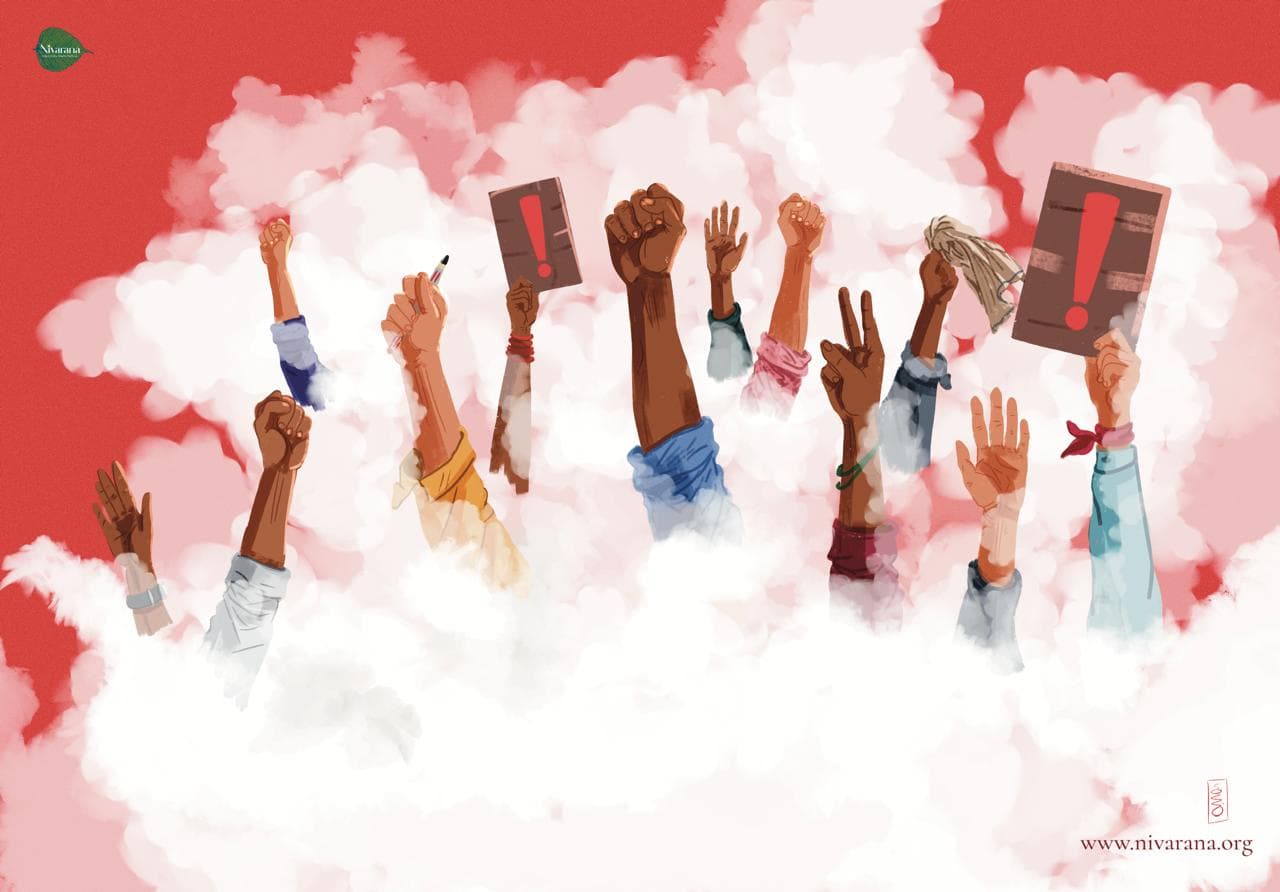
Image by Gayatri