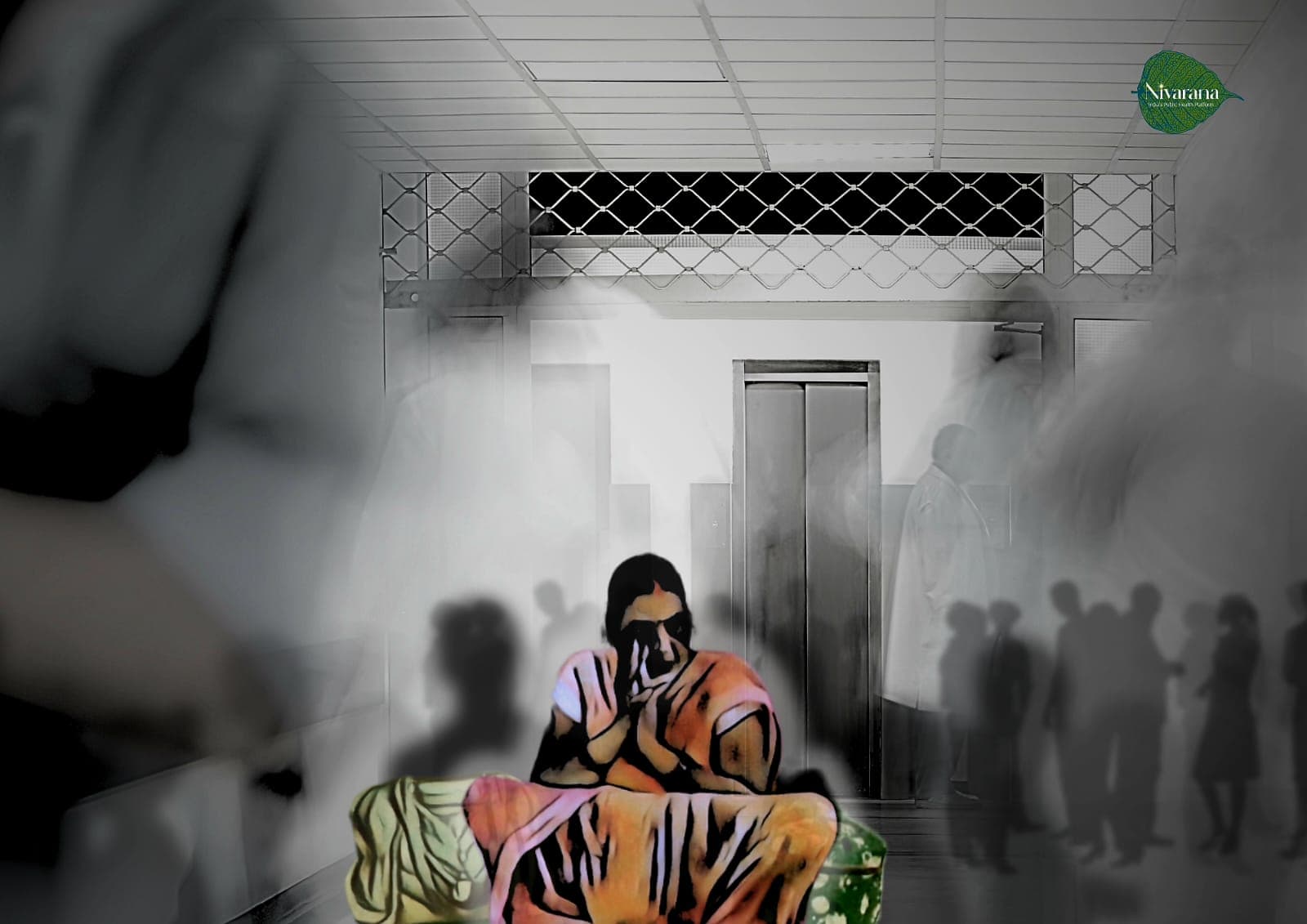
It began like any other ordinary day- one that carried no hint of the life it would undo. Everyone left for their office or college, and I, then a college student, accompanied my mother to one of the most reputed government hospitals. She was there to consult a doctor and fix a date for what we were told would be a minor procedure for the removal of a small lump on her abdominal wall. This lump had appeared a few months after her gallbladder removal surgery. For nearly two years, both private and public doctors had reassured us repeatedly, “This is a lipoma (a lump of fat tissue), and there is nothing to worry about.”
3 years later, that same lump was found to be a sign of advanced and aggressive gallbladder cancer. By then, the disease had already reached its final stage and only a few months were left - not for a cure, but enough to prepare ourselves for the end.
What followed that day was not merely the story of a person with cancer, but also a revelation of the deep fractures within our cancer care system - medical errors, structural delays, an absence of urgency, and institutional negligence that often pass unnoticed and unaccounted for in public healthcare facilities. Together, these failures are quietly transforming treatable conditions into a terminal one, even as many individuals within the same public healthcare system are working to improve it.
Therefore, this story is both a personal experience and a public indictment, offered not to assign individual blame, but to expose a system that repeatedly fails those who depend on it the most.
Genesis of an “Indian Disease” in my mother’s body
It began in 2013, with a pain so ordinary that no one suspected it could be the beginning of anything catastrophic. My mother started experiencing discomfort in her lower abdomen and was soon diagnosed with gallbladder stones, a condition in India that rarely inspired urgency at that time. With no public healthcare facilities nearby, particularly during the night, we were often compelled to visit a local informal healthcare provider who would prescribe medicines and occasionally administer painkiller injections when the pain became unbearable.
When the pain persisted for months, she travelled to Delhi to get her gall bladder removed. The surgery was declared a success. Her biopsy report read: chronic cholecystitis and cholelithiasis, which simply means inflammation and stones. Nothing alarming. We breathed a collective sigh of relief. After months of recurring pain and many sleepless nights, life appeared to return to normal.
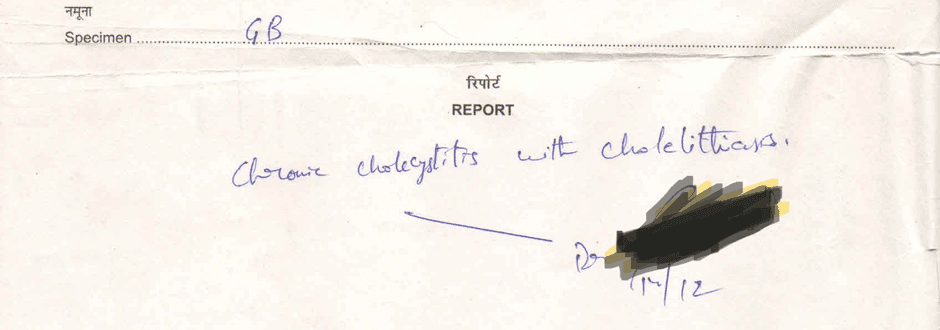
Histopathological report post Laparoscopic Cholecystectomy (2013)
But the body carries the consequences of what systems overlook
A few months later, she began to feel pain at the site of the surgical stitches. Initially, the local clinic doctors dismissed it as discomfort due to the surgery. Then a small lump appeared. About two and a half years after the surgery, we returned to the same hospital for evaluation, as the lump had not reduced in size and was now associated with pain. The doctors examined her and pronounced it harmless- a fatty lump, a lipoma, they said. It would dissolve on its own.
Still, we wanted certainty. They advised a biopsy: a fine-needle aspiration test (FNAC). Given the delays in public hospitals, we went to a private facility. There, we were told the lump was too small to test. The doctors simply noted their observation and sent us back. On the basis of this unsuccessful test, the hospital doctors conclusively labelled it a lipoma. They reassured us there was nothing to worry about and sent us home.
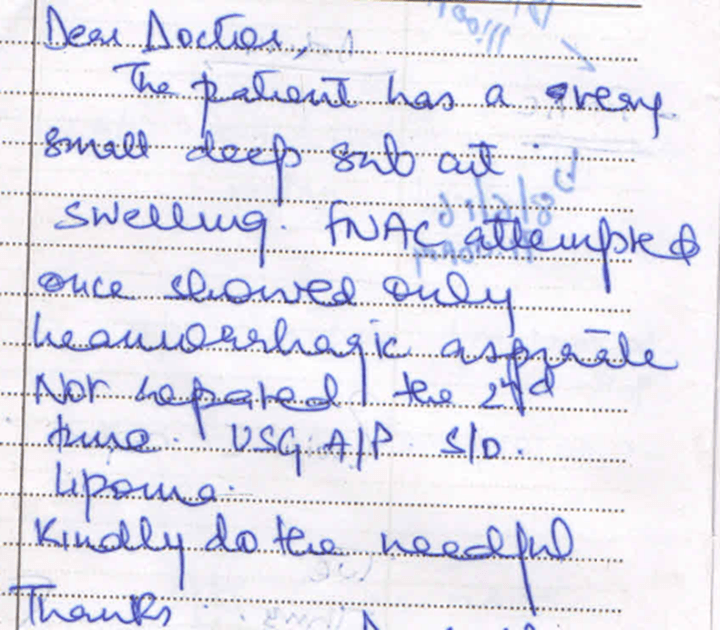
FNAC test (Unsuccessful) at a private hospital
Until then, a doctor’s word had been law in our household. We believed them. We felt relieved. The pain, however, did not subside.
My mother endured it quietly, holding on to the reassurance she had been given. Months passed. Her discomfort persisted. Six months later, we returned again. This time, the doctors suggested surgical removal of the lump and even fixed a date. Before surgery, they said, a biopsy would be required. On the scheduled day, she waited in the hospital from morning until evening. Finally, she was told the biopsy was not needed and that the lump would be removed directly during surgery.
Since the surgery date had already been allotted, she was asked simply to wait. On her way out of the hospital, she lost her file. We searched desperately, talking to bus drivers, visiting depots along the route, retracing steps, but the file was never found. With no other option, we returned to the hospital.
We explained the situation to the doctor, but the absence of digitised medical records only worsened matters. The loss of the file meant the loss of time. We were asked to repeat all the tests. In a system where surgery dates take months, everything had to begin again- and we complied.
When we returned with the fresh medical reports, the senior doctor shared: “Apki mother ko cancer hai aur ye body men fail chuka hai (your mother has cancer and it has spread in the body).”
These words divided our lives into a clear before and after. On that day, years of pain, reassurance, delay, and dismissal collapsed into a single sentence. What had been treated as an ordinary illness was revealed as something far more severe, long ignored, and shaped by deeper systemic failures.
Concealing and communicating diagnosis
That day, when the doctor shared the news, I was dumbstruck. My mind stopped working. I did not know what to say or what to do. I wondered whether there might have been a better or more sensitive way to communicate the diagnosis.
When I stepped out of the consultation room, I found my mother waiting outside. She had been asked to leave before the doctor shared the diagnosis. I had often seen her cry over small things, and I had often scolded her for it. But that day, I could not.
As we walked out of the hospital, she asked me what the doctor had said. I lied to her several times. But she was my mother, and I was her son. She could read the fear in my silence.
As we waited for the bus, weeping, she said, “Mujhe pta hai doctor ne kya kaha hai… pareshan mat ho sab theek ho jaayega. (I know what the doctor told you. Don’t worry. Everything will be alright.)”
I had always thought of her as an emotionally weak woman. But that day, standing face to face with her own death, she found the strength to console me. Where did she find such courage? I did not know.
Throughout the journey home, my mind was racing, thinking of ways to tell my siblings. It was not as easy for me as it was for the doctor. When we reached the place we were staying at in Delhi, I locked myself in the bathroom and cried. I had not cried for years, but that day, I compensated for all those years.
In the evening, when my siblings were home except for my father (who was still in Uttarakhand), I still could not gather the courage to tell them. I knew how the truth would collapse them from within, but the information had to be shared. So, I wrote everything on a slip of paper, handed it to my elder sister, and walked out of the house. By the time I returned, my house and our lives were not the same anymore. It was no longer only my mother who was afraid. All of us were. Because we did not know what awaited us.
A mother and her child in the ‘Kingdom of Ills’
I learned very early that when you seek treatment in a government hospital, you do not fight your illness, but the system itself. Serious illnesses, especially those that demand constant treatment and repeated hospital visits, do not affect patients alone. They slowly consume the emotional strength, time, finances, and peace of the entire family.
The endless queues, long waiting periods for tests, shortage of beds, and constant delays in treatment often wound patients and caregivers in ways that sometimes feel more exhausting than the disease itself.
Every day, lakhs of patients and their caregivers are forced to become citizens in the kingdom of illness. While some are able to return quickly, others remain confined for years, many never escape and some die as the citizens of the ‘other place’, not because of the limits of medicine itself, but because structural, social and economic barriers deny them timely care.
It was now our turn to enter this kingdom and confront not only the illness, but the system that governs it.
The struggle began with a series of tests. The first was a CT scan. We were made to wait an entire month as they did not accept any scans done in another centre. When the report finally arrived, the doctor confirmed what he had already communicated.
From that moment, some questions began to trouble me.
In 2013, when my mother’s gallbladder was removed, the doctors had declared her perfectly healthy. How, then, did cancer appear in the same body, diagnosed in the same hospital?
Two and a half years later, when we returned with a lump, why was it dismissed as a harmless lipoma? How did it suddenly turn out to be last-stage cancer?
Just three months earlier, before her medical file was lost, doctors were preparing to remove the lump surgically. Why were we not told then that it was cancer? Did they truly not know, or did they choose not to tell us?
I knew that asking these questions openly could obstruct her treatment. So, I kept them to myself.
Silence became a strategy for survival at the public hospital.
Later, we were referred to the surgeon who had performed her gallbladder operation in 2013. He ordered more tests: a PET-CT scan and blood investigations. Since PET-CT scan machines were not available in the public hospitals, we were sent to a private centre. Another twenty days were lost in the formalities and paperwork. When the reports came, the doctor repeated the same verdict, adding: “Surgery is no longer possible. Chemotherapy is the only option.”
This time, I gathered the courage to ask the surgeon: “How did this cancer originate? And why were we not told earlier?”
The surgeon responded with irritation: “How should I know where it came from?”
His assistant then cited Steve Jobs’ late diagnosis, invoking a celebrity anecdote to normalise systemic delay and recast institutional failure as individual fate, implying that if someone of his stature could not know in time, a person like me should simply accept the same fate.
I had no choice but to choose silence again.
When the option of surgery was ruled out, we were referred to the Oncology Department, where the cycle of investigations began again; cardiac tests, invasive procedures, and repeated examinations (which were nothing less than torture) took a heavy physical toll.
These tests, too, were not available at the hospital, so we were again referred to a nearby superspecialist hospital. But to get them done there, we first needed an OPD card from that hospital, and then get a date for the test from the doctor in that hospital.
A system devoid of empathy
Only forty cards were issued each day at this super speciality hospital. To get one, you had to be among the first forty in line. Which meant arriving at dawn or sleeping overnight outside the hospital gates. My mother decided to spend the night there. My exams were approaching, so my father came from Uttarakhand and went with her. He was fifty-eight years old then.
At 4 a.m. in the morning, when the gates opened, people began running, rushing upstairs to secure a place in line. Later, my mother told me that in a stampede-like situation, people dropped their belongings. Some fell. Some were injured. But no one stopped. Because falling behind meant losing your chance at treatment.
In that desperate race, my mother, a Stage IV cancer patient, had to run. My father, too, forgot his age. They managed to secure a card. But the system’s cruelty was evident- it had numbed us to others’ suffering and pushed everyone into competition for survival of the fittest.
It took us a month to complete all the tests. By then, three months had passed since her diagnosis. We were running in circles. Not a single day of treatment had begun till now.
Despite all these investigations, the doctors still could not identify the origin of the cancer. Finally, they diagnosed her with gallbladder cancer, an aggressive disease that is sometimes referred to as an ‘Indian disease’ because of its relatively high prevalence in northern and northeastern India. They informed us that chemotherapy would begin soon.
As no clear assurance or explanation was provided, we felt disheartened and asked to seek a second opinion. We were told to put in writing that if any complications arose, we would be responsible for delaying treatment. I wrote and signed the note in the patient's file.
And then we reached All India Institute of Medical Sciences, an apex Indian hospital, a last hope for many, for their opinion. Seeing her critical condition, the doctors there told us she had very little time left, around four to five months maximum. They advised us to continue chemotherapy if the hospital is offering or go for palliative care at the previous hospital.
More than the news, what was more painful was that, in the rush of the moment, the doctor shared all the details in front of her without assessing what she already knew about her disease. Until then, she was still fighting. She had hope, however small, and was holding on to it. Hearing the conversation unfold around her, hearing her future reduced to timelines seemed to extinguish that last bit of faith.
We walked out of the consultation room in silence. Around us were countless patients and anxious families, each carrying their own burden of fear and uncertainty. Yet in that crowd, we felt utterly alone.
At that moment, I realised how these large institutions had failed not only us but many others who came seeking care and hope. We had trusted them at a stage when the illness was still manageable, only to find ourselves abandoned until it reached a point where recovery seemed impossible.
What hurt most was not just the disease, but the feeling of being abandoned by the very system we had trusted when we needed it the most.
Months of hospital visits, misdiagnoses, and delayed care had left us with little hope. We walked out of the country's premier public hospital, believing recovery was no longer possible. Sitting silently at a bus stop outside, we had no idea that our greatest test was yet to begin.
The journey that followed challenged our resilience, faith, and endurance. The doctors had given us a timeline, but life had other plans.
A search for hope
During one of the meetings with relatives that evening, one of our relatives suggested going to the Delhi State Cancer Institute (DSCI). After reaching DSCI, we were told to repeat the tests yet again, and they asked us something that I hadn’t heard before or had been asked once in previous hospitals. They asked me to bring the slides from her 2013 surgery.
I returned to the old hospital where she was operated on in 2013. And asked for it. But instead of giving me the slides (stored specimen of the removed gallbladder in 2013), a scribbled note was handed to me within a few minutes, stating that the slides had been reviewed and that no malignancy was found. When I requested the slides, they refused.
Only after three days of repeated visits and humiliation did they finally hand them over.
At DSCI, the slides were re-examined. The report confirmed exactly what it had in 2013: mere inflammation and gallstones. Nothing else. Which meant that back then, my mother had been well. The cancer had originated and developed later.
DSCI referred us to a super-speciality government hospital in Delhi to explore surgical options. In many ways, this referral turned out to be one of the few mercies in the entire process.
This hospital represented what public healthcare can be at its best: a government institution with super-speciality facilities and doctors who were not only highly competent but also deeply sensitive and humane. Whose mere presence was enough to soothe the souls of the patients standing at the edge of death. Yet, even here, the familiar reality of the system persisted. The rush and the race were the same.
What became evident was that even the most capable public hospitals are constrained by systemic overcrowding, referral overload, and the absence of clear surgical timelines for high-risk cancer patients.
Once admitted into the system, everything began again from the beginning. Another month slipped away. Eventually, after prolonged discussions and evaluations, the doctors decided to attempt surgery. For the first time in months, I felt a cautious sense of hope that perhaps my mother could survive more. Since no beds were available, we waited three more weeks before my mother was finally admitted.
After admission, the doctors here, too, asked for her 2013 pathology slides. I informed them that the slides had already been reviewed, but they insisted on getting them again. Once again, I found myself running between departments, offices, and corridors. What followed were three days of relentless struggle - requests, refusals, waiting, and exhaustion. This time, however, with the support of the doctors at the super speciality hospital, I was able to retrieve them. The contents of the report were never communicated to me at the time.
My mother remained admitted to this super speciality for sixteen days. During these days, three times she was taken to the operating theatre, three times she waited the entire day, and each time she was sent back. Every time, a new explanation was offered: previous surgeries had taken longer than expected, or there were simply too many patients.
No one was at fault, and yet the delay was repetitive.
Even in that time of uncertainty, my mother never lost hope. Each day, she would pray, read from her religious scripture, and then make her way to every patient admitted in the room. Many of them seemed to be standing at the edge of life itself, including herself. She would gently blow what she called “pious” air over the parts of their bodies afflicted by ‘bimari’ and whisper prayers for their healing. Sometimes she would cry with them. Almost always, they would cry with her, as if their tears were a silent acknowledgment that they understood each other’s pain in a way few outside that space ever could.
In that ward, it felt as though a ‘kingdom of illness’ had transformed into a ‘nation of illness’- where pain, suffering, and struggle made us forget the superficial differences that divide us outside the hospital. Caste, class, religion- none of it seemed to matter there. Only illness and hope were the bonds that united us.
Curiously, no one spoke the word “cancer.” Every illness was described instead as bimari- a softer, safer substitute. The avoidance revealed the fear and stigma still attached to the name, even when most of them had the same disease.
I also remember climbing the hospital stairs and noticing that on every floor there was a picture of prophets belonging to a different religion. It felt intentional- as if the hospital was trying to offer comfort to everyone, no matter what faith they came from. In a place filled with suffering, these small symbols gave people something to hold on to.
By this time, most of the relatives had accepted that she wouldn't survive, given her condition and stage of the disease.
But finally, five months after the healthcare system had diagnosed her cancer, in July 2017, my mother underwent the surgery. The surgeons removed as much of the cancer as was possible. It was not a victory. But it was, at last, an intervention in the positive direction.
A brief moment of joy and return to the kingdom
The joy I felt when the surgery was finally completed was immense. Greater still was the relief that we might, at last, return to ordinary life, the life we had abandoned for five months in hospital corridors, waiting rooms, and endless queues. For a brief moment, it felt as though the worst was behind us.
The post-surgical report confirmed what we already feared: the tumour was cancerous. And because it had not been entirely removed, chemotherapy was advised.
Just three days after a major, life-altering surgery, my mother was discharged. Perhaps this was inevitable in a system starved of beds. But in the absence of a post-operative care system, early discharge shifted clinical risk from the institution to the family.
As at home, there was no sterile environment, no nursing care, no supervision; her stitches burst open: one wound nine to ten inches long, another three to four. The sight was terrifying. We rushed her back to the hospital. Thus began a new routine. Every day, we travelled 26–27 kilometres, climbed multiple stairs, waited for hours, only to have the wounds cleaned and bandaged. This went on for a month. After that, we continued the dressings at home for two more months.
Occasionally, a local doctor would come, but the sight of an open abdomen was too disturbing, too risky; eventually, even they stopped coming. For a brief period, I became the doctor myself- gloves on, hands trembling, cleaning and dressing wounds I was never meant to touch. Chemotherapy could not begin until the stitches healed. That delay alone cost us three months.
Chemotherapy finally began, and once it did, our lives revolved completely around the hospital. Every week meant repeated visits for check-ups, blood tests, medicines, and long hours of waiting. If any infection appeared, more injections and hospital trips followed. Most of our week passed inside hospital corridors.
Our home no longer felt like a home. It felt like an extension of the hospital. We believed all this suffering would eventually bring healing. But after months of treatment, the scan showed the cancer had spread further, reaching her right shoulder.
The delay caused by the burst stitches, combined with the chemotherapy not working, had led to the spread of the disease.
Earlier, doctors had spoken of a second surgery to remove the remaining cancer. She was even admitted to the same ‘ideal’ super-speciality hospital for ten days for that purpose. But now, that option was gone. And she was referred to the same hospital (which was partly responsible for her condition) again for chemotherapy due to the proximity to home and convenience.
When we reached there, on a normal OPD day, I asked whether another round of chemotherapy would help. The answer given by the present doctor was vague: “We cannot say. We will do what we can.”
I pressed further.
“Is there at least some chance of recovery?” and some more questions….
The reply still rings in my ears: “This is a government hospital. If out of 100 patients we treat 70, no one questions us. If you are dissatisfied, you may go to a private hospital.”
A year of struggle had hardened me. I was no longer afraid to ask questions. So, I asked the question that had burned within me from the beginning:
“No one has ever told us how this cancer came. Your doctors first said it was a lipoma. If it developed later, how did it suddenly reach the final stage?”
The question angered her. She shouted, “Go ask the hospital where the gallbladder surgery was done! They made the wrong report!”
Then she realised that the surgery had been done here in this very hospital.
She fell silent and asked me to leave.
I had long suspected negligence, but fragments of information were easy to dismiss. That day, with a single slip of the tongue, my doubts were confirmed. I began to understand that this was not a single medical error, but a chain of failures because of an inefficient, fragmented, and unaccountable healthcare system.
Diagnosing the failure: not one person’s mistake
What happened to my mother cannot be explained by a single error, a single doctor, or a single hospital. It was the cumulative outcome of multiple institutional failures, each seemingly minor in isolation, but devastating in sequence. Seen together, they reveal how India’s healthcare system routinely converts delay into advanced disease, avoidable suffering, and, in some cases, premature death.
A. The 2013 Surgery and missed opportunity:
Gallbladders with large stones can conceal early cancer. Surgeons are trained that if suspicious signs appear during laparoscopic surgery, they must immediately convert to an extended cholecystectomy to prevent spread. Were those signs missed during my mother's surgery? Even if there were no signs of cancer at the time of surgery, we should have been informed about the potential future risk.
This is particularly important because India bears one of the world's highest burdens of gallbladder cancer, with the highest incidence among women in northern India (21.5 per 100,000), leading to it being widely regarded as an "Indian disease." Gallstones, the most significant risk factor, are present in 60–90% of gallbladder cancer cases.
Given this well-established association, clinicians should counsel patients with gallstones, even after surgery, about the possibility of future malignancy, the warning symptoms to watch for, and the need for prompt medical evaluation if such symptoms develop. Such communication enables patients and caregivers to remain vigilant and seek timely care. None of this happened. The surgery was declared a success, and the chapter was closed.
B. Conflicting Pathology Reports and Diagnostic Oversight:
When I visited the Specialist Hospital to collect the histopathology reports following my mother's cancer removal surgery, I was handed two reports. The first was the report of the tumour that had been surgically removed. The second was a report of the review of the histopathology slides from her 2013 gallbladder stone surgery.
Until that point, I had never been informed about the contents or findings of the reviewed 2013 slides. It appears that this report may have been provided to me by mistake.
After obtaining the report, I consulted other doctors for an independent opinion. They informed me that the reviewed slide report indicated early signs of cancer in the 2013 gallbladder specimen. These findings were not mentioned in the original histopathology report prepared in 2013, which had diagnosed only chronic cholecystitis with cholelithiasis and had made no reference to malignancy or premalignant changes.
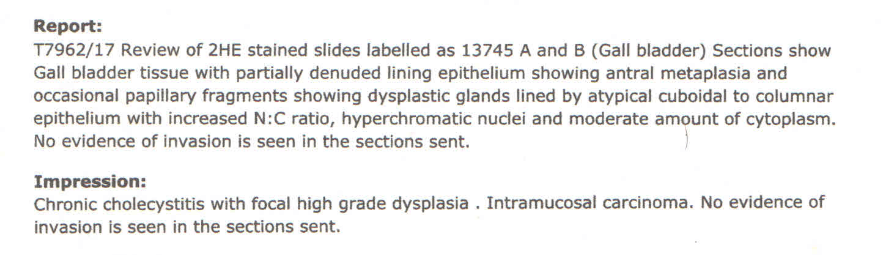
Report of the Reviewed Slides from the 2013 Gallbladder Operation
The divergence between the 2013 histopathology report, which documented only inflammation and gallstones, and the 2017 review of the same slides at a superspeciality hospital, which identified intramucosal carcinoma (an early-stage gallbladder cancer), raises serious concerns regarding diagnostic accuracy and pathology oversight.
C. Port-Site Metastasis and Failure to Act on Red-Flag Symptoms:
Port-site metastasis is a known complication of laparoscopic surgery when cancer is present. When a lump appeared at the port site two and a half years later, doctors dismissed it as a benign lipoma. Even when pain persisted, and even when surgical removal was planned, no urgency was communicated neither with patient or the caregiver.
D. Concealment or Ignorance:
Six months later, doctors scheduled surgical removal of the lump without disclosing the possibility of malignancy. Whether this reflected an attempt to conceal earlier errors or a continued failure to recognise them remains unclear.
E. The Delay as an Institutional Norm:
On 21 February 2017, cancer was confirmed and described as critical. Yet months passed with tests but no treatment. CT scans took weeks. PET scans took longer. Each department prescribed new tests and hospitals restarted the process anew. No one owned the timeline. No protocol defined how quickly cancer care must begin. Time, the most critical factor in oncology, was treated as expendable. Therefore, the delays here were not accidental. They were institutionalised.
F. Fragmentation of Care and Loss of Medical Continuity
When my mother’s medical file was lost, years of history vanished instantly. The system offered no backup, no digitised record, no continuity. We were simply told to begin again. This fragility of patient records is not just a clerical inconvenience; it is a clinical hazard. Repeating tests consumed precious time, exposed her to further stress, and delayed definitive care.
G. Withholding of Medical Records:
Initially, the hospital refused to release the 2013 slides. Instead, they hastily wrote on my written application that everything was normal and signed it. Only later, under pressure, were the slides released- revealing early cancer. This resistance to transparency deepened the delay and eroded trust. Patients cannot seek second opinions or informed consent if critical information is withheld. That refusal cost us time and right diagnosis, and timely care.
H. Premature Discharge and Absence of due Post-Operative Care:
After the major surgery, she was discharged in three days. The lack of proper post-operative care led to burst stitches and a three-month delay in chemotherapy- during which the cancer spread further. This was not bad luck. It was the predictable outcome of a system that prioritises bed turnover over recovery.
Taken together, these were not isolated failures. They were the predictable outcomes of a system stretched thin, shielded from scrutiny, and structurally conditioned to normalise harm. In such a system, no single actor is solely responsible, yet patients bear the full consequences.
Need for a healthcare revolution in India
I was still searching for answers, not knowing whether my doubts were justified or whether I was even thinking in the right direction. But the system or the people in it did not create any room for my doubts to be addressed. They rather fostered mistrust. I do not have medical training; what little I know about this disease has been learned the hard way, through experience.
One day, while waiting to collect medicines from a government hospital dispensary, I met a middle-aged woman. She stood ahead of me, hesitantly asking questions about a medical procedure. When I asked what had brought her there, she began narrating a story I already knew too well: gallstones, laparoscopic surgery at the same hospital, a lump at the excision site, and then silence, as if the rest of the story was too heavy to say aloud. I could fill in the gaps and visualise where this was headed.
I did not tell her what that lump could mean. Not because I did not know, but because I knew she would not be able to bear it.
She weighed barely 35- 40 kilograms, stood alone, with a very young child waiting somewhere outside. And in that moment, I realised something terrifying: she would not be able to do what I had done to save my mother.
My education, a few connections, some savings, and, most importantly, my constant presence beside my mother had given us a fighting chance. These were the advantages she could never afford. Her chances of survival or even getting any surgery done felt low. I often wondered how many people like her exist in this country who suffer in silence.
As I continued to seek answers, I realised that my mother's case was not an isolated tragedy but part of a much larger systemic problem. Filing RTIs and writing to the concerned authorities became my way of documenting and communicating the gaps I had witnessed. Some doctors advised me to focus solely on my mother's treatment, reminding me that she should be my only priority. They were not wrong. Yet I could not ignore the questions that remained unanswered.
When I sought legal advice, I was told that justice in medical negligence cases, especially related to public hospitals, is extremely difficult to obtain. The burden of proof falls largely on patients and their families, while legal proceedings can take years to reach a conclusion. Later, when I wrote to the hospital authorities seeking clarification, the Chief Medical Officer acknowledged that there had been an error in the 2013 report. However, responsibility was attributed to a doctor who had already left the institution, and since the individual was no longer employed there, no action was taken.
That response revealed another deeper problem. When accountability rests only on individuals and not on institutions, mistakes remain uncorrected, patients are left without justice, and the same suffering is destined to be repeated.
With time, it became clear to me that while individual activism can highlight these failures, it cannot resolve them. The gaps in our healthcare system demand something larger: systemic reforms, institutional accountability, and the political will.
There are two ways to understand what happened to my mother. One is a private tragedy. A family’s misfortune in the face of an aggressive disease. The other is evidence of how healthcare systems function when they are fragmented, overburdened, and insufficiently accountable. I have come to believe the second interpretation matters more, and that’s why I thought of writing this.
Unlike many others we encountered along the way, my mother survived, who is now a case study for doctors but also an inspiration for many locals. Yet the years of suffering, pain, uncertainty for her as well as her family, and the heavy expenditure of time and public resources were not inevitable. They accumulated gradually, shaped less by biology alone than by the way the healthcare system operates.
Unless these patterns are confronted and corrected at the institutional and policy level, this story will repeat itself- in different families, different hospitals, and different regions, sometimes with far worse outcomes.
My experience as a caregiver taught me that a healthcare system is not truly measured by the size of hospitals’ buildings, the number of its healthcare workers, or the sophistication of technology alone. It is measured by how it stands beside its most vulnerable patient at the most critical moment. If systems do not listen to the lived experiences of those who pass through them, they will continue to repeat the same mistakes- turning individual suffering into a pattern that touches countless families.
Edited by Parth Sharma.
Image by Janvi Bokoliya.