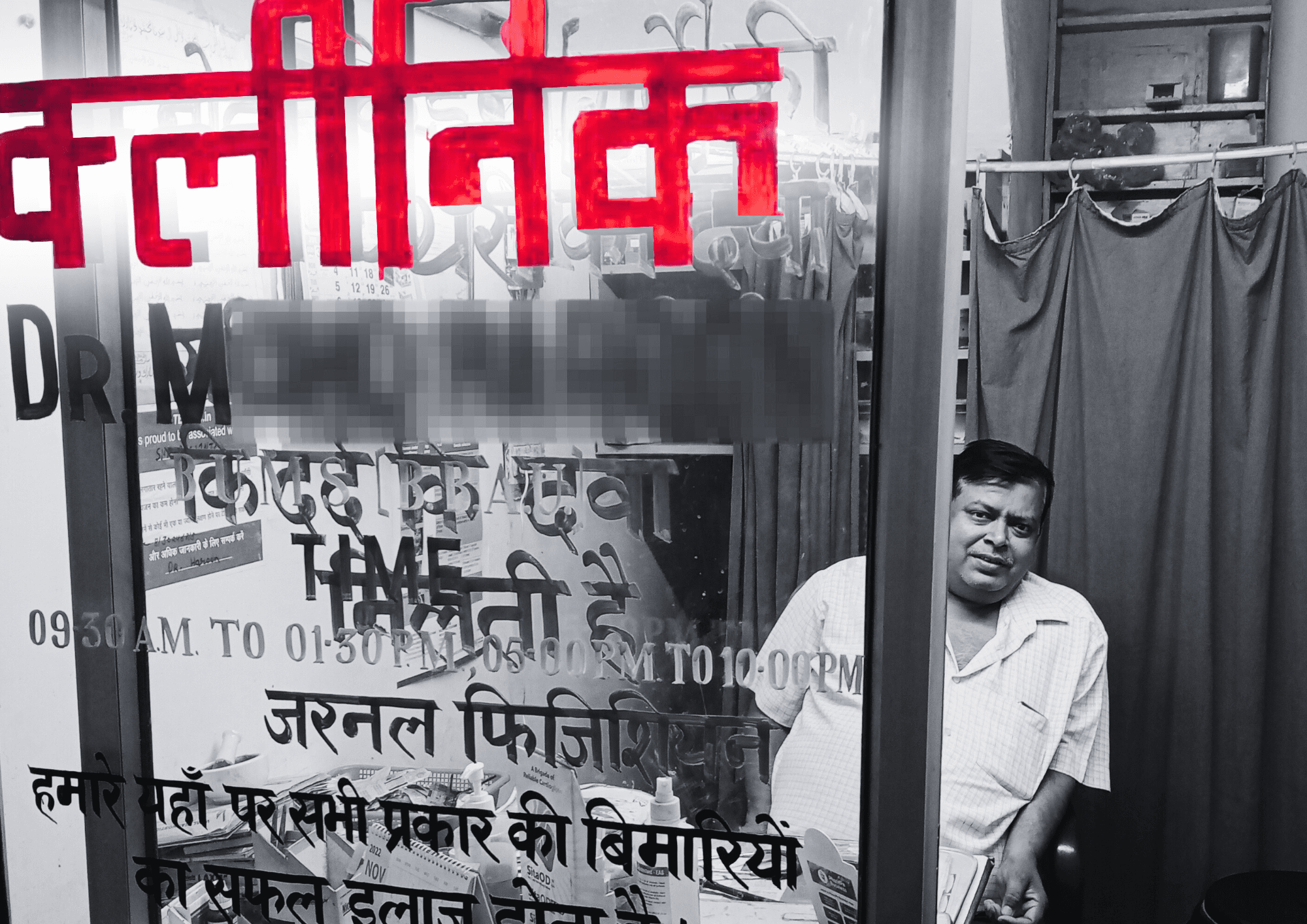
Seated in Dr. R’s hole-in-the-wall clinic located between a salon and a grocery store, I watched as he skillfully changed the saline solution connected to a middle-aged man. Sitting by his side, his wife looked exhausted. “Kal toh theek the, aaj achanak behosh ho gaye, toh main inhe yahaan le aayi,” (Yesterday he was fine, today he suddenly fainted, so I brought him here) she said to me.
Dr. R began his practice 12 years ago in a slum cluster in South West Delhi, before which he worked as a doctor’s assistant at Safdarjung Hospital. He has no formal medical training or degree, but his patients don’t seem bothered by this minor detail. “Mere jaise lakhon doctor hai Dilli mein (There are lakhs of doctors like me in Delhi)” he said. “Agar hum practice band kar de, aspatalon mein baadh aajayegi (If we close our practice, the hospitals will be flooded).”
Indeed, a heterogeneous group of informal health providers (IHPs) such as Dr. R, abound in low-income neighbourhoods across Delhi. Typically starting as apprentices under formally trained doctors, as pharmacists/compounders, or as non-medical staff in healthcare facilities, they open independent practices after some years of experience gathering.
Primarily dealing in allopathy, their practice displays no fidelity to any one medical system. Predominantly men, IHPs are embedded within the community and become the first point of contact in quests for therapy undertaken by the ill or the wounded. They are in a sense quintessential ‘family doctors’.
Focusing on rural India, opinions both for and against IHPs argue that they fill the “gaps” in the healthcare system. While barriers to accessing the formal healthcare system, like stigma faced by the poor in public hospitals, or a lack of formal facilities, are indeed important, we must ask why else people seek care from IHPs.
A focus on cities like Delhi, where on paper “adequate” public and private facilities exist, allows us to do so. What do they actually offer? Focusing on IHPs, this article examines the role and importance of family doctors in India. It also raises critical questions about dynamics within the clinic in primary healthcare that resonate beyond the context of IHPs.
Family doctors (who are often synonymous with, but not always the same as GPs) are primary care practitioners who address a wide range of conditions in families, providing treatment across age groups. At their best, family doctors possess double vision: they see patients as bodies and psyches in need of medical intervention, and simultaneously as full-fledged human beings entangled in complex relationships with others. This duality, along with their proximity to patients and their families, affords them the ability to offer ‘personalized’ care.
This is in contrast to the more bureaucratic, detached forms of care one has come to expect from doctors in both the public and private sectors amidst the increasing of healthcare. Being able to observe patients and their families over time, they can track how the acute morphs into the chronic, and how the chronic often presents as acute. Attuned to their patients’ particularities and idiosyncrasies, they with diagnoses and treatments in response to these particularities, with varying degrees of success.
Over time, families come to trust their advice and seek their counsel on medical concerns small and large. Thus, they become confidantes providing a sense of mental, physical, and spiritual relief.
Of course, this is a rarity in people’s everyday care-seeking experiences in clinics and hospitals in India, especially for marginalized groups. However, I suggest that IHPs do embody some of the aforementioned ideals – at times consciously, but chiefly stemming from the structural context in which they practice.
Take for instance the built environment of their clinics. Like Dr. R’s clinic, these are usually single-room structures, nestled between residential and commercial plots in dense bastis (slums), with minimal signage. Inside, a desk and chairs, shelves full of drugs, a bed, patients, and the provider, all compete for space. When open, patients move in and out without any prior appointment or bureaucratic interface.
Open longer hours in the day than Mohalla Clinics (which typically close at 2 p.m.) and other government dispensaries, their geographical location and open-door ethos combine to foster ease of access otherwise unfamiliar in hospitals and nursing homes.
As one patient told me, “Raat ko kaam khatam kar ke hum yahaan dawaiyan lene aa sakte hai, ya kisi bhi samay inko (referring to IHPs) phone pe pooch sakte hai (At night after we are done with work we can come here for medicines, or at any time ask them on the phone)”.
In contrast at “free” government facilities, endless waiting times, exorbitant bribes, mistreatment by security personnel, and loss of a day’s wage mean more than mere incompetence or inefficiency. These bureaucratic-institutional experiences register as, what anthropologist David Graeber calls, ‘structural violence’. While IHPs and government hospitals are not substitutable, the former’s easy access and availability coupled with respectful communication make them a more desirable option for most minor illnesses and injuries.
As members of the communities they serve, IHPs have long-term investments in their patients’ lives. Beyond relational or emotional concerns for the well-being of their neighbours, the economic imperative to retain patients over time acts as a buffer against prescribing rogue, dangerous therapies. Acutely aware that mishaps could land them in trouble with community members, they have developed strategies to ‘read’ tricky patients. For instance, they screen for signs of alcoholism (and therefore potential liver damage), referring such patients to larger facilities.
Comprehending patients is also, as Dr. T emphasized, about understanding their inner lives. What is troubling them? Are they able to communicate this well? “Jab aap unse dhang se baat karenge, tabhi who apni dil ki baat khul ke keh payenge” (Only when you talk to them nicely will they be able to openly say what’s in their heart). Diagnosis is then as much about inspecting bodies as it is about creating conditions for patients to narrate the nuances of their illness experience.
Their “thick relations” with patients are further evidenced by the terms of address people use to refer to them: “daktar saab” (doctor sir), “uncle”, “beta” (son), “bhaiya” (elder brother), all suggest a familiarity and kinship beyond a vertical relation of ‘doctor as expert’ and ‘patient as layperson’. IHPs maintain a convivial atmosphere in their clinics, where people walk in and out, gossiping, or discussing mundane, everyday affairs with them, thus reinforcing the horizontality of relations the terms suggest.
Often IHPs who are older become sources of moral and pastoral care, like Dr. U, whose clinic also serves as a nursery/tuition centre for young children, and who regularly holds awareness sessions about the perils of smoking or consuming drugs. These moral forms of care extend to interpersonal interactions between patient and provider, where physical contact with patients is not a source of anxiety.
Referring to cleaning dirty wounds or dealing with blood, Dr. G said, “Doctor ko kabhi ghinn nahi karna chahiye” (Doctors should never be repulsed by their patients). Seemingly trivial, when seen against the backdrop of notions of disgust and hygiene in India that operate through caste-based norms of purity-pollution, these small gestures of contact begin to look more significant.
Embodying similar material and social conditions as their patients, IHPs are keenly aware of how these conditions cause people to fall ill and restrict access to proper care. Attributing illnesses to infrastructural hazards such as unclean water, or food insecurity, as opposed to people’s individual lifestyles, in my experience they double-up as diagnosticians of some of urban India’s foremost public health problems.
Aware of their patients’ economic constraints, the IHPs I observed allowed patients to pay when they could, often sustaining long-term credit relations with them – something unimaginable in more formal settings. This then is far from the image of IHPs as ‘crooks’ looking to exploit the poor (although no doubt many do – a phenomenon equally common in the formal sector).
While their practice could pose threats to people’s wellbeing, it would be inappropriate to attribute these threats solely to IHPs, without acknowledging these problems as pertaining to primary healthcare more generally. Nonetheless, these should be taken seriously. IHPs’ ‘empirical therapy’ and symptomatic treatment without diagnoses could lead to the misidentification of underlying problems, causing adverse health consequences over time. Their use of antibiotics, analgesics, and steroids has the potential for iatrogenic problems at the individual level and contributes to anti-microbial resistance at the population level.
Further, they explained to me that they are sometimes vulnerable to pharma companies’ marketing ploys, whose agents push potentially dubious drugs onto them, and in turn onto patients. However, while these harms must be contended with, IHPs’ indispensable role within their communities makes any straightforward reckoning difficult. Positioning themselves somewhere between ‘social workers’ and ‘entrepreneurial service providers’, their contributions cannot be overlooked.
In the post-COVID moment, debates about community health workers have taken on an unprecedented urgency. Given India’s misguided fetish for specialists, recently states like West Bengal have controversially proposed shorter diploma courses for doctors, and Andhra Pradesh has launched a family doctor programme. Thus, now is a good time for a sincere conversation about IHPs’ role in India’s healthcare system.
The focus of this piece, however, was to look beyond these debates and zoom in on the patient-provider relationship in IHPs’ clinics. Many have proclaimed early signs of the erosion of the clinical relationship in the context of increasing reliance on data-driven healthcare technologies. But for millions who seek care at IHP clinics, this is far from true.
Therefore, we must reconsider how relations within the clinic – always conditioned by relations outside it – affect the achievement or failure of good care. Taking IHPs’ practice seriously allows us to interrogate this further, by asking a set of practical, conceptual, and ethical questions. Would training/institutionalizing IHPs help improve health outcomes, or end up fostering similar hierarchical dynamics among patients and providers as seen in formal settings?
Conceptually, a focus on IHPs allows us to ask what or who a ‘doctor’ is, and what the limits of their role in healthcare provision should be. Is a degree a prerequisite to be counted as a doctor, or is social recognition more important? Or perhaps a combination of the two? What, if anything, distinguishes a ‘doctor’ from a ‘healthcare worker’?
And finally, should notions of ‘quality’ predominantly be about technical proficiency, competence, efficiency, and rationality? Or are the harder-to-measure social and moral dimensions of care such as empathy, aesthetics, dignified communication, and conviviality equally a part of, and not just additional to, what we understand as quality care within the clinic?