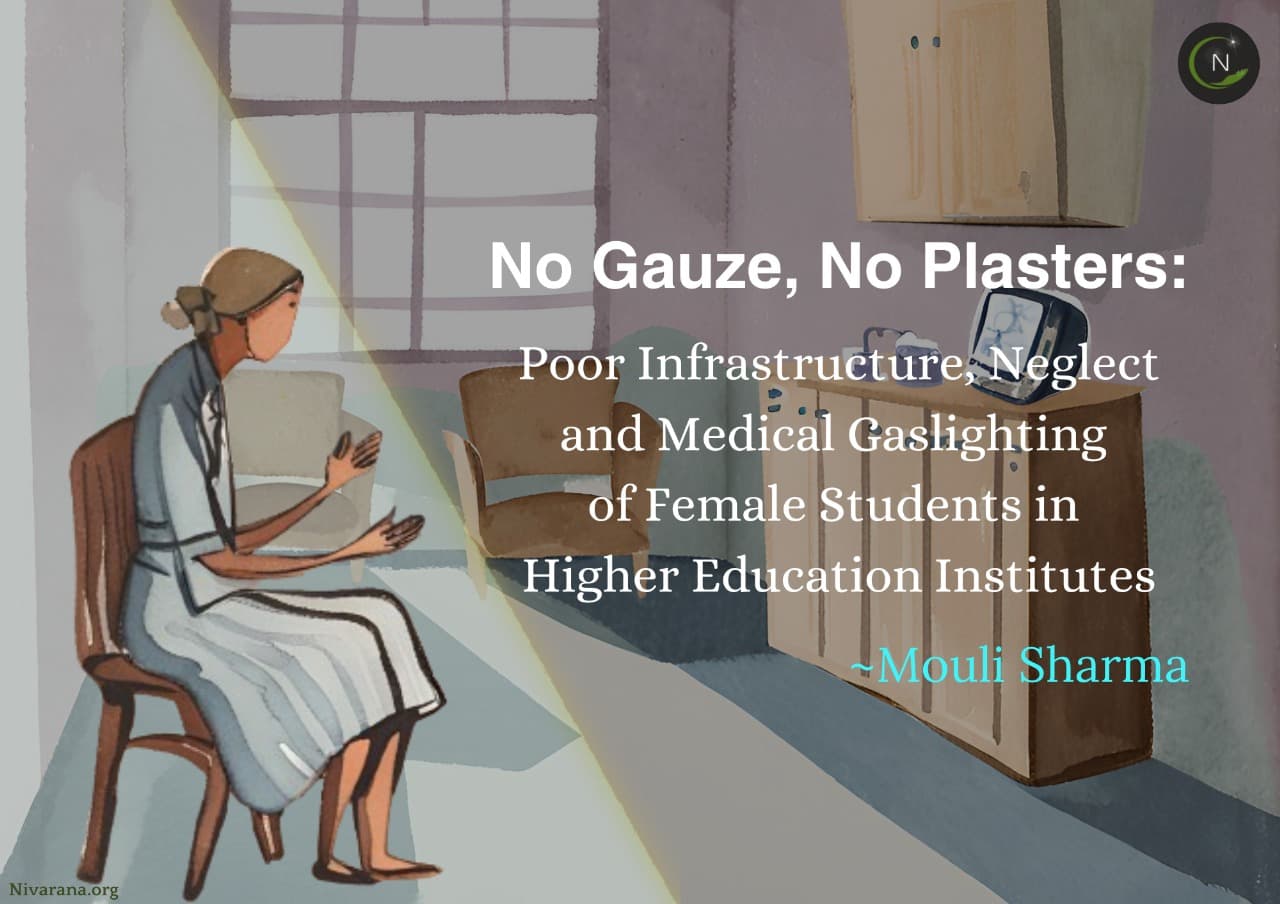
No Gauze, No Plasters: Poor Infrastructure, Neglect and Medical Gaslighting of Female Students in Higher Education Institutes
Part three of our series on women’s health in Indian public institutes examines the neglect of clinical care in women’s colleges, exposing stark resource disparities and systemic apathy. From inadequate first aid to medical gaslighting, we uncover the hidden struggles of female students seeking basic healthcare.
Part Three of a Series on the Normalised Neglect of Women's Health in Indian Public Institutes
In part I and part II of this series, the discourse concerned the sanitary and menstrual healths of women in Indian public institutes respectively. In this part, we shift the focus to the treatment of women and female students within the clinical ecosystems of institutions, i.e. their in-house patient care, as well as an interesting discrepancy in resource availability of female vs co-educational colleges.
Shell facilities in government institutes
“I remember my ankles being scraped raw on the day of the [NCC] fest. I went to the medical room hoping to get some first-aid, but all they gave me was one band-aid. The nurse said she wouldn’t give me even a second one for my other ankle unless I showed her blood,” said Manasvi, an office bearer of Udaan—Kalindi College’s NCC company. Manasvi eventually had to have a friend bring in band-aids from a pharmacy outside. They cost two rupees.
As mentioned, the three broad areas of focus in this series, of which is the third and final part, are the sanitation, menstruation, and clinical facilities of Indian HEIs. The overlaps between the three are significant, even if not always obvious.
For instance, one of the more damning revelations from our investigation, as detailed in Part II, was the complete unavailability of pads and menstrual products at Orissa's NISER. This premier science institute, located on the outskirts of Bhubaneswar, faced shortages following the closure of its shopping complex. The problem worsened during town-wide lockdowns, especially during the region’s frequent cyclone seasons.
At another institute covered in this report, Delhi University’s infamous Kalindi College, though, scarcity is dictated not by changing weather patterns but a perennial resource-precious attitude. This mindset extends beyond sanitary napkins to the entire ‘essential facility’ that the college website describes as a ‘well-equipped medical room’ where they provide ‘good medical facility to students and staff.’
Students like Manasvi here are forced to buy basic first-aid items like band-aids and gauze from pharmacies outside campus. To receive any assistance at the infirmary, they often have to exaggerate their difficulties. In contrast, menstrual products are readily available—for sale.
Kalindi College's patient care stands out in contrast to the other institutes surveyed in this series—including NISER, JMI, the University of Nagaland, and Shri Venkateswara College—all of which are co-educational. Unlike these institutes, where students are often denied treatment despite available resources, Kalindi's issues can be traced directly to a sheer lack of medical provisions.
One wonders if this signifies that there is a de-prioritization of health investment in higher education institutes when the HEI in question is established to cater to women alone.
The failure of in-house healthcare services in NISER is well illustrated in Part II of the series. Here, students find themselves trapped between two extremes—the neglect and underfunding seen at Kalindi and the bureaucratic hostility of better-funded institutes like NISER and JMI. In these institutions, ‘health centres’ function more like hospital super-specialties, where students must prove the severity of their illness to access treatment.
A similar pattern emerges at Delhi University's prestigious Shri Venkateswara College. Several female students reported being prescribed dismissive treatments such as "try exercising more" or "take less stress" for serious conditions like asthma and vertigo.
While this analysis highlights Kalindi as the most understocked and inadequate medical facility in the study, it does not provide a definitive picture of women's healthcare in all-female institutes. Kalindi alone cannot bear the weight of representing the state of medical care across women's colleges as a whole, but its shortcomings do raise serious concerns about the often overlooked intersection of gender, education, and healthcare access.
When does a student ‘deserve’ medical aid?
During my time at Kalindi, the website spoke of a mythical ‘Dr. Rajshree Lal’ who was to be available for attending students and staff for their ‘minor complaints’ for three hours every alternate day of the week. The remaining time, the room was to be under the management of Ms. Rekha, who would visit the college every day from 9 AM to 5 PM.
In my three years at the institute from 2021 to 2024, neither I nor anyone I knew ever saw Dr. Lal. To us, she was nothing more than an intricate imagination, as were the generous timings. Most students knew the medical room as synonymous with nurse Rekha, a smiling, kind-faced woman, whose schedule was significantly more flexible than the website indicated.
“I remember having a fever of around 100 one time back in my first year,” recalled a student we shall call Pinky. “I somehow managed to drag myself to the medical room in between classes – and this was nearly noon, so the heat was severe – and it was closed. The door was bolted. I looked around, I tried to ask people, but there was no one.”
It was a while before anyone arrived at the room to Pinky’s aid. On the verge of passing out in the scorching heat, she eventually let herself in, deciding to wait inside.
“I must have waited for—what, at least another 15 minutes, before anyone came. I was so happy I thought I’d finally get something, anything, even just a Crocin or glucose, really, whatever they’d give me, at that point. But turns out it was just someone from the cleaning staff who’d noticed the door was open. She came in and started interrogating me, yelling at me for presuming to let myself in, even implying I may have stolen something. I was shocked.
"She stayed till and even after the nurse arrived, which was a while later, but I was too weak to leave – though I really wanted to. When she came, she was in no hurry to help me. She just silently watched as the woman berated me for another long while before finally asking me what was wrong."
As of November 2024, Ms. Rekha has been replaced by Ms. Neha Rana, and any mention of a doctor on campus has been removed from the website.
As for Pinky: She was given a small paracetamol tablet in exchange for her signature in the infirmary register, and she never went to the medical room again.
Serious conditions are misdiagnosed and dismissed
In a small survey of female DU students conducted for the article, despite 27% of the respondents reporting that they suffered from chronic illnesses, none of them ever sought help from their institute's infirmaries or health centres. 60% of total students reported interactions with institutional medical facilities during their higher education, but only 13% felt that their concerns were taken seriously.
One of the students recalled an incident from her unnamed school, where she had been advised to "exercise or sleep more" after approaching the infirmary with severe chest congestion. It was only upon seeing a specialist much later that she discovered that the congestion she'd been experiencing was not in fact, normal; she was asthmatic.
"Other doctors don't consider college healthcare providers' diagnosis to be precise," said a respondent from Venkateswara, commenting on the unreliability of in-house college clinics. "Usually the responses range from 'they don't get paid enough to treat every patient with the same care' or 'they're not trained enough to do so'."
The prescription of 'exercising or sleeping more' is far from limited to undiagnosed asthma patients; a third of the respondents—largely from Venkateswara—reported being told the phrases 'it's just stress', 'it's not that much', 'it's all in your head' or 'just try exercising or sleeping more' at their college infirmaries—all responses commonly associated with medical gaslighting.
Surprisingly, despite this number being more than half of those who'd sought these facilities in the first place, none of the surveyed students believed that medical gaslighting had victimised them in any significant way. In response to a question over whether medical gaslighting affected/delayed their treatment or diagnosis, 53% of the surveyed female students outright said 'no', 33% said they were 'not sure', while the remaining avoided the question entirely.
Unsurprisingly, these experiences nevertheless impacted their relationship with seeking treatment, with 40% of respondents stating that they went on to avoid seeking medical care from now on due to them, and only 13% ever reported their experiences to anyone else.
‘If you can bring yourself to the infirmary, are you really sick?’
Accounts like the above are unfortunately far from rare, reflected most clearly in the tired resignation found in the two demographics best versed with medical rooms: NCC and Sports. In my experience, there is an atmosphere of hostility around the mere act of approaching the infirmary for these groups. Students are expected to exaggerate ailments and injuries to be ‘entertained’, creating a dangerous culture of normalising one’s medical grievances as well as lying about them, or else pushing oneself to the edge to avoid being treated with suspicion.
In an interview with Inkhabar, Indian ace-rank kick-boxer Shraddha Rangarh, who recently won four medals at the WAKO World Cup 2024, including a gold, cited underdeveloped infrastructure as the single most significant factor keeping the country's athletes behind the rest of the world. "Our equipment is substandard, our infrastructure is substandard, our washrooms are disgusting. Everything is unhygienic."
Echoes of Kalindi's ragged and non-committal sports facility and administration—down to the dirty washrooms—could be heard in Rangarh's testimony. The testimony painted a dismal picture of the country's future in sport and also highlighted the gravity of avoidable injuries in a field where a single fall can be career-ending.
"Our grounds are filled with rocks! Half the people end up twisting their ankles and tearing ligaments tripping over them. This is how their careers end," Rangarh said of her experience training in the NCR.
Treatment and first aid are doubly crucial in these situations, and the consequences of neglecting them are even more devastating. As an NCC cadet, I often witnessed firsthand the uglier parts of taking someone to the medical room and the degree of damage those marching boots are capable of inflicting on single-socked feet.
We used to train out in the parking lot during the summers, and students would pass out or come close on a near daily basis. The concrete was unpaved and littered with broken glass, eternally in the ‘process’ of repair, but it was the only ground available to us, and the choice was between training there or not training at all, so we did. As did the boxers, the kabaddi players, and the basketball team. But our choice to train came at the compromise of also being a choice of hurt. The infirmary was a luxury we sacrificed.
Infantilism and faking injury to avail of care
When it got awful for someone, we would lie. We developed workarounds, loopholes, and scripted acts. You can’t send in four or six girls to get glucose, or everyone will get nothing. So we’d only send those who threw up or passed out – for those who were on their period, we didn't even risk practice.
As an obvious, if unspoken, rule, no one would ever go alone; it was understood that if you could bring yourself to the medical room, you weren't sick. If you got another student to speak for you, the nurse reluctantly provided first-aid, electrolytes, or painkillers because they could exaggerate the issue.
We felt like children at school, caught doing mischief. Infantilised, embarrassed, and always desperate. You did this to yourself, we'd tell each other semi-regularly, and always ourselves.
The normalisation of such practices is especially egregious because the only qualified doctor on the premises was there to treat minor medical issues. In their own words, the authorities’ description of the room and its capabilities makes it clear that they do not exceed being able to provide elementary medical aid to students for their ‘minor inconveniences.’
The refusal of medical staff in a women’s HEI to then entertain and treat what inconveniences they do deem as minor is not just apathy – by itself distasteful in any healthcare centre – but genuine malpractice in a country where college-aged women suffer the highest degree of medical gender bias, constantly baiting girls to bring them more than they can chew, and refusing to bite what they can.
Conclusion: Infrastructure as the language of institutions
Rhetorics such as, ‘if she can walk and talk, she isn’t sick’ and 'she did this to herself' about women's non-urgent medical issues are sadly far from exceptional to Kalindi. Modern medical culture, not just in India, lends itself to the assumption that women in pain are, ‘making it up.’ The phenomenon, termed medical gaslighting, has been recorded to disproportionately be weaponized against women the world over, and to the degree in India that the number of women that can receive treatments and diagnosis for their grievances is half that of men.
“The mental conditioning of Indian society has led to women having a very high threshold of patience and silence. The health of a woman is not a priority in our country. No one wants to invest in women's health. It works both ways because most of the time women also keep silent about their health issues," said Ranjana Kumari, director of the Centre for Social Research in New Delhi in response to the overwhelmingly skewed sex ratio in Indian medical access uncovered by a 2019 Harvard study.
By treating women’s health infrastructure as an issue on the back burner, unworthy of improving, prioritising, or maintaining, women are being declared unworthy of investment.
Bureaucracy is the language our institutes use to communicate with us. When not just hospitals but even college infirmaries demand women prove the reality of their pain before earning treatment, when names are entered into ledgers recording the number of glucose glasses that young girls have greedily downed, when nurses tsk and snap at female patients for trying to ‘seek attention’; when students are charged money for a pad but not for a band-aid—we are being told the same thing.
Our institutes are saying to us that, necessarily, women are not worth accommodating. Necessarily, they are not worth conveniences and dignity, not worth educating past the 12th grade, and not worth keeping healthy.
They are saying that women are not necessarily worth saving.
Acknowledgements
Additional research by Rishita. Rishita is a Life Sciences graduate from Delhi University's Shri Venkateswara College and is currently pursuing her postgraduate education in Environmental Sciences at the University.