
In the formal healthcare system, if you want to know how much was spent on treatment by a patient, you will usually find a record for it. On most occasions but not always, someone had to provide a bill and receive a payment. But if you want to know what happened to the people receiving care afterwards, you are unlikely to find any records.
I started noticing this at a health policy conference in Bengaluru this June. I had gone expecting three days of arguments about health systems and policy, robust discussions on how we finance, organise, and make healthcare better. I had not expected one of the first questions to be something as basic as whether we knew what people were dying of.
Counting deaths, not their causes
A little bit of digging led me to a startling finding.
India registered 86.5 lakh deaths in 2022. A medically certified cause was recorded for 19.3 lakh of them, only about 22 per cent. Our country had a glaring problem, and that question at the conference was nontrivial. We are relatively better at recording that someone died, but not what they died of.
That does not mean we have no idea what Indians are dying from; we just have another system for this. A sample of deaths is investigated by verbal autopsy, where trained investigators ask families about the symptoms and circumstances around a death. This is how we have been able to estimate, at the population level, that non-communicable diseases, like heart attacks and cancers, now account for more deaths in India than infectious ones like diarrhoea and pneumonia. This method is useful for understanding the cause of death at the state or country level.
The problem becomes clear when you come down to the district-level. A district health officer can tell you how many people died in their district last year, but they will not be able to explain the cause of these deaths reliably, as only state-level data is available through surveys.
They do have other district-level data at their disposal. The National Family Health Survey gives them figures on child deaths, immunisation, and blood pressure among others. But none of that tells them what the deaths in their district were from, or whether that pattern looks different from the state they are being averaged into.
Go below the district level, and the problem gets more concrete. Dr. John Oommen, who has spent nearly four decades working with Adivasi communities in Odisha, describes villages where the health system barely has a presence. In an interview with IDR, he says: “If your village has 100 houses, an Auxiliary Nurse Midwife (ANM) will visit. If there are 50 houses, an anganwadi worker will come. But if a village has only 10 houses, nobody comes. You're not on the radar, not for the system. And the reality is that many tribal villages are this size. And so, the highest number of deaths occur in villages with 10-20 houses.”
Even when information is being collected, the record is not always a neutral account of what happened. Recent research on dengue surveillance in India found that reporting targets, pressure from senior officials, and fear of reprimands contributed to under-reporting. The researchers found that meeting reporting targets could take precedence over data quality and using the information for local action.
When someone does stay long enough to see what is happening, the picture can look different from what the larger system suggests. Dr Oommen puts it bluntly:
“The most common diagnosis today for an adult male Adivasi is hypertension. The most common cause of adult death in our community is chronic kidney disease.”
When someone actually looks closely, the picture can be very different from what the larger system sees. The problem therefore is not just that a district has too little data. It is that the data available to it depends on whom the people in the system want to reach and what they want to record and report.
What the record is for
The question worth asking of any health record is not whether it exists, but what it was intended to do. Much like an insurance claim is itemised with the intention of paying it, a death is registered with the intention of settling legal facts, not of diagnosing the cause of death in the population. Once we ask what each record is intended for, the blind spots stop looking like failures and start to look like designs.
A few years ago I worked on a study of 181 women treated for breast cancer in government hospitals under Andhra Pradesh's scheme for families below the poverty line. The scheme knew what it had spent on them down to the rupee, a mean of ₹48,477 each and ₹87.7 lakh in all, itemised by procedure because it had to know that in order to pay. However, it knew much less about what was happening to women with breast cancer whose treatment the government was paying for. In this group, fewer than 10 in 100 women had presented with early-stage disease.
This information holds true only for the women who managed to reach this cancer hospital. But what about the women who sought treatment elsewhere or did not receive treatment at all? The existing data sources in India fail to offer a reliable answer, as the population-based cancer registries in India cover only 10% of the population, including mostly urban areas.
A registry’s job is to tell the state how many women are being diagnosed with cancer, at what stage, and in which part of the country. Without that information, it is difficult to know whether a screening programme or awareness campaign is changing anything.
The treatment record answers a different question. Once a woman enters the system, the scheme needs to know what was done and what it cost so those things are recorded in detail. What happens to the woman beyond that transaction is unknown. Did she recover? Did the cancer return? Did she complete treatment?
The two examples leave us with different blind spots, but they raise the same question. With deaths, the system gives us a reasonably good picture of how many people died but much less resolution on what they died from when we come down to a district. With breast cancer, the picture becomes very detailed once a patient enters the treatment system: what stage she presented at, what was done, and what it cost. But the record provides no information on the impact of the disease on people in a region, irrespective of whether or where they sought treatment. It also doesn’t tell us about the quality of the treatment and if the patient returned to good health.
Precise about the bed, vague about the patient
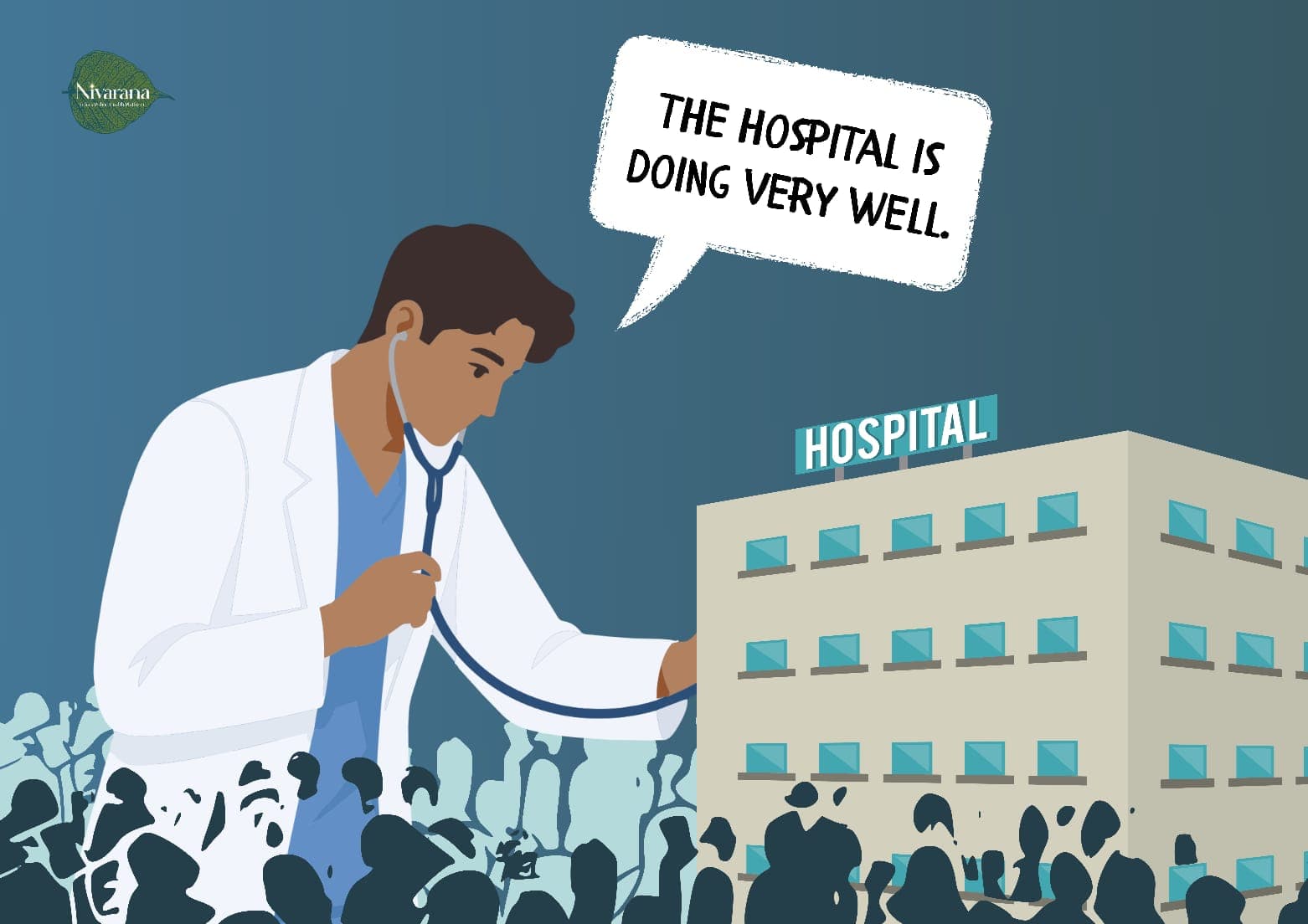
I only found the language for this later, in business school of all places. I started seeing a variation of the problem inside hospitals. The information there is not necessarily missing or too coarse. In fact, some of it is extremely precise. But what gets measured most consistently is what the hospital needs to run financially: how much a bed earns and how long it stays occupied. Two of the numbers that organised private hospitals track closely are average revenue per occupied bed per day and average length of a patient’s stay.
These numbers can tell you quite a lot about what is happening inside the hospital. Revenue per bed per day can rise because the hospital is treating more complex cases, because prices have gone up, or because of high patient turnover.
A shorter stay in the hospital may highlight good clinical care, but the number itself cannot tell you whether the patient recovered, was transferred elsewhere, or came back three weeks later with the same problem. The hospital has a precise record of what happened to the bed. It may have a much less precise record of what happened to the person who occupied it.
A FICCI and EY-Parthenon report last year looked at about 250 hospitals and 75,000 beds across some forty cities. It found that what Indians spend on hospitalisation has been growing by roughly nine per cent a year. Four to five percentage points of that growth came from treating more complex and sicker cases while about three points came from price increases. Revenue, in other words, can tell you that the economics of a hospital are changing without telling you whether patients are doing better.
Fewer than 10 in 100 private providers hold full NABH accreditation, and accreditation does more than I had assumed. The standard in force since January 2025 requires accredited hospitals to track clinical indicators every month, including risk-adjusted mortality, surgical site infections, unplanned returns to theatre and returns to intensive care within 48 hours. Readmission to the hospital, surprisingly, is not one of them.
But those numbers are not publicly available in a form that lets outsiders compare hospitals. The National Accreditation Board for Hospitals & Healthcare Providers (NABH) publishes which hospitals are accredited, not what their indicators show. So, a patient, an insurer or a regulator still cannot put two hospitals next to each other and ask which one actually does better. The same report found that more than eight in ten patients want objective information on hospitals before choosing one, and that nearly 90 in 100 clinicians want agreed outcome measures.
By the time I got to the hospital numbers, I realised I had been circling the same problem three times. The pattern was becoming clearer. Each part of the system records what it needs to do its job. The state needs a death registered. A payer needs an itemised claim before it can settle it. A hospital needs to know how long its beds are occupied and what they earn. The records are therefore very good at describing only some parts of the patient’s journey.
Measurement follows responsibility
It helped me to picture this as a sum of parts. Imagine everything the system could know about a patient's care: what severity of the disease the patient came with, what the treatment cost, whether the care provided was of good quality, and whether the person actually got better. Imagine each of these getting a level of importance according to how much the system measuring these needs them.
Since a payer is responsible for paying, it has a reason to measure expenditure. The hospital is responsible for running its beds, so it measures occupancy and revenue. The state is responsible for registering deaths, so it counts them. But since nobody is clearly responsible for knowing whether the patient ultimately got better, that outcome is not recorded.
That is perhaps what bothers me. We have built a fairly rational way of running the machinery of healthcare. But the interests of the person experiencing the illness inside this system are not taken into account.
However, does measuring and reporting patients’ outcomes lead to an improvement in care?
The evidence on this is mixed. In the United States, studies of cardiac-surgery report cards found that making outcomes public changed provider behaviour - doctors chose to not operate on high-risk patients. England, meanwhile, publishes hospital-level mortality indicators and quality ratings, making it possible to compare hospitals on at least one measure of patient outcomes.
But being able to see a problem is not the same as doing something about it. A district officer can have good cause-of-death data, but without a skilled public health workforce, financial resources, and authority over the hospital in their district may have very little ability to act on what the numbers show.
The dream
The need, therefore, is not just to measure patient outcomes but to measure with the intention of improving care for as many people as possible.
The first change should be to give the patient's outcome an owner at each level of the health system. For the policymaker, that means mandating a few crucial outcomes every provider must report and naming who is accountable for each. For the hospital administrator, it means publishing those outcomes next to the revenue figures, not beneath them.
For the healthcare providers, it means following the patient past her discharge and recording outcomes; for example, did she recover, or did the cancer return, rather than closing the loop at the last billed procedure. For the payer, the government or the insurance company, it means paying partly for whether people got better, not only for what was done. A more practical version of this idea may be to reward providers that achieve better outcomes.
This would not mean measuring everything. A designated health authority would have to decide which outcomes matter, the relevant provider or health-system authority would have to be responsible for following them, and the payer or regulator would need the authority and resources to act when the numbers show a problem. The point is simply to make sure the patient's story does not disappear between everyone else's paperwork.
Edited by Parth Sharma
Image by Janvi Bokoliya