“The basic issue will be that they [livestock farmers] cannot afford it,” a veterinary surgeon in Chikamagalur district replied to the author’s question on the new proposed guidelines to control Antimicrobial Resistance(AMR).
This was the second time the same sentence featured in the same conversation. Earlier we were talking about the risks of Anti Microbial Resistance, when the doctor had mentioned that if second-line or third-line antibiotics become the norm for all treatments, the farmers will be unable to afford them, for their animals, as well as for themselves when they get sick.
I was in the first year of Master’s then, on the first of the three field components of my coursework.
One evening, some of us walked into the veterinary hospital there, largely because the bulk of the people we had spoken to kept an animal or two to add to their subsistence income. Many of the animals looked ill-nourished, and the occasional farmer mentioned they struggle to break even, despite the additional income they expected the animal to bring.
What started as a generic conversation on the roles and responsibilities of a veterinary doctor in rural Karnataka turned into the problems he saw but was unable to resolve, the chief among which was the misuse and resulting resistance with regards to antimicrobials.
Anti-Microbial Resistance (AMR) is a situation where microbes evolve over time to become resistant to various anti-microbials used on them. This is a natural process of evolution, but it has been accelerated by various factors, which include overprescription, unregulated sale and consumption, sub-par manufacturing and storage practice, poor adherence to treatment protocols among others.
AMR puts entire populations at a higher risk of infectious diseases, increasing risk of infection rates and mortality. Beyond primary treatment of infections, AMR also affects the treatment possibility of other non-communicable diseases like cancer, where antibiotics are necessary to prevent infections during the course of the treatment, or even surgical procedures ranging from a c-section to various other curative or palliative surgeries.
AMR additionally leads to rising costs of healthcare, as higher potency anti-microbials would be required to overcome resistance to first line drugs. Such second line drugs are more expensive, which effectively puts the healthcare out of reach of the many people who are already living on the economic margins of the society.
An example of how this plays out would be the crisis in treating Multi Drug Resistant Tuberculosis (MDR-TB). The emergence of MDR-TB in Peru, for instance, worsened the TB crisis, as the nation was already struggling with an inadequately financed TB treatment program, which made the prospects for second-line treatment worse.1 Apart from the economic demand on the state and the people, higher potency antibiotics also tend to pose higher short term and long-term risk to patients while driving worsened resistance.
More recently I came across an Instagram post on a handle that goes by @that_mallu_doctor, who posted one of his patients’ Urine culture report that showed resistance to all second line and third line Antibiotics.
A series of guidelines exists to prevent/control the rise of Anti-microbial resistance. Perhaps the most significant of them for our discussion is the observance of withdrawal periods when Antimicrobials are used in livestock animals.
Withdrawal period here, is a period that is maintained to ensure the food product (milk or meat) from the animal becomes fit for human consumption, i.e. that antimicrobial residue becomes less than the Maximum Residue Limit permitted for human consumption.
To facilitate this, the Drugs and Cosmetic rules were amended in 2023, to make it mandatory to mention withdrawal period on the label of veterinary antimicrobial drugs. The new Action Plans being developed by various states and the centre to combat the rising resistance presupposes that this withdrawal is followed.
The practice in the field is rather different, largely because a chunk of the Indian livestock farmers are small or marginal farmers, with an article from 2023 noting that 88% of livestock being owned by marginal, small and medium farmers ie, farmers with land holdings less that 4 hectares.
The practice in the field is rather different, largely because a chunk of the Indian livestock farmers are small or marginal farmers, with an article from 2023 noting that 88% of livestock being owned by farmers with holdings less that 4 hectares. Such farmers are classified as marginal, small and semi-medium farmers. For such farmers, with marginal incomes, each animal is an investment of what would be a significant part of their life savings. Perhaps the expectations from the investment would be better understood when we look at another argument from the same study that says that these farmers get 16% of their income from animals.
When an animal gets sick, the owner in the best case contacts the veterinary doctor in the nearest dispensary. He prescribes a treatment regimen based on the clinical presentation and the general microbial resistance in the locality. If the animal is a milch animal i.e animals bred or raised primarily to provide milk; the farmer continues to sell the milk that is produced. If the farmer starts to feel that the animal isn’t getting better or that it is losing weight, it is sold for the highest price. This is more relevant in meat animals, whose value depends on the muscle bulk, which once lost is practically hard to regain. The panic selling is also an attempt to make the most returns of the investment.
A veterinary surgeon back home in Kerala mentioned that they often estimate a guess based on the disease and resistance profile of the locality, as affordable veterinary diagnostic facilities are tests are hard to reach, especially in rural areas. Multiple Veterinary doctors have recounted the prevalence of this practice, of continuing to sell milk, and later for meat, without regard to withdrawal periods, as well as for meat trends as pretty common in their practice.
The solution to this problem however, is not easy to enforce more stringent protocols, or increase the number of laboratories that offer testing facilities for antibiotic residue. The reason behind these practices, takes us to the statement we started with, that “they cannot afford to’.
Imagine a subsistence farmer with two cows, one of which gets sick and is put on antibiotics for five days. Add to that, around seven days of withdrawal period, which makes it at least 12 days where he can’t sell any milk. Calculating for a cow that gives 10 liters of milk a day, at a cost of Rs.50 per liter, that is a loss of around Rs 6000, along with the expenses incurred in treatment and feed. Similarly, for the males reared for meat, any weight/muscle loss triggers a panic sale midway through the treatment, given the fact that the value of the animal depends on its weight, and farmers can’t afford to wait for the animal to gain it back.
Animals products obtained without following withdrawal periods, are highly likely to have residues of the antimicrobials used on the animals, which ingested over time, will lead to the consumers themselves developing resistance to the said drugs. The risk of this increases when produce is sold directly, without pooling, for example when milk/meat is sold directly from the farmer to the consumer.A study in Bangladesh showed that pooled milk has lower rates of antibiotic residue detection4, though that is no consolation to the fact that the practice is contributing to the AMR crisis at hand.
The state response in general to AMR has been to improve awareness on AMR, improve surveillance on usage patterns, and increase the number of laboratories equipped to test residue. However this response seems rather insufficient, given that it doesn't interrogate the systemic cause of factors that drive AMR, which as mentioned above, might be that of economic precarity. This is why I would like to argue that the crisis of AMR is a development problem as much as a public health problem.
A common trope we often partake in, when we find that marginalized people contribute, in whatever sense to a larger problem, is to launch a full blown narrative that argues for a lack of awareness on the part of the marginalized people. Perhaps a familiar example of this would be the argument that the use of Chuhlas by rural families is a major driver of air pollution, despite the presence of more aggressive and long standing drivers of the same.
Similarly, blaming farmers for not following best practices, or conducting awareness campaigns on the best practices in the use of veterinary medicine might be the most obvious response. However if hope to bring some serious change, we must create conditions that enable livestock farmers to follow best practices, which here might be reintroducing native breeds that might be better resistant to local disease, better insurance value for farm animals, and systems for immediate disbursement of insurance amounts and other state interventions that effectively reduce cost of veterinary treatment, along with mechanisms to lift people out of abject financial precariousness.
This need for cognizance of the socio-economic determinants of individual behaviour and practice, requires a transdisciplinary approach, which is fortunately present in the “One Health” approach. One Health is a collaborative, multisectoral and trans-disciplinary approach to achieve optimal health outcomes recognizing the interconnection between people, animals, plants and their shared environment.
Emphasis on this issue will perhaps come from working with the interconnection between people, animals and their shared environments, which is why development practitioners need to be a part of the systems we develop to combat Antimicrobial resistance, or any public health concern for the matter. Eventually these small and marginal farmers will be among the worst affected, as new generation therapies would be economically and physically out of their reach.
Edited by Christianez Ratna Kiruba
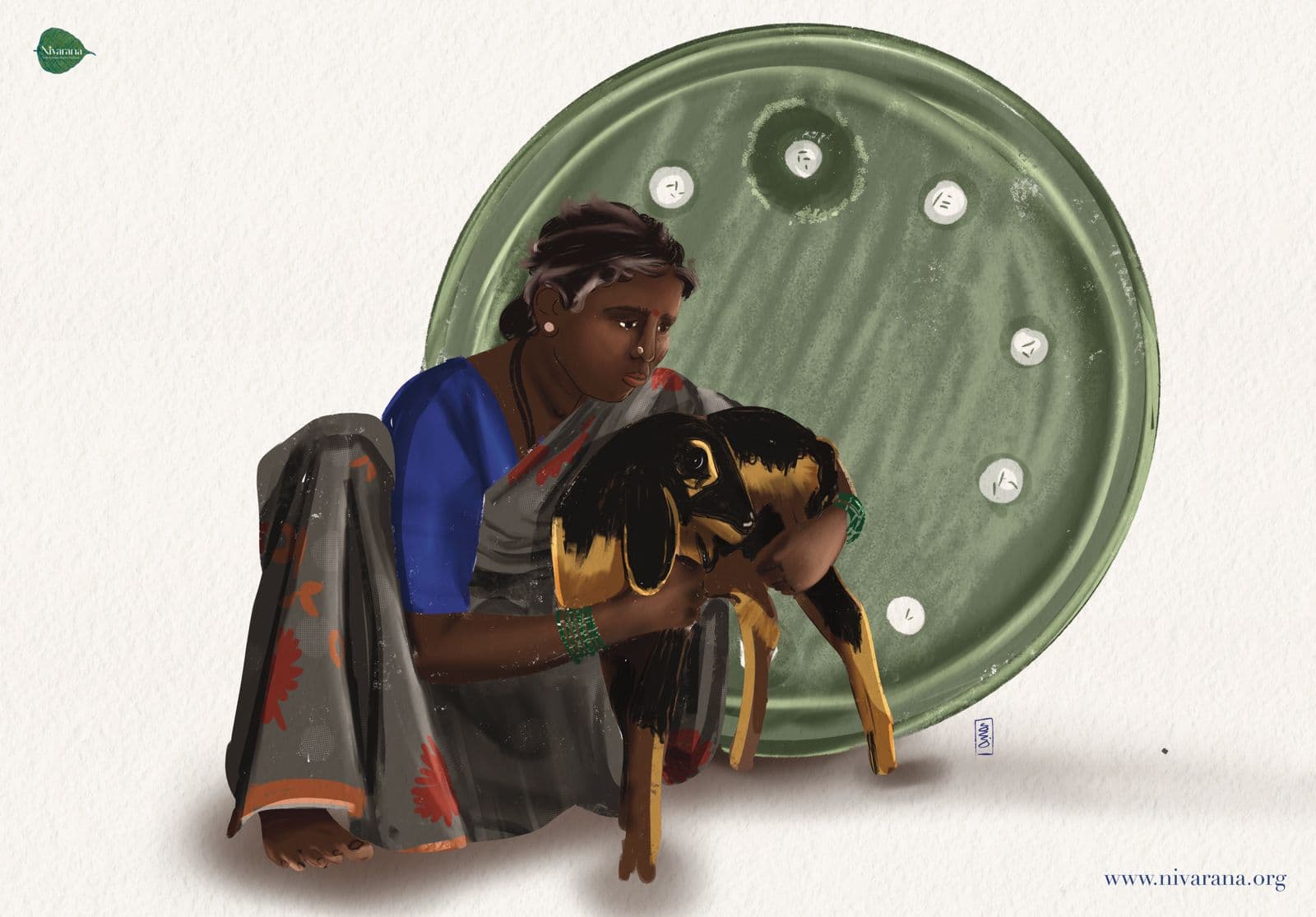
Image by Gayatri
The illustration is inspired by a photograph by Arjun Swaminathan, published on India Development review, on 13 May, 2020, linked: Here