In 2024, India was the global leader in the number of protests. Injuries from lathi charges, tear gas, stampedes, and other forms of crowd control commonly emerge from protests. In such situations, the immediate priority is always to seek medical care. However, it is equally important that your injuries are properly documented through a Medico-Legal Case (MLC).
An MLC is not merely a hospital formality. It creates an independent medical record of your injuries and the circumstances in which they occurred. This documentation can be crucial if you later seek legal accountability, challenge unlawful use of force, or simply need an accurate medical record for future treatment. Many people are unaware that emergency treatment should never be delayed because of medico-legal formalities, and that an MLC can usually be prepared without first filing a police complaint.
The following guide explains what you should do if you are injured during a protest.
1. Seek Medical Care Immediately
Your health comes first. Go to the nearest hospital or emergency department as soon as possible. A government hospital is generally preferable, as some private hospitals may, unfortunately, hesitate to register medico-legal cases despite being legally obligated to do so.
2. Request an MLC
Tell the doctor that your injuries occurred during a protest and request that an MLC be prepared. An MLC should be prepared whenever injuries have medico-legal significance.
3. Emergency Treatment Must Never Be Delayed
Providing emergency medical care is the hospital's first responsibility.
Documentation and medico-legal formalities should never delay necessary treatment.
4. Give a Clear History of What Happened
Tell the doctor:
- where the incident occurred;
- approximately when it occurred;
- how the injuries happened;
- what caused the injuries (for example, a baton, pellet, tear gas shell, stampede, fall, or another mechanism);
- who caused the injuries, if known.
Your medical record should accurately reflect your own account. Ideally, it should include detailed documentation of how the trauma occurred, where it happened, and, where known, who inflicted the injuries.
5. Ensure Every Injury Is Examined and Documented
Tell the doctor about every painful or injured area, even if no injury is immediately visible.
Documentation should ideally include:
- abrasions;
- bruises (contusions);
- cuts and lacerations;
- swelling;
- tenderness;
- fractures or suspected fractures;
- burns;
- pellet or projectile injuries;
- injuries caused by restraints or dragging;
- injuries inside the mouth or scalp, if present.
Each injury should be described by its:
- exact location;
- size and dimensions;
- shape;
- colour;
- nature;
- stage of healing (where applicable).
Where possible, injuries should also be marked on a body chart.
6. Report Exposure to Tear Gas or Other Crowd-Control Measures
Tell the doctor if you experience:
- burning or watering eyes;
- breathing difficulty;
- persistent cough;
- chest tightness;
- nausea or vomiting;
- dizziness;
- skin irritation.
These symptoms should also be documented.
7. Report Psychological Symptoms
Violence during protests can also cause psychological trauma.
Tell the doctor if you are experiencing:
- severe fear;
- panic;
- uncontrollable crying;
- emotional numbness;
- confusion;
- memory gaps;
- nightmares;
- difficulty sleeping.
These symptoms are medically important and should be recorded in your medical notes.
8. Report Any Loss of Consciousness or Memory
Tell the doctor if you:
- briefly lost consciousness;
- fainted;
- cannot remember parts of the incident;
- developed confusion afterwards.
These symptoms may indicate a head injury and require careful evaluation.
9. Obtain Copies of Your Medical Records
Request copies of:
- the MLC report (including the MLC number);
- discharge summary;
- prescriptions;
- investigation reports;
- X-ray or CT scan reports;
- any other relevant medical records.
Keep both physical and digital copies safely.
10. Remember Your Rights
- Emergency medical treatment does not depend on filing a police complaint first.
- Medical examination and documentation should be objective, independent, and respectful of your privacy.
- Police should not be present while the doctor examines you or records your statement in the MLC.
- You do not need to be brought by the police or be accompanied by the police for an MLC to be prepared.
Proper medical documentation protects both your health and your legal rights. Even if you are unsure whether you will pursue legal action, obtaining an accurate medical record soon after the injury can become invaluable later.
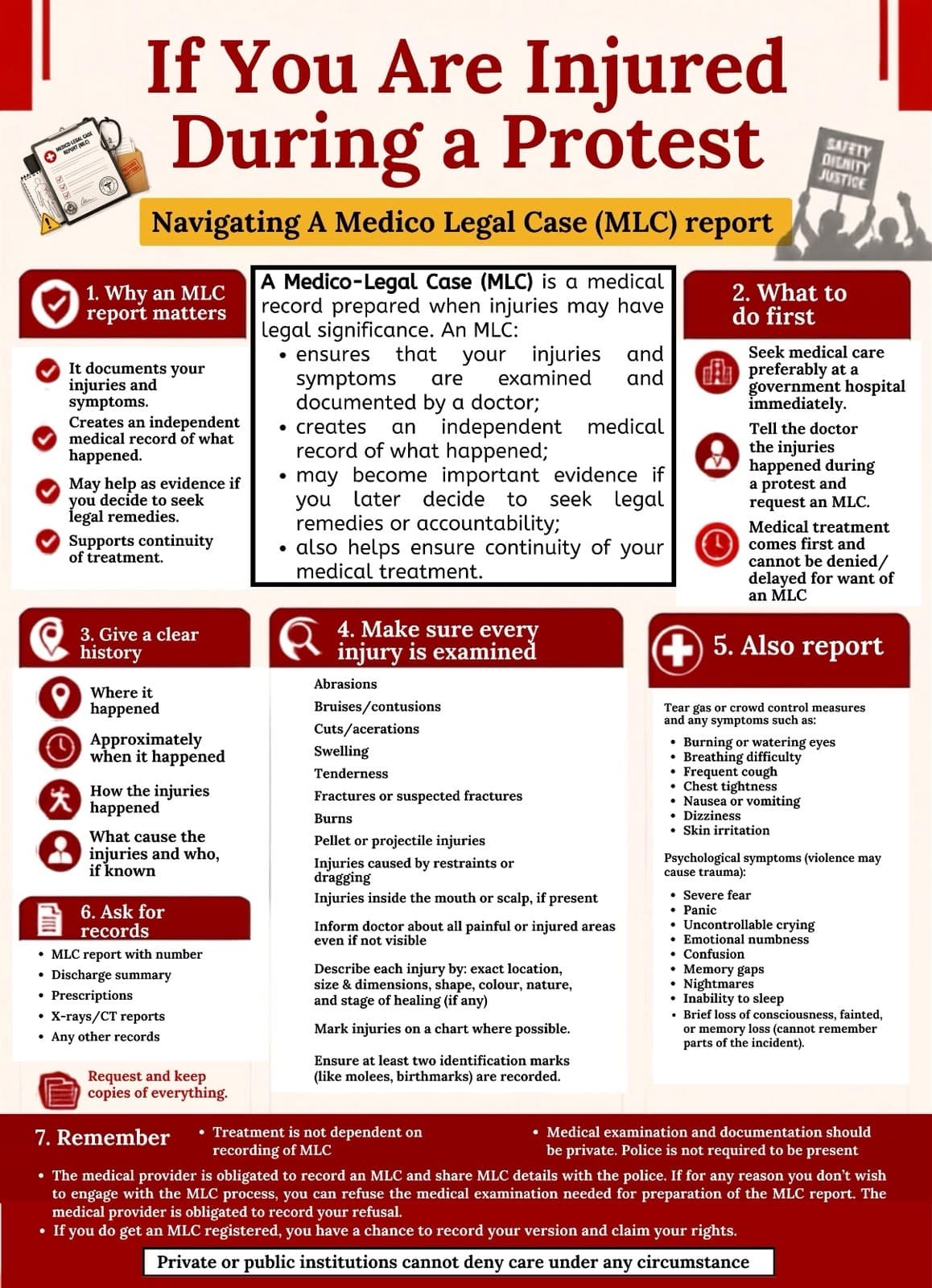
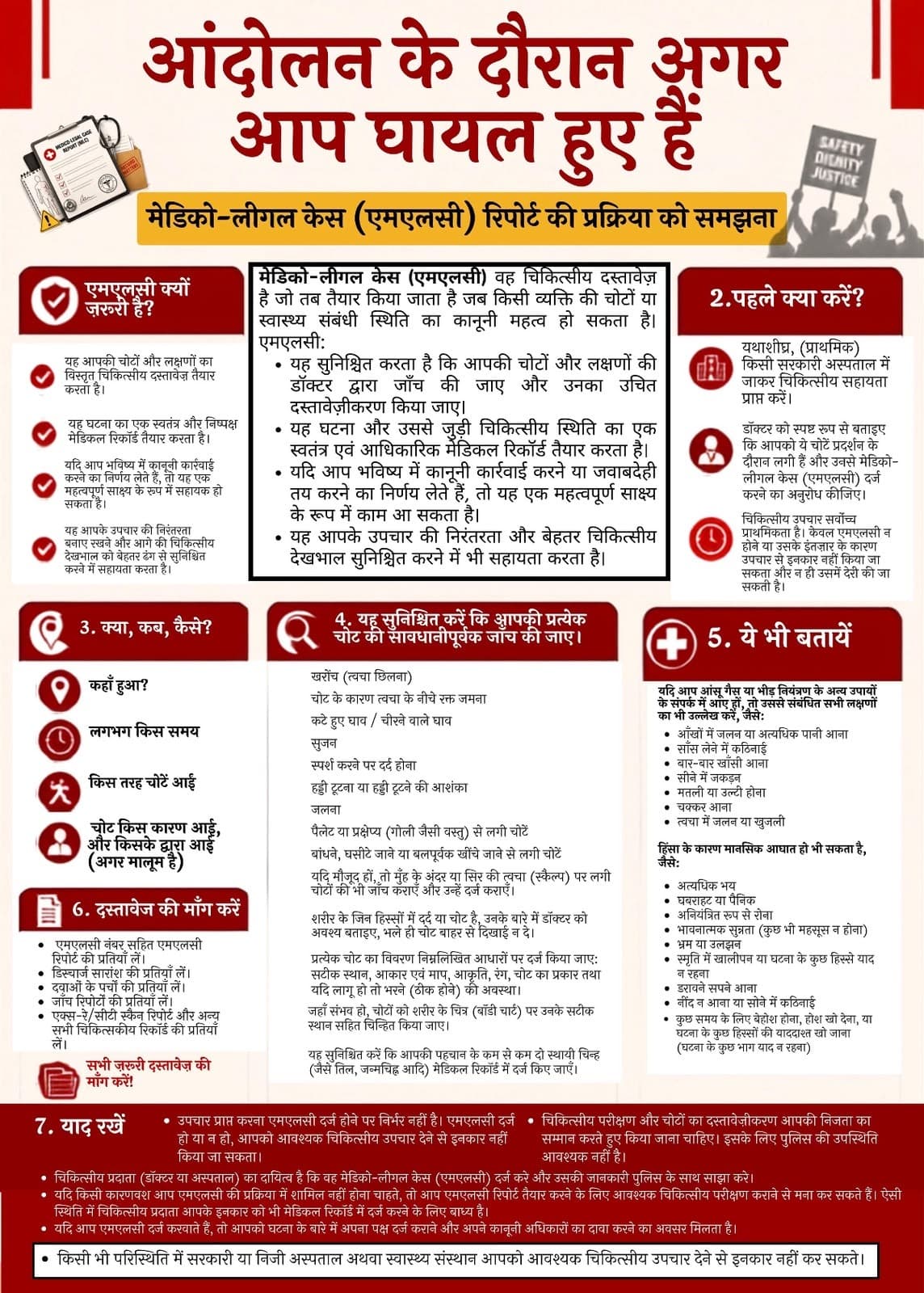
For easy reference, we have summarised these recommendations into downloadable posters. Please download them, share them widely, and display them at protest sites, first-aid stations, and community spaces so that anyone who is injured knows how to protect both their health and their rights.
(This guide was prepared by a group of lawyers and public health professionals.)
Image by Janvi Bokoliya.