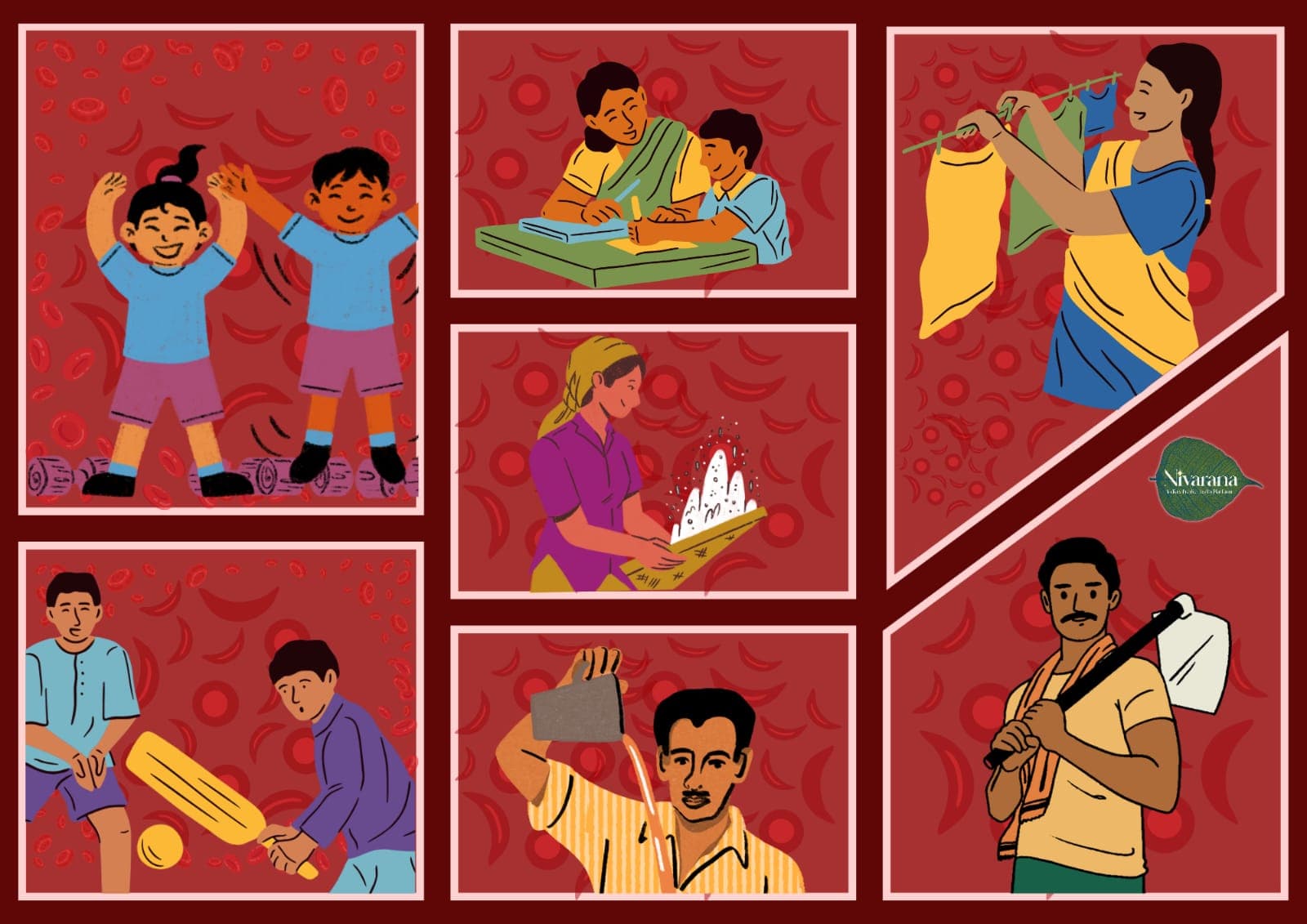
Parth (interviewer):
Thank you all for joining. Today, we want to understand how sickle cell disease is being managed in Chhattisgarh and, more importantly, how communities are being engaged in that process. Let me begin with a simple question: What does this disease actually mean for families?
Devmuni (mother of two children with sickle cell disease):
When my children first fell sick, we didn’t even know what this disease was. We went to private hospitals. Every time they needed blood, it cost a lot. We kept spending… until we had to sell our land. I had three children, all diagnosed with sickle cell disease. With no awareness and no access to affordable care, we spent everything we had. I eventually lost one child before reaching a system where treatment was available. Now (after the collaborative work of Sangwari with the public health system), in the government hospital, medicines and blood are available. My children are doing better. But those years… they were very difficult.
Parth:
Let’s hear from someone living with the disease. Can you tell us about your experience growing up?
Basant (a patient advocate and advisory member of SCD project of Sangwari) :
I used to have a lot of pain as a child. Because of that, I missed school. But people didn’t understand. They thought I was lying… that I just didn’t want to study and was punished. I felt ‘like a fish out of water’, struggling to survive, misunderstood by everyone around. I used to feel very alone. But after joining peer support meetings (started under the collaborative project of Sangwari and the public health system), I met others like me. Now I feel… there are people who understand.
Parth:
I have this question for Dr Yogeshwar. From a public health perspective, how big is this issue?
Yogeshwar (a public health practitioner and researcher working on SCD):
In Chhattisgarh, around 10% of the population carries the sickle cell gene. That’s a large number. The population of Chhattisgarh is above 3 crore (30 million), which means there are close to 30 lakh (3 million) carriers in the state. The prevalence of SCD is about 1-3 per 1000 population based on epidemiological studies. Thus, the state has an estimated 30000-90000 patients with SCD. The entire state of Chhattisgarh has 5-6 hematologists.
Hence, it will be difficult to solve this problem with the help of hematologists. Since a large population of Chhattisgarh lives in rural areas and has difficulty traveling, we need to first address this problem at primary and secondary care levels while simultaneously building the capacity for tertiary care. Also, since it is a genetic disease, issues related to marriage crop up; therefore, it is extremely important to engage communities. They would play a very important role in the prevention of this condition.
Parth:
So this is not just a clinical issue?
Yogeshwar:
Not at all. It’s a complex condition. There’s physical suffering—pain, anemia, crises. But also mental suffering, social stigma, and economic hardship. Families lose income. Marriages are affected. People feel isolated.
Parth:
Now I would like to come to Dr Abhijit. Why is community engagement so central to this work?
Abhijit (a public health practitioner working on SCD):
I don’t see any reason not to involve the community. This is a lifelong condition. Patients live with it every day; they understand it better than anyone else. And remember, the most affected populations are often marginalized. If we don’t involve them, we miss the realities of their lives.
Parth:
Many programs start with community outreach. But your approach was different?
Yogeshwar:
As health professionals working at the grassroots level, we often start community outreach at village levels first, building a bottom-up model, but here we used a top-down approach. We realised that if we start at the village level, there will be only a few patients per village due to the prevalence of this condition, and getting the traction needed to build community work from the villages could be difficult. We also needed to show the patients that they would benefit from the medical therapy, particularly with hydroxyurea, the standard of care for SCD worldwide. Therefore, we began by strengthening clinical care in district hospitals. Patients needed to see that treatment works; only then would trust be built. Then we started building a community of patients and health practitioners.
Parth:
And after that?
Abhijit:
Then we moved towards the entire community to generate a dialogue to address the social aspects of this condition.
Parth:
What were the first steps?
Yogeshwar:
We started with care coordination. We deployed a team of counsellors at two district hospitals in a public-private collaborative model. These counsellors started streamlining the care of patients in the district hospitals. All the medical care was provided by the medical staff at the district hospitals. We created patient registries at the district hospitals at Ambikapur and Surajpur; because earlier, even the system didn’t know how many patients the district had. These counsellors helped patients navigate the busy district hospitals, provided genetic counselling, and made phone calls to remind them about following up regularly and taking hydroxyurea. If a PwSCD did not visit after 2 months, a home visit was made to understand challenges.
Parth:
And how did that help?
Yogeshwar:
It allowed active follow-up. We could call patients, remind them about treatment, and ensure continuity of care. Close to 70% patients started following regularly, which is a large number for a public health system and, for that matter, even for a private setup. With patients receiving continuous care, they started seeing the benefit of the medical care.
Parth:
I would now like to come to Dr Baidyanath. I’ve heard a lot about your peer support groups. What happens in those meetings?
Baidyanath (a public health doctor and divisional coordinator of the SCD project of Sangwari):
Something very simple but very powerful. Patients sit together and talk. For many, it’s the first time they meet someone else with the same condition. One person says, ‘I feel this pain,’ and another says, ‘I feel it too.’ That connection… it starts healing.
Parth:
So it’s emotional support?
Baidyanath:
Yes, but also learning. Patients teach each other how to manage crises, when to seek care, and how to take medicines.
Parth:
Now, I would like to get Basant’s perspective on peer support group meetings. How do these meetings help those living with SCD?
Basant:
Before these meetings, I couldn’t even speak in front of people. Now I can. I feel confident. I can connect with others who have challenges similar to mine.
Parth:
I would like to come back to Dr Yogeshwar. You have also involved a peer counsellor in Sangwari’s project. How was this experience?
Yogeshwar:
Yes. When someone with lived experience speaks, it makes a difference. They understand the struggles: standing in long queues, dealing with pain, and managing daily life.
Parth:
So they became part of the solution?
Yogeshwar:
Exactly. Not just recipients of care but contributors.
Parth:
I’m particularly interested in your patient conferences. How are they different?
Yogeshwar:
In most conferences, patients are absent. Here, they are at the center.
Parth:
What happens in these conferences?
Yogeshwar:
Patients share their experiences. Doctors listen. Administrators listen. Even policymakers listen to the challenges faced by people living with SCD. These challenges are not only medical but also social.
In our first conference, over 200 patients and caregivers came. For many doctors, it was the first time they realized the scale of the problem. In one of the conferences, participants highlighted the struggles faced by those with SCD in getting education and earning a livelihood. SCD disrupts both in a major way and threatens not only the present but the future of the family.
Parth:
How are these conferences beneficial to persons with SCD?
Devmuni:
At first, I was hesitant to go. But when I saw so many people like us… I felt hopeful. I thought my children could also get better.
Parth:
Now I would like to come to Indurose. As a nurse and a district coordinator of the project, how do you see these conferences?
Indurose (a nurse, hospital administator and district coordinator of SCD project of Sangwari):
These conferences create a bridge. Patients can speak openly. Providers understand real-life challenges—not just symptoms. As multiple topics are discussed in these conferences, they also help in patient and family education—about nutrition, pain management, and warning signs. And they build trust.”
Parth:
What strikes me is that this is not just about treatment.
Yogeshwar:
Yes. Sickle cell disease affects everything: education, livelihoods, relationships. We need to think beyond medicines and think about the broader human angle of this condition.
Parth:
You have taken multiple steps to engage the community of persons with SCD in their own care by engaging peer counselors, starting peer support groups, and holding patient conferences. What is the long-term vision?
Yogeshwar:
Our long-term goal is to build a community of patients and families who are informed, connected, and empowered. We are already seeing this—patients becoming advocates, forming networks, raising awareness.
Parth:
This was such a wonderful discussion, so much learning came out of it. If there is one takeaway from this conversation, what would it be?
Basant:
That through a collective action, we are not alone.
Devmuni:
That treatment should be accessible to everyone.
Yogeshwar:
That healthcare must move beyond hospitals—into communities.
Sickle cell disease may begin in the blood. But as this conversation reveals, its impact and its solutions are deeply rooted in society.
Sometimes, the most powerful intervention is not a drug or a protocol, but a simple realization shared in a room full of strangers:
“You feel this, too? Then maybe… I can live with it.”
Edited by Christianez Ratna Kiruba
Image by Janvi Bokoliya