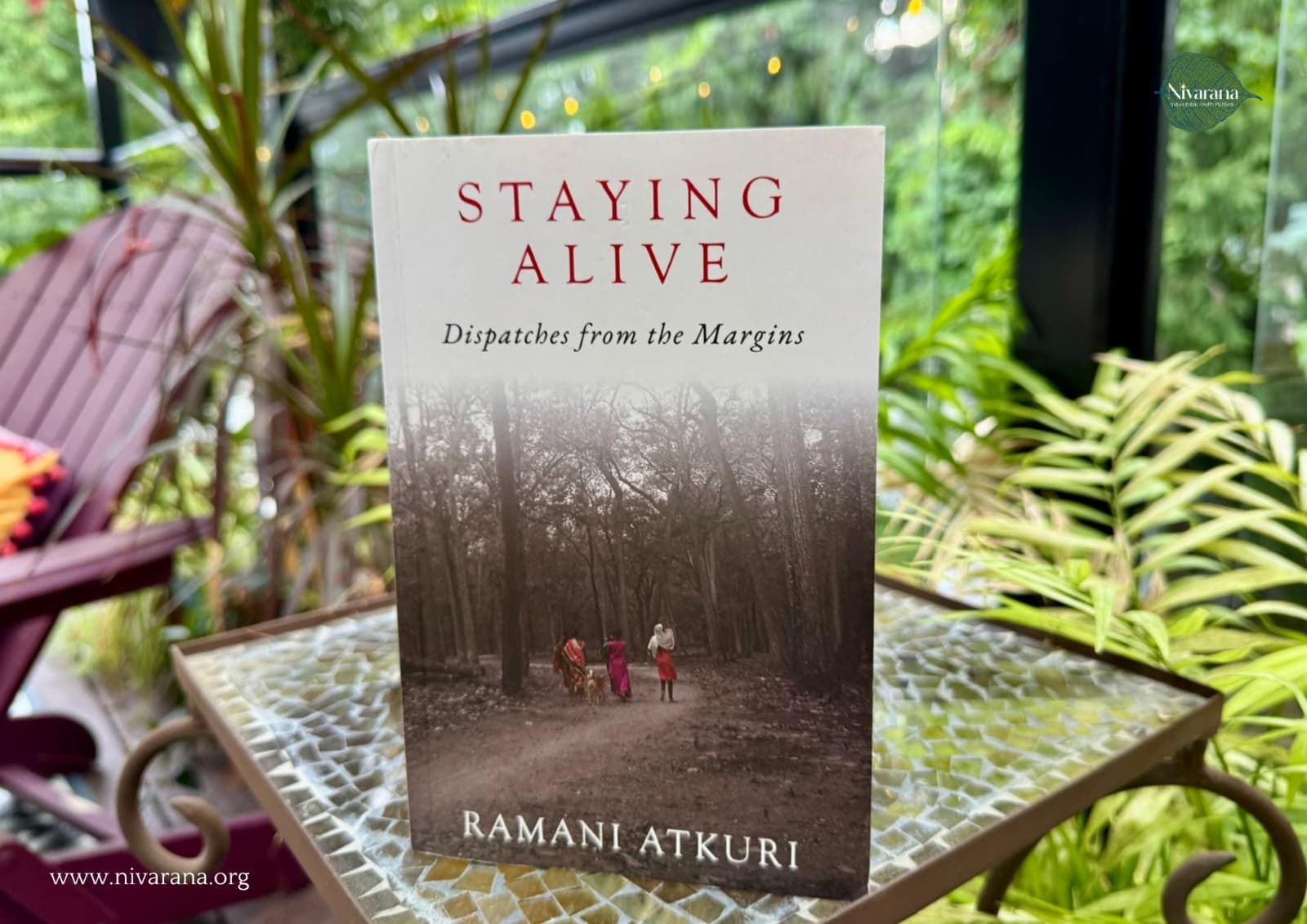
I finished reading Staying Alive: Dispatches from the Margins today and found myself reminiscing about a train journey I undertook about a year ago. The journey followed a riveting reunion at my alma mater, Christian Medical College, Vellore. About 70 of the 140-odd people who had completed their postgraduate training in the Department of Community Health at CMC Vellore gathered for a day of memories, conversations, and reconnecting.
On the return journey, I had the opportunity to spend a good amount of time with the author of this book, Dr. Ramani Atkuri. A humble and unassuming professional, I learnt that she had spent over three decades working in the ‘hard-to-reach’ rural and tribal areas of Central and Eastern India. I had the fortune of being inspired by her in person on that journey. And while reading her book, I could almost hear her voice in my head, stating, matter-of-factly, the abysmal condition of healthcare for the disadvantaged in our country.
That perhaps made the book even more powerful for me.
What is the book about?
The book paints a deeply disturbing, raw, and real canvas of the state of affairs in what is generally referred to as ‘the periphery’ or ‘the margin’ in India. Anyone who has lived and worked in rural and tribal areas of our country will relate to the graphic stories Dr. Atkuri narrates. But what makes these stories come full circle is the way they reveal the interplay of social, political, and economic factors that shape people’s health and their ability to seek healthcare.
Take, for example, the author’s description of ‘Sewage Basti’, a temporary settlement of labour migrants in Ahmedabad, Gujarat. The babool-tree houses covered with plastic sheets, the daily lives of the migrants, their precarious existence and the challenges they face because no one considers caring for them their responsibility—all of this is described with an immediacy that statistics alone can never convey.
Similarly, under Project Tiger, forests marked for ‘no human habitation’ resulted in the displacement of tribal forest people in the Achanakmar Wildlife Sanctuary. Dr. Atkuri traces how a decision that may have appeared, on paper, to be about conservation affected the lives, livelihoods and health of people over the years. These are not simply stories about healthcare. They are stories about land, displacement, poverty, work, governance, environment, and power, and how all of these eventually find their way into a person’s body.
The author uses riveting narratives, recent data, statistics from published research, and infographics to make the colours on this canvas even more vivid. The stories are often difficult to read. My eyes actually teared up when Sombari Sabar’s story ended. And yet, the book never feels as though it is trying to manipulate the reader emotionally. The facts are allowed to speak for themselves.
The book takes us through the ground reality of major public health problems in India, including infectious diseases, malnutrition, accidents, accidental and deliberate poisoning, animal bites, and snake bites. It makes for an important reality check for urban and metropolitan Indians who may hold misconceptions about India’s health system. In fact, that is precisely how the book begins—with a challenge to some of these assumptions.
One of the recurring messages is that healthcare cannot be separated from the systems that surround it. A health centre may exist, but what happens when the road is poor? A doctor may be posted, but what happens when the position remains vacant? A referral may be medically necessary, but what happens when the patient has no affordable transport? A hospital may provide treatment, but what happens when the family has to spend money they simply do not have?
The book describes how a weak or absent public transport system can adversely affect the health of people living in ‘hard-to-reach’ areas. It also has a detailed chapter critiquing public health infrastructure, unnecessary or inevitable referrals, large proportions of vacancies and the human-resource dilemmas involving non-physician healthcare providers—issues that continue to haunt the health system across the country.
Reading these sections, one is reminded that the health system does not begin at the hospital door. Sometimes, the road to the hospital is itself a determinant of whether someone survives.
My favourite chapter in the book, however, is the one called ‘Jhollawalahs.’
I have carried a jhola, a simple cloth bag, for as long as I can remember in my adult life. So perhaps I was predisposed to like this chapter! But there is a deeper reason why it resonated so strongly with me.
The chapter details the role of non-governmental, non-profit organisations, referred to as civil society organisations, in India’s health system. I currently work in the non-profit health sector myself, and I found this chapter particularly meaningful. After pages that paint such a dreary picture of the inequities and failures surrounding healthcare, ‘Jhollawalahs’ brings in a sense of possibility.
It reminds us that the story of Indian healthcare is not only one of government failure or deprivation. People and organisations are working quietly, often with very limited resources, in places where the formal system struggles to reach. They carry their jholas, travel long distances, build relationships, experiment, advocate, collect evidence and, sometimes, simply refuse to accept that the status quo is inevitable.
Importantly, the book does not romanticise the margins. Nor does it romanticise those who work there. Instead, it asks us to look honestly at what is happening—and then to ask what we can do about it.
That, to me, is the greatest strength of Staying Alive.
The book is heartbreaking, but it is not hopeless. It is angry without being shrill, factual without becoming dry, and deeply personal without becoming sentimental. Most importantly, it makes the ‘margin’ visible. It reminds those of us who work in healthcare that the people we describe in reports as ‘hard-to-reach populations’, ‘migrants’, ‘tribal communities’ or ‘underserved groups’ are not categories. They are people with names, families, histories, aspirations and an extraordinary capacity to survive circumstances that most of us would find unimaginable.
Who should read this book?
The book is a must-read for anyone who is responsible for the health of India’s citizens—public health professionals, officers in the Indian Administrative Service, doctors, policymakers and researchers. However, it is written in a way that allows people from other professions, and indeed the ‘general public’, to engage with it as well.
One of the strengths of the book is that it does not assume that the reader already understands public health. The book frequently contains explainers for terms that could otherwise be dismissed as ‘public health jargon’. The author explains concepts such as out-of-pocket expenditure on healthcare and repeatedly highlights India’s inadequate public health investment and its far-reaching consequences.
A book you mustn’t wait to read
Staying Alive is not merely a book about the problems of India’s health system. It is an invitation to look beyond the health system—to the society and structures that produce ill health in the first place.
And perhaps that is why, after finishing the book, I found myself thinking not only about the people Dr. Atkuri writes about, but also about that train journey a year ago.
I remember the woman I met as much as I remember the book she has written. And now, when I think of Staying Alive, I can hear her voice again: calm, grounded, deeply aware of the enormity of the problems, but still carrying her jhola and moving forward.
That may be the most inspiring message of all.
Edited by Parth Sharma
Image by Dr Madhukar Pai