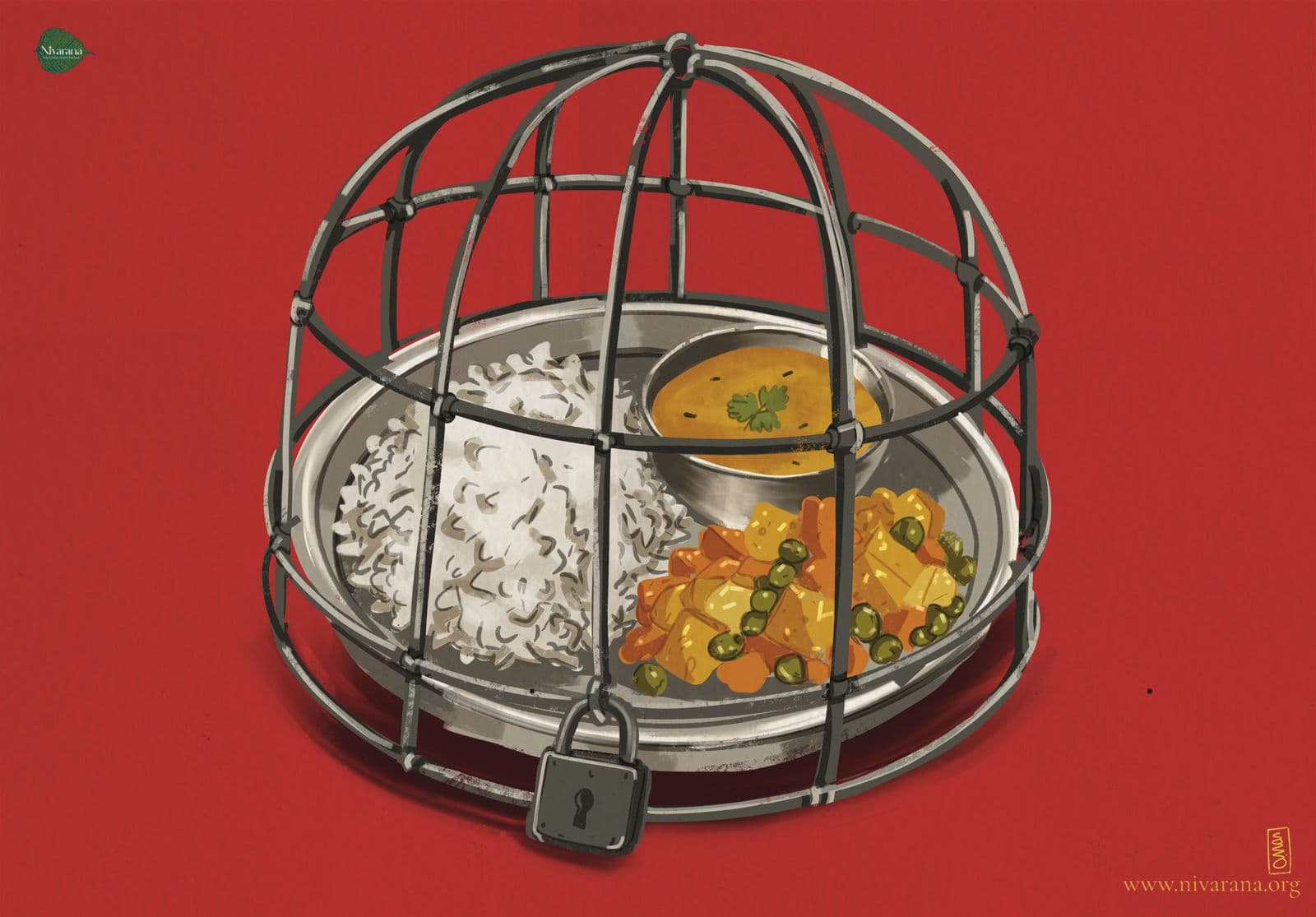
Food is a central aspect of women’s lives. They spend significant amounts of time sourcing ingredients, cleaning them, preparing food, and, in rural areas, growing food crops on farms. In most Indian households, women play an instrumental role in managing the kitchen, groceries, and the refrigerator, if one is available. However, most women do not have much of a say in what the household, and by extension themselves, get to eat.
This is because social, cultural, religious, and caste-based norms govern the food scene in most households. Where is food procured from, who prepares it, what time do people in the house eat, do they eat out often, do they order-in on the myriad food-delivery apps available, do they stock processed food at home, the questions and associated judgments related to food are endless and shaped by these unseen power structures.
In India, as per the latest national survey data (2019-2021), more than half of the adult women in India (a whopping 57%) have anaemia and most of these women have anaemia that can be attributed to nutritional deficiency. And while India continues to battle this huge public health problem, with a health program- Anaemia Mukt Bharat, it treats it as a problem of poverty and resource availability alone. The program’s main strategies which include testing for and treating anaemia with supplements while important, ignore the fact that food is deeply emotional and invisibly governed.
Tackling all nutritional deficiencies - not just anemia, among women, requires an understanding of the emotions, feelings, and societal norms that decide how, what, and when women in India eat.
Central to this discussion is the concept of food-shaming. It is a common phenomenon that I have seen prevalent across all socio-economic sections of society.
Now, what exactly is food-shaming? In my experience and understanding, it is any form of verbal or non-verbal communication that shames a person for their choice of food, quantity, the way it is prepared, who prepares it, or the timing of consumption. It makes a person feel bad, angry, or hurt about their choices related to food consumption.
When Eating is Framed as Selfishness
For most rural women, who must do hard physical labour in agricultural farms, days start early, and they care for not just the people in the house, but also for the farm animals. It is hard, back-breaking work, and yet, their meals are scarce, not because they do not have enough, but because they are conditioned to put everyone else first.
One of my rural woman patients told me, she wakes at 5 am and has her first meal only by 1 pm. Meanwhile, tea and biscuits do the trick of keeping hunger at bay. I asked her why she does not have her meal earlier. She quipped in Marathi, “Sasre kutha khau detat kaama sampla paryant.” Which translates to my in-laws do not like it if I eat before I finish all the chores. Even the tea is frowned upon. “Kithi chai pithe ga he”—how much tea she drinks in a day!
Result of all this? Scores of women with nutrient deficiencies.
On the other end are women who are visibly and/or clinically overweight/ obese, even in rural areas. One such patient of mine, from a rural household, told me, she was asked to take only 2 meals a day after she got married. She was used to three before she got married. The shame written on her face when she told me she felt extremely hungry every day was heartbreaking.
Worse in the Marital Home
Women are routinely shamed for the way they cook, what they cook, and how much they prepare in their marital household. ‘This is not how it is done, at our place,’ they are told by their in-laws. Women are shamed if they do not cook as much as their previous generations did. If the choice of vegetarian versus non-vegetarian food is a mismatch between the daughter-in-law and the marital home’s family members, comments are passed, and shame creeps into the air.
“Kuch bachta hi nahi, mere liye” (I don't have anything left for me) said a doctor friend of mine, who lives in a joint family (very well-educated family, and very well-off as well). Quantity is a huge issue; women are shamed if there is less food or if the food goes to waste. Married women are expected to fast on certain days of the week, during certain festivals. It is believed that husbands of women who fast have longer lives. If women choose not to fast, then they are shamed for being selfish and not being religious.
Women, even highly qualified professionals, who get married and move in or visit their in-laws, have told me they do not feel at home with their in-laws. They often must ask permission before they eat from the common kitchen. If they do not ask for permission, they are shamed for eating by themselves and/or not sharing, or for eating before the husband/ in-laws do.
Even the timing of eating food is strictly governed and so is the order of who eats when. The wife eating before her husband or in-laws is considered inappropriate, even indecent. And if she does, she is called names, or ‘food-shamed.’ Many women feel like they are being watched and judged when they eat. Another professional woman wrote this heart-wrenching poem in a WhatsApp group, where we were discussing food-shaming (a whopping 70+ messages were shared in 24 hours on the topic). She chose to be anonymous.
They beg you to sit down and eat,
You decline, trying to be discreet.
They insist — you give in,
You eat... they begin —
They count, and the shame is complete.
A glance at your plate, then a sigh,
A whisper too loud — “Did you see why?”
“She skipped all the chores,
But look — second course!”
Their kindness was just a decoy lie.
Obviously, this phenomenon is way too prevalent than we care to admit. My patients from rural households, my friends, family, colleagues across our country, all have a bit to share. The wounds run deep, the onslaughts are frequent, often from other women, family members, and friends.
Motherhood and Food Shaming
Children’s eating habits and choices are completely the responsibility of the mother, in most Indian households, and mothers are often criticised for the way they provide food to their kids. Mothers are expected to give up their portion of the food for their children, and if they do not, ‘yeh kaise maa hain?’ ‘What kind of a mother is she?’
The shaming starts very early on, during pregnancy and the postpartum period. There also exist a wide variety of crazy food taboos women are subjected to during this period. It is also quite common for mothers to eat old, cold food, while the children and the men get to eat hot and fresh food - a practice which is encouraged and celebrated.
Food Shaming for the Urban Working Woman
As more women step out to work in urban areas recently, food shaming too seems to have evolved with that change. Having less time at home, and even less time in the kitchen, allows food shaming to take the shape of guilt in the urban working woman’s life. I remember how our grandmothers and mothers would make a big-dabba-full of fried snacks and sweets for festivals. I do not. And this fact is surrounded by guilt and shame. I prefer to make smaller quantities and fewer in variety. Most working women are shamed for not preparing the ‘special’ time-consuming snacks that the previous generations made, notably, in large quantities.
The daily schedule of a working professional woman in a metropolitan city often starts at 7 am followed by exercise, getting dressed, and leaving for work by 8 am, considering her possible long commute to work. Typically, she may have a house-help (almost always women from lower-income groups) who start their day even earlier, maybe at 5 am. The house help sets things in order in her home, fills water (water supply in informal settlements/slums in the city is very erratic), cooks for her family, and comes to the home of the middle/upper-middle-class woman by 7:30am. The working woman may pick up breakfast on the way or have breakfast that her house help has packed for her.
Which of these two women do you think would be food-shamed? In my experience, both.
Shame creeps into their lives, like water through the cracks in the walls of an old building. The working woman may be shamed for having help at home. Elders in her home may tell her that they never had such luxuries, and if she is married, she may internalise the shame and feel guilty for not cooking for her partner and/or children. The house help, who has probably only had a hurried morning tea, may have the first meal of her day at noon, despite having woken up at 5 am. If she is working in multiple homes, she may feel it is ‘inappropriate’ to eat in the homes she works in. House help may avoid eating in the homes they work in for fear of being blamed for theft as well and often employers may not offer her food at all.
Food-shaming in the Age of Delivery Apps
The advancement of delivery apps and other conveniences also has altered the shape of food shaming that occurs. Comments are passed, insults are flung around, if women order food, if they eat out, if they use ‘short-cuts.’
With growing consumerism, our relationship with food has become more complicated, not less. The humble kirana store has given way to supermarkets lined with packaged foods, while “instant,” “fast” and so-called “healthy” options are now everywhere. Ordering food is easier than ever—a few taps on a smartphone can bring almost anything to our doorstep.
Yet women seem to find themselves on the wrong side of judgement regardless of what they choose. Order in, and they may be called lazy for not cooking. Eat out with friends or try an unfamiliar cuisine, and they may be told they have abandoned the simple, traditional meal they should have prepared at home. Prefer to stay home and eat what they cooked themselves, and they risk being called boring or accused of being overly conscious of their figure. The choice of food may have changed, but the scrutiny surrounding women’s choices has not. There always seems to be a right way for a woman to eat—and an endless list of reasons why she is getting it wrong.
To sum it all up, shame is central to the choices women make about food. And when programmes around malnutrition fail to understand this - they risk not being able to address the problem holistically.
If we want to address malnutrition among women, we must also ask who decides what a woman eats, when she eats and how much she is allowed to eat. We must recognise that food is not merely a source of nutrients, but also a site where power, care, duty and control play out every day. Until women can eat without guilt, judgement or having to put everyone else before themselves, our efforts to improve their nutrition will remain incomplete.
Edited by Christianez Ratna Kiruba
Image by Gayatri