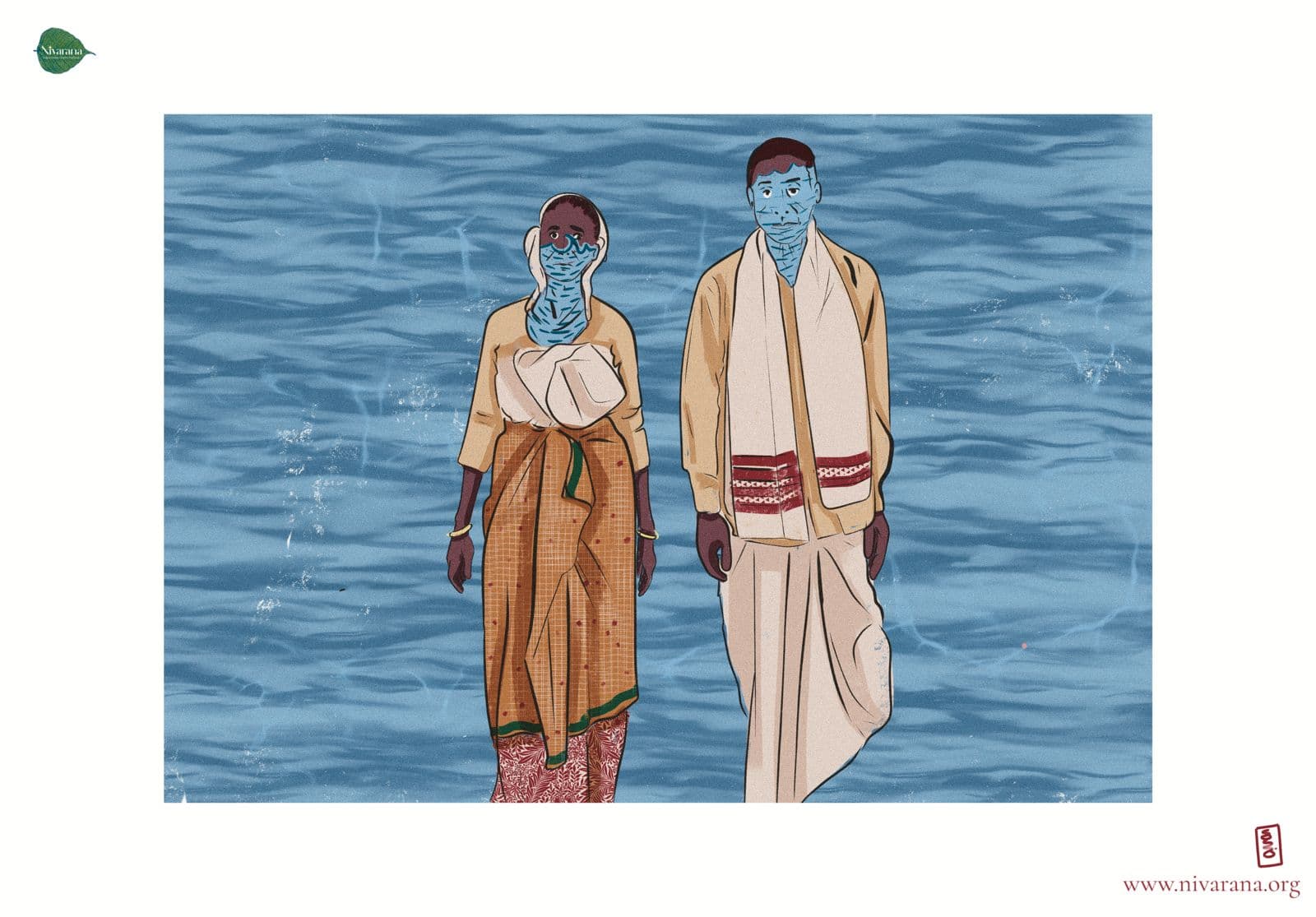
After the Flood, Fear Remains
“I think my blood pressure is high,” was the first thing that 45-year-old Ramen Deka (all names changed for protection) told me. I was helping out in my capacity as a doctor in Ligiripukhuri, one of the flood-stricken areas of Nazira.
Facing me in a decrepit government high school building with destroyed benches and planks of wood surrounding us, Ramen sat under the only functioning fan in the entire building and wiped beads of sweat off his brow. He was trying to share the effect the flood left on his psyche in the language of the body.
When asked for more details, he says, “Last night, I was trying to sleep and suddenly felt like water was washing over my entire body, threatening to drown me. I could feel water on my face, though there wasn’t any. My heart began to beat extremely fast, and I had to get up and immediately take a few deep breaths. I have never experienced something similar before.”
For Ramen, whose house had been submerged in at least two to three feet of water till two days ago, this school building had been a makeshift refuge. As he sought my medical advice in the same space, I realized that there was no accessible mental health language available to him to express the feeling of anxiety or panic. Palpitations meant pressure barhise (blood pressure has risen) to him, and he could not fathom there being some other reason for the dread he felt in the depth of the night.
We checked his blood pressure regardless and it came out to be normal. “Do you think you are scared because something potentially life-threatening happened to you just two weeks back?” I asked. Ramen did not appear convinced. I didn’t spend much more time convincing him, going back to examine his body thoroughly and giving him some multivitamins and a painkiller gel for when he occasionally has aches and pains.
Relief Camps as Essential Healthcare
Being in a disaster medical camp has taught me the importance of something very important – something I used to not define as good healthcare when I was a high-flying medicine resident in the esteemed halls of CMC Vellore.
As interns and even PG residents – especially in very clinical specialties – I have heard people make fun of public health outreach camps that we see anyone conduct. “This isn’t real medicine,” I have heard people say. “We are constrained by the lack of investigations, we are not evaluating people well, we give what medicines we can, which are oftentimes not the best medicines for that illness, and cannot do guideline-based management of diseases.”
There is some truth to these limitations. But “real medicine” is itself a luxury when resources are limited. The inability to provide investigations, treatment of choice, or guideline-based care should not become a reason to withhold care, nor should it diminish a patient’s dignity.
The question is not whether we can provide ideal care, but how we can provide the best possible care while creating pathways to what the camp cannot.
We met a lot of patients with skin infections of all kinds during the camp. Intertrigo (infection between toes), onychomycosis (nail fungal infection) and your garden-variety ringworms.
While we had taken Luliconazole ointments – plain, because over-the-top fixed drug combinations and profit motive have no place here – we did not have Itraconazole, which dermatologists are now prescribing because ringworm has become increasingly difficult to treat. We did not have permethrin or ivermectin for scabies in the drugs we carried, which we realized was a huge mistake when we saw at least 20 people with it.
Furthermore, the advice of hygiene, to wash regularly and keep dry, often seemed like something we could only offer to people who were a tad more privileged than the rest.
Zahira Begum, for one, told me in no minced words that staying dry isn’t an option for at least a few more days. “I am cleaning my house now after the water has receded a bit. There is water on the floor still; we have put a large cloth to soak up as much as possible, but I am going to have to walk over the cloth a few times.” To this, we had to advise her to wear slippers inside the house and to wash her feet after coming out and pat them dry before she goes to retire in her relief camp residence until the house becomes habitable.
What we could do was take the names of the people who needed these medications. We made a large list – of those who needed itraconazole and those who needed medications for scabies. We provided them with antihistamines for the itch for the time being, with a plan to return in the following days with the treatment they needed. The hospital helping us with the camp assured us that those medications would be made available.
We didn’t leave them with nothing - the antihistamines we gave would likely reduce the itch for both the scabies and fungal infections alike. More importantly, people knew their problem was witnessed and accounted for. They knew that more help – specific help for their specific condition – was on the way.
Soon enough, we were refilling prescriptions for those with chronic illnesses like diabetes mellitus, systemic hypertension, asthma, and hypothyroidism with the supplies that we had on hand. And it made a difference. People were coming with sugars of 300 and systolic blood pressures of 190 or so, because their prescription medicines had been washed away.
“Why didn’t you go get a refill from the pharmacy across town? They have opened and are dispensing now.” I asked 65-year-old Ashim, who came to me with blood pressures of 180/90. “I don’t know if I have anything to live for anymore,” he said, shocking me. “I have lost my livelihood. All my cattle and chickens are washed away. I am living like a homeless person on someone’s charity in my own land. I am unable to provide for my wife and children. Why does it matter that I live?”
This made me realise that in disaster-stricken areas where fear, sadness, pain and trauma dominate, the barriers to access to healthcare stop being about stocked shelves. The fact that someone has come to the area and is offering any healthcare at all, for free, might just be the difference between someone like Ashim availing his life-saving medications or giving in to hopelessness.
I wonder, then, if taking home his medications for the next month or two gave Ashim a reason to believe that his life was still worth continuing.
The Dignity in Care
In between treating people with fevers, lung infections, urine infections, and gastroenteritis, of which there were many, I came to realise that what little healthcare that is offered in a disaster camp does something important – it reduces suffering. And sometimes, that has the most impact, because a person finds relocating and living in a relief camp a little more bearable when they are doing it without added pain, itching, or fever.
This also helped me reconsider which provisions are important for disaster relief. As someone who had had no experience prior in this scenario, I used to believe that food and clothing are the most important relief materials that could be dispensed. And I still would not deprioritize them today.
Two experiences from this camp helped me understand what makes the most impact better. The prime among them is returning to the basal level of hygiene. One of the most devastating aftereffects of floods is the wreckage they leave behind- the silt dragged into homes, the cattle now festering on the street as carrion, putrefied waste commingled with flood water and carrying stench everywhere.
Returning to a semblance of normalcy
One of the women who looked the happiest told me that she felt so because she was able to clean the area where she lived for relief. For 38-year-old Monira Begum, that made all the difference. “Though three to four families were living there, we were given bleach and cleaning agents. We set to work immediately, and the place felt habitable soon enough. The mosquito nets we got also helped us by ensuring at least a few hours of sleep at night. Some people who brought relief also brought bottled water – saying other sources might be unclean. I felt safe drinking that.”
Monira doesn’t know whether any kind of chlorination has occurred so far and doesn’t know how to use a chlorine tablet herself. She said she might worry about what kind of chemical is in what she is putting in water. But the fact that bottled water was provided for her makes her feel safer. In the wake of a flood, when the water pooling inside houses and coming from the taps can carry sediment, odor, and disease, these supplies can mean the difference between health and disease.
I had not expected how deeply this devastation can affect even hunger. A majority of the patients who came to me in the health camp complained about being unable to eat. “I ate only one meal all of yesterday. I am trying to bring myself to eat today, but I am unable to,” said Dimbeshwar, a 50-year-old gentleman. When I slowly asked some of them why they felt unable to eat, the problem of the smell emerged.
“Floods have washed away cattle and other animals who have died in that water; the stench surrounding us and the relief camps is unbearable. Many people try to eat, but they throw up whatever they manage to stuff down their stomachs. Several are anxious about the safety of the food. The stench is truly the main thing that is bothering us,” he said.
The human brain is wired to protect us from external danger. It associates bad odors with rotten food. The nausea that bad smells trigger cannot differentiate the source; it reflexively prevents us from eating, as long as the smells persist.
What the Water Takes Away
This was perhaps the strangest thing I learnt in that camp. When we think about disaster relief, we tend to think about the things that keep a person alive: food, water, shelter, medicines. But oftentimes, it is about the things that make today bearable and tomorrow look possible.
It is about being able to sleep. It is about being able to eat without vomiting. It is about having clean feet when you lie down at night. It is about not being afraid that the water you drink will make you sick. It is about being able to walk into the space where you are temporarily living and feel that, however briefly, it is habitable.
Someone I was travelling with to the camp area complained to me that some relief workers brought cigarettes and smokeless tobacco to offer people. He believed that such money could be used on other necessities instead. But when I saw the people who came to me, who looked ashamed when I asked them to open their mouths to examine because their teeth had nicotine stains and those who apologized to me for that, all I could tell them immediately was, “If this is a pleasure that gets you through today, do it. Why would I ask someone who has lost everything also to give up one thing that is currently able to anchor them?” Preventive medicine is important, but difficult to place in the midst of life-changing disaster.
More than anything, I came to feel that our presence itself mattered in these spaces.
The Value in Being Seen
There was value in simply being able to sit across from someone and listen to them recount the fact that everything they owned had been washed away. To talk about fear and sadness. To say, “I am worried about tomorrow,” and have someone listen without asking them to pay for the consultation, the medicines or even the space to say it aloud.
Perhaps this is one of the least visible forms of disaster relief.
When almost everything has been taken away from a person, being listened to is a small way of giving something back. So is being able to make a choice, to clean the space where you sleep, to drink water without wondering if it is safe, to sleep for a few hours without mosquitoes, to take the medicine that keeps your blood pressure under control, or simply to have someone tell you that the medicine you need will be brought back tomorrow.
These things restore something that a flood takes away alongside homes and possessions: agency.
And with agency comes dignity. With dignity comes the possibility of hope.
I think that may be one of the most important things disaster relief can offer—not simply a way to survive the disaster, but a reason to believe that there will still be a tomorrow worth surviving for.
Edited by Radhikaa Sharma
Image by Gayatri