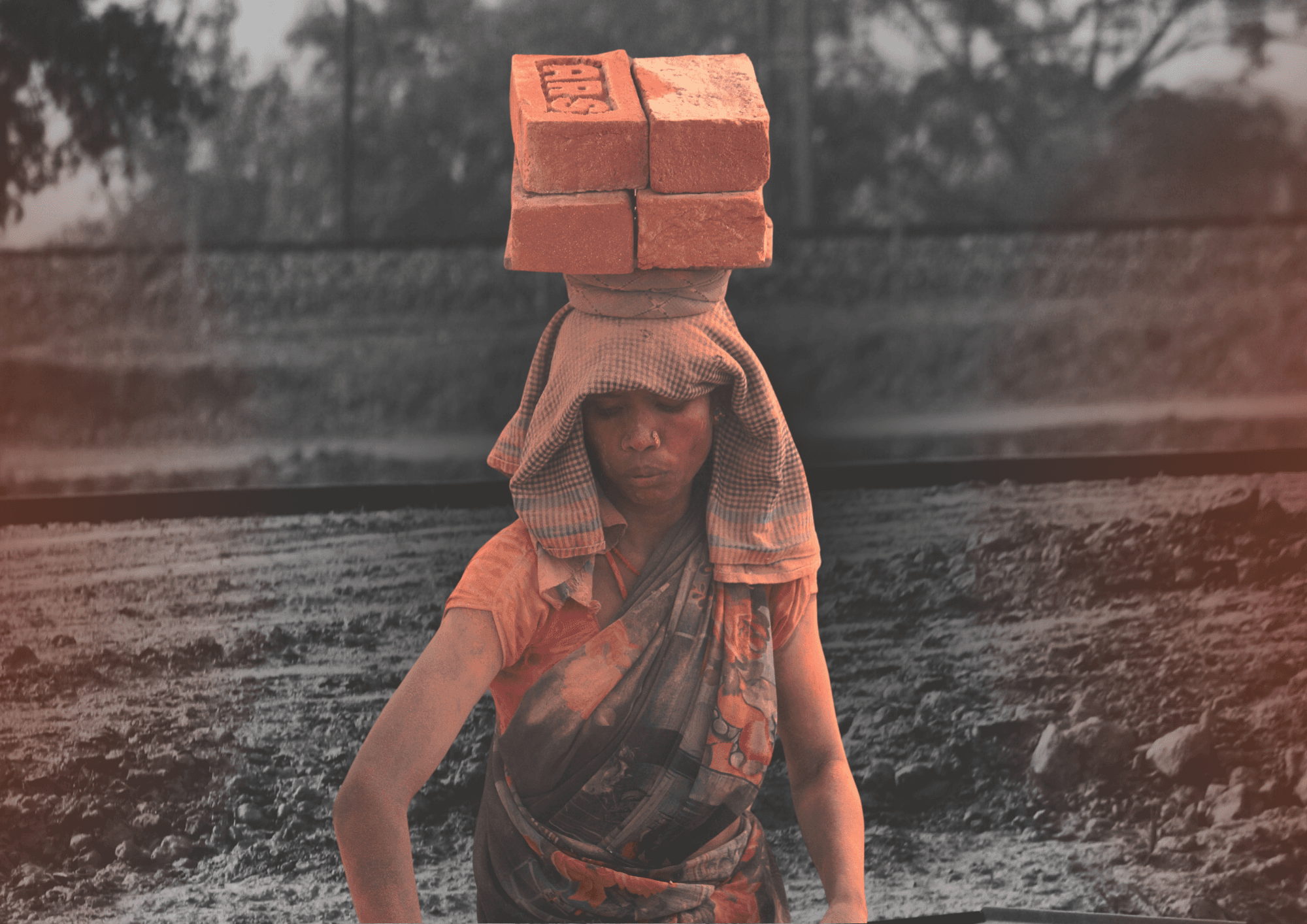
Mahesh works as a master fireman at the brick kilns in eastern UP. As a certified fireman, he oversees the practice of firing bricks at multiple kilns and trains the firemen of the reporting kilns. The firing technique defines the quality of the bricks and therefore, the business profits, making the role of a fireman crucial in the brick-making process.
Mahesh, a high school pass-out, undertook on-the-job training to become a certified fireman. While certification safeguarded his job, it left him unprotected from the daily health and safety risks that came with it. “Lack of provision of safety equipment such as gloves, masks and wooden slippers for the kiln workers jeopardizes our health, especially in peak summers,” notes Mahesh. Wooden slippers protect firemen from the radiation coming from the kiln roof and flames. But Mahesh pointed out that “those slippers if provided, wear off in a short span of time, and by the time we receive new slippers, our feet are already burned.”
Mahesh is one of the one crore migrant workers working in over 100,000 brick kilns in India who endure hazardous health and safety risks to produce approximately 20,000 crore bricks in a year. Globally, India ranks second after China in brick production. The brick kiln industry in rural India is the second largest employer of seasonal migrant labourers after agriculture. Yet there is little compliance by the industry to the occupational health and safety (OSH) global norms set by the International Labour Organisation (ILO) or the operational criteria set by the State Pollution Control Boards (SPCBs).
High levels of ambient heat and respirable suspended particulate matter originating from the kilns make the laborers susceptible to acute health conditions impacting their skin, eyes, respiratory, and locomotor systems. Work-related accidents are also common due to the labour-intensive nature of their jobs.
Studies also point towards higher incidents of workplace injuries where piece-rate workers are employed, as they may end up harming themselves to achieve their daily targets. Piece-rate workers are remunerated for the number of pieces, in this case, bricks, completed rather than the time spent. Women labourers and children of workers also suffer from poor reproductive, maternal, and child health and nutrition.
Within this scenario, this article explores some key reasons for the poor health of workers and barriers to better health conditions for kiln workers and their families and suggests some pathways to overcome these barriers.
Why migrant workers are at increased risk of poor health
The State Pollution Control Board lays the guidelines for emission standards, construction norms such as the height of the chimney, and recommended fuel mix for the kilns. Further, it mandates proper waste disposal, dust, and pollution control measures such as developing a green belt and a perimeter wall around the kiln. However, there is poor compliance and regulation of these norms.
The Interstate Migrants Workman Act, 1979 broadly covers the rights of migrant workers. However, poor legislative control has failed to protect the rights of migrant workers in the brick industry. The Indian Social Security Code and Occupational Health and Safety Code 2020, which replaces 13 labour laws and seeks to regulate the health and safety conditions of workers in establishments with 10 or more workers, mines, and docks is yet to be enforced. Similarly, the Building and Other Construction Workers Act, 1996 while offering economic support for serious health issues for kiln workers suffers from poor implementation. Globally, ILO Convention No. 155 on occupational health and safety at the workplace has not been ratified by India.
Increasing occurrences of climate change-induced extreme heat events in a high thermal stress work environment of the brick kilns compounds the overall health impact on the workers. A study in Chennai pointed out that heat exposure in the kilns in summer months exceeded the international standard limits for safe work. The same study revealed that more than 8 in 10 workers complained of tiredness, weakness, and dizziness, and almost 1 in 2 confessed to reduced productivity in summer.
Ram Pratap, a raw brickmaker from Banda has been working as a kiln labourer for the last 17 years. Acknowledging the alarming rise in temperature, he shared, “Working in extreme weather conditions – summer or winter, often makes us sick. Then, we have to depend on private clinics.”
Some efforts have been made to make the workplace safer. The past few decades have witnessed new technological innovations to abate carbon emissions from the industry. Popular solutions include the natural draught zig zag firing technique which mandates stacking of the bricks in a zigzag pattern instead of a straight line to increase the path length of the airflow and thereby improve the fuel combustion rate. This technique substantially reduces the amount of carbon dioxide emissions by 20% and also mitigates workplace-related accidents due to the comparative reduction of manual labour secondary to improved fuel efficiency.
However, this technique results in only a marginal reduction in the amount of suspended particulate matter. Other more effective solutions such as vertical shaft brick kiln or Hoffman kiln technology are cost-intensive and therefore, less desired by most kiln owners, who are largely micro & small - scale entrepreneurs.
Access to healthcare for migrant workers: a far-fetched dream
Brickmaking as a process demands the enterprise to be set up on the outskirts of any city as per the environmental norms set by the SPCB. For instance, the UP Brick Brick Kilns (Sitting Criteria for Establishments) Rules, 2012 state that kilns need to be set up beyond 5 km of any municipal corporation, biodiversity zones, or historical monuments or at least 500 m to 1 km of any residential area, school, and hospital.
The resulting segregation of different social groups of workers, who migrate from other states, weakens their access to an already frail public healthcare system. Further, the poor quality of public healthcare infrastructure in the connecting villages forces workers to travel far distances to the cities to access better quality care in private hospitals.
Suresh Rathore, MGNREGA Mazdoor Union Leader from Varanasi, UP informed that while most of the workers have Ayushman cards under the Pradhan Mantri Jan Arogya Yojana (PMJAY), there are no Jan Arogya Kendres (JAK) available near the kilns where workers could seek health services. Workers have to spend at least INR 200 to travel to the city and show proof of serious health conditions or hospital admissions to be able to purchase basic medicines.
These labourers are also likely to defer seeking healthcare in the fear of losing daily wages. There is also a risk of negative earnings that can result from borrowing money for additional out-of-pocket expenses such as purchasing medicines. Social isolation and caste-based discrimination make things worse. Brick kiln labourers, often belonging to the SC community, are poorly represented in worker organisations. Additionally, due to their informal and migrant worker status, they are deprived of individual agency or collective power. Their ability to seek timely health services is bound by the decision of the kiln managers and owners, who weigh business profits over workers' health.
“There's no doubt that in any place where workers are organized, the government pays more attention to them. The labourers from other states (outside of UP) are also taken advantage of because they are not organized and there is no one to look out for them,” said Suresh, MGNREGA worker leader.
Brick kilns largely operate during summer to leverage the hot weather conditions for making bricks. The seasonality, physical remoteness, piece-rate payment system, and labour intensity of the work make it an unattractive job for the local workforce. Informal migrant labourers are brought in from states to fill the workforce gap without any formal employment contract. The resulting lack of any form of social security adds to their woes.
The labourers take an advance payment from the subcontractors, mostly to repay debt taken for marriage or medical treatment, the top two reasons for money borrowing. The piece-rate system pushes the entire family to migrate and work on the kilns. This form of seasonal and informal employment, coupled with the lack of a social network in destination areas, leaves the workers and their families vulnerable to acute social security risks, including occupational health and safety risks.
Kiln owners and local panchayats of neighbouring villages also do not feel responsible for the welfare of the migrant workers as they belong to different states and are beyond their constituencies.
The way forward
The barriers discussed above represent a range of structural challenges intersecting an unequal migrant labour system and a weak public healthcare system. The nature of these barriers necessitates bringing together diverse stakeholders, especially those who hold local-level accountability. One of the key approaches to address some of the immediate health needs of the workers could be to adopt decentralized solutions.
Local authorities such as municipal corporations, gram panchayats, and Village Health, Nutrition, and Sanitation Committees (VHNSC) should address the health issues of brick kiln workers and urge them to develop solutions contextual to the hyper-local needs of workers in kilns near their villages or cities.
One of the initiatives by Gram Pradhans, in coordination with district authorities, could be to ensure that Jan Arogya Kendras, as per the PMJAY, are established in villages and brick kiln workers, irrespective of their migrant status, are able to enjoy portable rights to access required health services in these centers. Existing health centers should be impaneled under the PMJAY scheme to improve access to healthcare.
Additionally, efforts to strengthen the brick kiln migrant workers’ membership in worker organizations, stronger regulation of working conditions, and mandatory provisioning of safety equipment to workers are some of the immediate measures needed to improve the occupational health and safety of the workers.
About the authors:
Harpreet Bhullar and Saniya Anwar are part of a multi-stakeholder platform called Buniyaad which is working towards building an equity-based decarbonization within the brick industry in UP. Saniya Anwar works as Campaigner at Purpose and Harpreet Bhullar works as Associate Director of Impact Measurement and Learning at Purpose, a social impact agency.