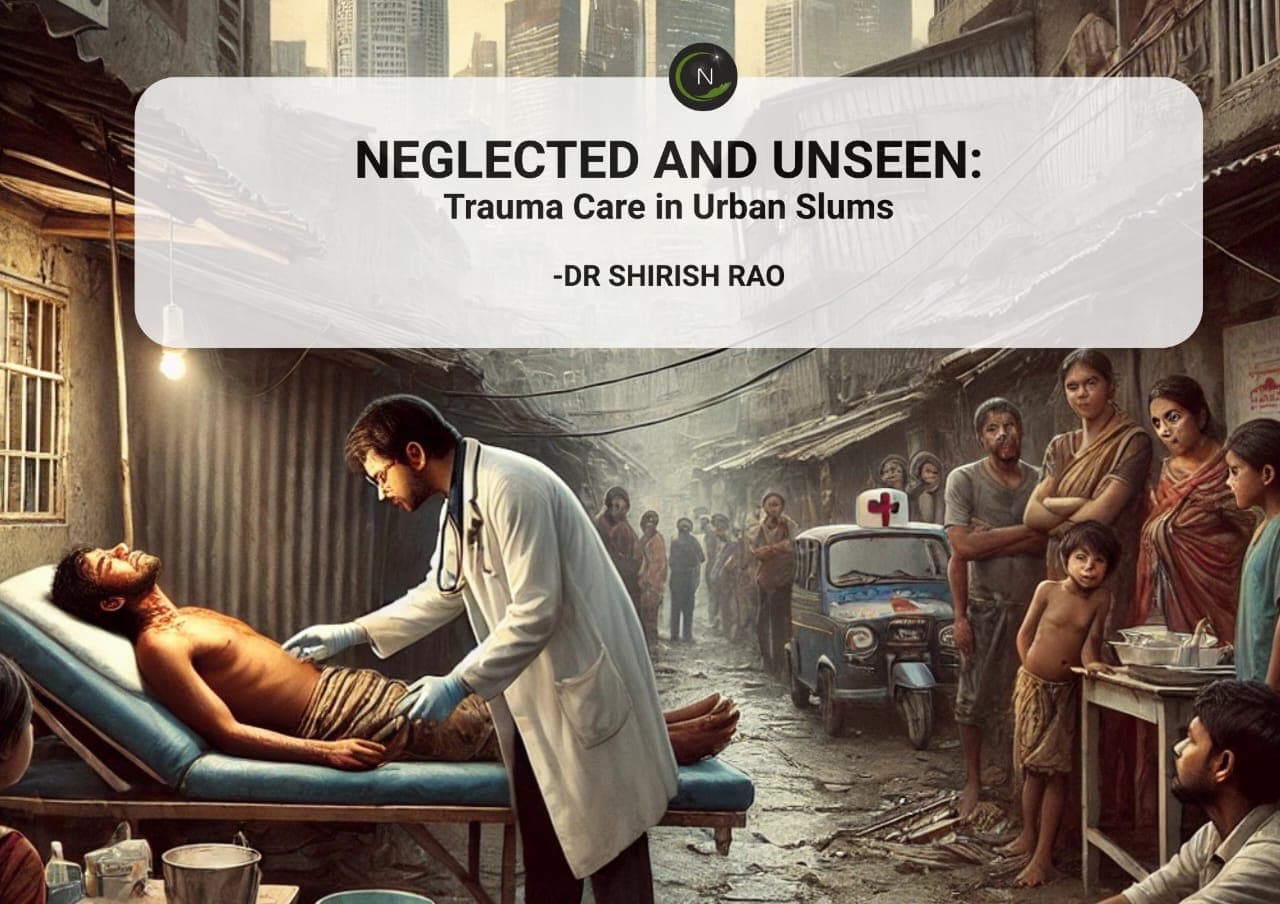
Life in Mumbai’s slums is marred by violence, trauma, and systemic neglect— as seen firsthand in a casualty ward where victims of assault, accidents, and abuse fight for survival daily.
Working as a casualty officer in Bandra has been eye-opening for me.
While Bandra is one of Mumbai's most elite areas, there are actually two Bandras. One is the glamorous world of high-rises and wealth, while the other consists of slum-dwelling, working-class communities.
The patients I see come from the latter. Their struggles—particularly with violence, trauma, and safety—paint a grim picture of urban life that often goes unnoticed.
Physical violence and assault
In my six months here, I've gained an unfortunate reputation—my shifts always seem to attract the worst trauma cases. It's as if the city's underbelly reveals itself in full force whenever I'm on duty.
To give you an idea, my New Year's Eve shift began with a patient walking in at 12:06 a.m., his scalp split open and bleeding profusely. A gang of 8-10 people armed with metal rods and a knife had attacked him. Gang violence, street fights, and mob assaults are rampant. Most cases stem from alcohol-fueled disputes, family conflicts, or property fights.
The sheer brutality of some cases is disturbing. Not all patients this badly hurt, but the number of assault cases we see is alarming. And these are just the ones reported to the police and sent for medical examination.
Slum infrastructure and fall injuries
My casualty department directly exhibits how poor infrastructure affects public health. Unplanned settlements, unstable staircases, and overcrowded homes make falls almost inevitable—especially for the most vulnerable: middle-aged women, older people, and, most commonly, children under five.
They casually toss around the phrase "Maaley par se gir gaya" (meaning they fell from the upper floor), even when an infant has fallen from a height. It's staggering. And yet, this is routine for us. Fractures, head injuries, concussions—these aren't isolated incidents but a systemic issue.
Sexual violence against women
Cases of sexual violence and domestic abuse are disturbingly frequent.
Two days ago, I saw a woman who was a victim of physically assault by a man in her neighborhood—a known harasser who has been troubling women in the area for years.
"He does this to many women," she told me. It wasn't an isolated case—I've heard the same from others.
The worst cases involve extreme brutality. A few months ago, a woman came in, bleeding from her head. She had just gone to fill the water when a man—someone known for terrorizing women in the slum—showed up. She called him a monster. He hit her with a hammer, dragged her across the street, groped her, tried to tear her clothes, and threatened to rape her.
Domestic violence cases are just as common, if not more. Women arrive at casualty in terrible states—bruised, bleeding, and broken. Some initially lie, saying they 'fell,' but later, a relative will pull me aside and whisper that their husband did this. And it's not just husbands—live-in partners, drunk family members, andeven in-laws are responsible for horrific assaults.
Sexual violence against children
Perhaps the most distressing cases I see are those involving children.
In just one week, I saw four to five cases of child sexual abuse. And that's just from my 30-hour workweek— then one can imagine how many more are coming in every month to this hospital. And this is just one hospital in one part of the city. The cases span all ages—two-month-old babies, five-year-olds, ten-year-olds, fourteen-year-olds. The abuse varies, but the pattern is horrifyingly familiar: kidnapped, molested, touched in the wrong places and kissed by adults.
It's not just girls—boys are victims too, abused by adult men and, in some cases, even by adult women.
These are not rare occurrences but a deeply embedded issue in the slum-dwelling parts of the city.
Road traffic accidents: A daily reality
The city's roads are a nightmare. Metro construction, unplanned roadworks, and a blatant disregard for traffic rules make accidents inevitable.
Every shift, I see bikers skidding on pothole-ridden roads, cars hitting bikes and speeding away, and pedestrians getting knocked down. Most cases involve fractures, abrasions, and minor head trauma, but now and then, there's a case that turns fatal. One such case happened on New Year's Eve.
A 17-year-old boy was came in with severe head trauma after a bike accident. He didn't make it. His family had barely processed the celebration of the new year before it turned into tragedy.
Railway accidents: The brutality of mumbai's lifeline
Mumbai's local trains, though essential, are just as dangerous as the roads. Falls from overcrowded trains, people getting hit while crossing tracks, and accidental pushes during rush hour are horrifyingly familiar.
Days after I joined, I saw the first railway case, a drunk man who fell off a moving train. who suffered a severe head injury and multiple fractures. He was lucky to survive, but not everyone does.
I was fortunate—or unfortunate—enough to witness the mass stampede where patients got stuck between the train and the platform at Bandra Terminus less than a month into joining my duty. At 3 a.m., the casualty ward flooded with patients suffering from mass polytrauma (multiple different injuries in the same person)—partial amputations (loss of body parts), multiple fractures, and profuse bleeding.
Patients lay all around, some in critical condition, while we scrambled to provide immediate stabilization. However, with no emergency surgical capacity at our hospital, we could only stabilize them and transfer them to a higher center. The incident was a stark reminder of the systemic gaps in emergency trauma care and the urgent need to strengthen secondary hospital surgical and critical care facilities.
Every week, if not every day, I see at least railwayaccidents, most of whom are brought dead to the casualty department.
The overwhelming burden on hospitals
The sheer volume of trauma cases places immense strain on surgical departments, particularly General Surgery, Orthopedics, and Obstetrics & Gynecology. To give context in numbers, all of these incidents get documented as medico-legal cases (MLC), and the current MLC number is over 2500, 2 months into 2025, with almost 40-50 cases each day
While fractures can often be X-rayed and managed with a slab, severe injuries—especially head trauma- require CT scans and neurosurgical evaluation, which are only available at tertiary centers, making timely intervention difficult. Polytrauma cases are even more complex, as secondary hospitals lack the necessary infrastructure, expertise, and resources to manage them effectively.
The only available anesthetists are residents on district postings from teaching hospitals, primarily assigned to emergency Caesarean sections, while other surgeries rely on private anesthetists for elective cases. This results in a complete absence of emergency surgical services beyond those involved in childbirth (also known as obstetrics), leaving most trauma patients without timely, life-saving interventions.
Considering that our dresser who does basic suturing has also been absent over the last week, providing emergency surgery seems pretty aspirational. Given the high burden of trauma, adequate investigation facilities and a trained surgical workforce are essential to ensure that secondary hospitals can provide comprehensive emergency care.
An unaccountable system
A patient after undergoing violent trauma from a fight, came back to me a week after I referred him to a tertiary care centre for a CT scan. He lost his hearing and was in constant pain, but as his CT scan was normal, no one was examining him further.
He roamed around four hospitals, both government and private for two weeks, lost his job due to absence and was still receiving threats of violence. I checked him and realised that there was a tear in his tympanic membrane (ear-drum) and referred him to the necessary ENT specialist. It is sad that he had to waste around two weeks and lose his source of income just to recieve the care needed.
Another patient - this time, a two month year old child came to me after trauma referred back from a medical college hospital. The relatives had no idea what was happening with the child, as they were discharged without being told anything. They were not even given a discharge sheet.
The problem as iterated above, is that there is no capacity building and infrastructure in secondary hospitals in a way that they can meaningfully take the burden and offload medical college hospitals and tertiary centres.
Law and order that ignores the poor
Despite the severity of these cases, justice often feels elusive.
We do our part—documenting injuries and providing medical care—but after that, the cases often fade into bureaucratic nothingness. We send these people back into the same world that failed to protect them in the first place.
Patients who suffer from trauma and violence often go unnoticed, their cases unprioritized, while their physical and mental scars remain with them. They leave the hospital with an MLC (medico-legal certificate) paper, but I have yet to see a patient return with a resolved case. Arrests happen, but trials drag on for years, lost in a maze of overburdened courts.
From our hospitals, we provide medical care, counseling, and legal support, trying to help victims navigate a system that seldom delivers justice. Yet, theresolution remains uncertain—buried deep within the overcrowded slums, where neither the media nor the government pays attention. The poor, the infamous, and the unimportant continue to suffer in silence.
When I asked the police officers who routinely bring convicts for medical examination, they admit that the jails are already full, and crimes are surpassing the system's capacity.
One officer told me, "Aaj pakdenge 2-3 din me chod denge, itne log ko rakne ka jagah hi kaha hai jail me, already sab full chal raha hai" (meaning we have no choice but to arrest them and let them go in a few days because there's nowhere to keep them.) The cycle repeats itself—violence, injury, treatment, release—while the cracks in the system only deepen.
Violence—whether physical, sexual, or structural—has become normalized in the slums. The emergency room is a revolving door of repeated tragedies. Hospitals are not just places of healing; they are mirrors reflecting societal failures. What I see in casualty is a direct result of systemic neglect—poor urban planning, lack of social safety nets, and a justice system that rarely delivers.
Until we address these systemic issues, hospitals like mine will continue seeing the same tragedies, shift after shift, year after year.