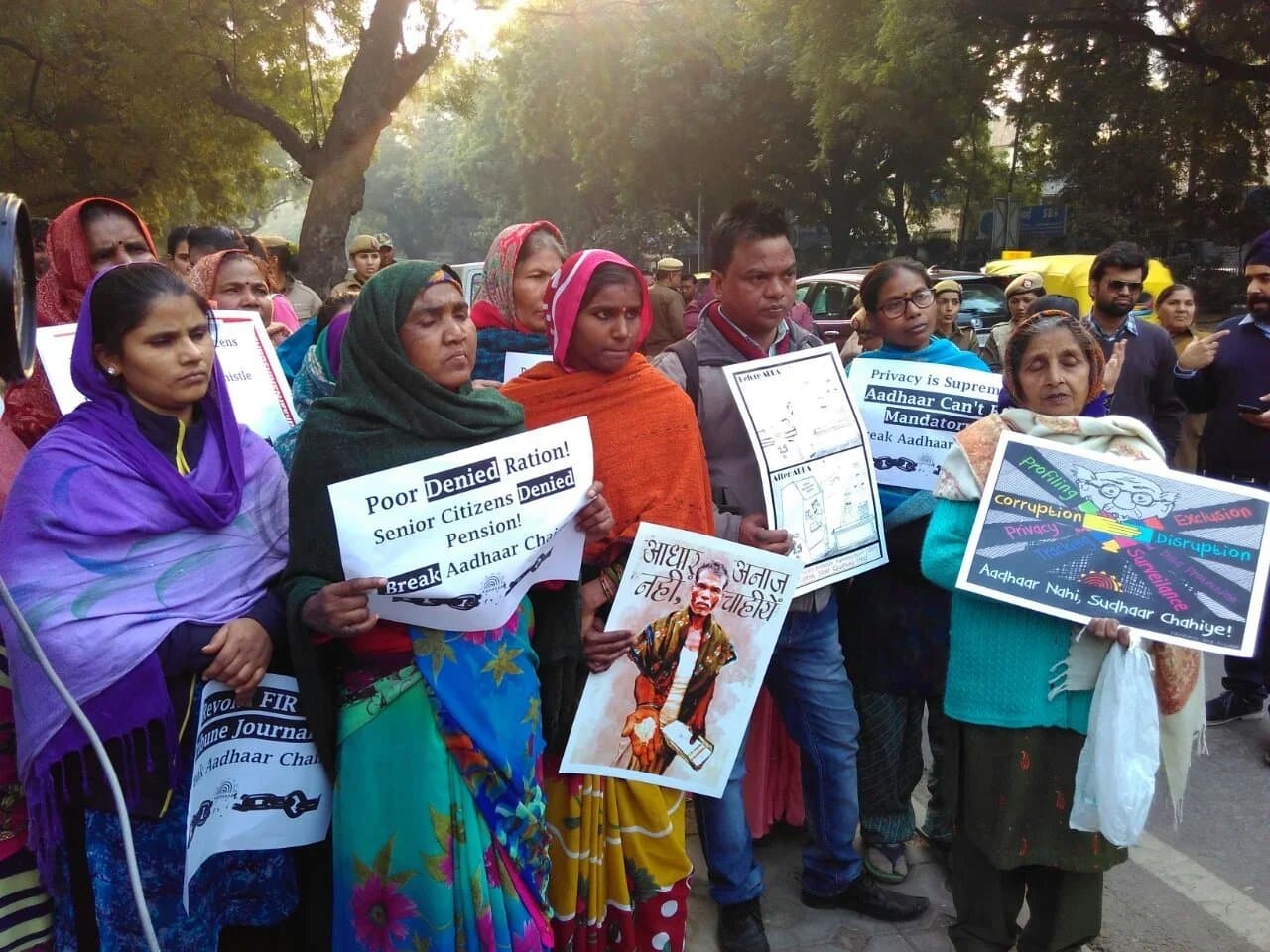

The statement below, endorsed by more than 50 Indian organisations aside from many individual signatories, was released on 10 December 2025 (Human Rights Day).
We are deeply concerned that efforts are being made to promote biometric identity systems similar to Aadhaar in other countries.
Aadhaar is India’s unique identity number, linked with a person’s biometrics (fingerprints, iris and photograph as of now). The number was rolled out with fanfare from 2009 onwards. The use of this number, and of Aadhaar-based biometric authentication (ABBA), was promoted to the hilt by the Indian government in close collaboration with the IT industry. Aadhaar was supposed to be voluntary, but it quickly became clear that living without it would be very difficult for most. Today, it is as good as compulsory. Most social benefits are out of reach without Aadhaar.
Aadhaar was rolled out in an explicitly “evangelistic” mode from day one. In recent years, it has been projected as a grand success by its promoters. Their friends in high places (like Davos, the World Bank, and the B&M Gates Foundation) are on board. There is an attempt, partly successful already, to project Aadhaar as a model and “export” it to other countries.
For our part, we view Aadhaar as a failed and objectionable model that should not be replicated in other countries.
Our main concerns:
-
Aadhaar involves the creation of a centralised database that includes biometrics as well as demographic information (e.g. name, gender, date of birth and address). This could turn into a dangerous tool of social control, especially, but not only, in the hands of an authoritarian government.
-
The linkage of numerous databases with Aadhaar magnifies the danger of it becoming a tool for profiling, surveillance, exclusion and worse. Centralised databases also pose data security risks by creating a single point of failure.
-
While the “core biometrics” (biometrics minus photograph) in the Aadhaar database are supposed to be secure, the rest is freely shared with authorised users of Aadhaar authentication, with minimal safeguards. This is a major infringement of privacy.
-
The demographic details attached to Aadhaar numbers in the database are full of errors, partly due to the hasty rollout. Yet severe restrictions have been placed on correcting this information. Meanwhile, people are expected to align other documents with this unreliable information. This is causing endless hassles to poor people. Many of them are excluded from some or all social benefits.