This morning, I received a message from a family member in response to a video I had shared of a speech by Umar Khalid on the importance of political accountability: "...you are again on the totally wrong track. Avoid such posts on social media and do whatever you want to do for the poor and needy people of the society."
Besides provoking anger, it made me pause and wonder: why are some (or rather so many) of us still not outraged by what is happening in this country?
In this year alone, countless people have lost their lives because of preventable systemic failures, from students driven to suicide to mothers and children dying after receiving contaminated medicines. Affordable healthcare, which was already slipping out of reach, is no longer the only crisis. Even good quality healthcare cannot be taken for granted, no matter how much money one is willing to spend.
What troubles me the most is not only these failures, but how quickly they are absorbed into the ordinary. Every day seems to bring a new threshold of what we are expected to tolerate, and that threshold appears to have no upper limit.
Forget demanding accountability for a moment. Why are so many people no longer even outraged? Why do so many continue to accept narratives that have repeatedly been exposed as false? At what point did we begin treating preventable suffering and institutional failure as the inevitable price of living in this country?
There is nothing new about this apathy. History has witnessed it before, both among those who govern and those who are governed.
In The Power of the Powerless, written in 1978, Václav Havel reflected on life under Communist rule in Czechoslovakia, where dissent had become a crime, and conformity was enforced not only through coercion but also through the quiet rituals of everyday obedience.
The essay emerged a decade after the crushing of the Prague Spring in 1968, when hopes for "socialism with a human face" were extinguished by the Soviet-led invasion. The years that followed, known as the period of Normalization, were marked by political purges, censorship, surveillance, and the systematic exclusion of critics from public life. Independent institutions were hollowed out, and citizens were expected to demonstrate loyalty to the regime, regardless of what they privately believed.
Yet Havel argued that this system was, in many ways, more insidious than a conventional dictatorship. He called it a post-totalitarian system. Unlike a dictatorship sustained primarily through fear and overt repression, the post-totalitarian order reproduces itself because ordinary people participate in it, often unconsciously, through countless acts of conformity.
To illustrate this, Havel describes a greengrocer who places a sign in his shop window proclaiming, "Workers of the World, Unite!" He does not display it because he believes in the slogan or because someone explicitly ordered him to. He displays it because everyone else does. It is an unspoken ritual that signals compliance, protects him from suspicion, and, as Havel writes, is "one of the thousands of details that guarantee him a relatively tranquil life in harmony with society."
Because the greengrocer hangs the sign, others do the same. The ritual acquires a life of its own. Timothy Snyder captures this distinction well when he writes that such a system is worse than dictatorship "not because some individual has total power, but because power is shared in conditions of total irresponsibility."
In a classic dictatorship, the greengrocer would have been forced to display the sign against his will. The act would have reminded him of his humiliation and the violence of the regime. In Havel's post-totalitarian society, however, the act no longer feels humiliating. It becomes routine. The individual grows indifferent to the lie because ideology transforms obedience into something that appears natural, respectable, even virtuous.
Under the guise of ideology, the post-totalitarian system demands conformity, uniformity, and discipline. It serves people only insofar as they serve the system. Any attempt to step outside the assigned role of obedience is perceived as a threat to the system itself. Havel argues that the true objective of such a regime is not merely to preserve the power of a ruling elite. Rather, it is driven by a self-perpetuating social automatism.
As he writes, "The inner aim of the post-totalitarian system is not mere preservation of power... Rather, the social phenomenon of self-preservation is subordinated to something higher, to a kind of blind automatism, which drives the system." Individuals, regardless of where they stand in the hierarchy, matter only to the extent that they keep this automatism functioning.
The result is that people gradually begin to live within a lie. Havel's most unsettling insight is that the system does not require genuine belief. "They need not accept the lie. It is enough for them to have accepted their life with it and in it. For by this very fact, individuals confirm the system, fulfil the system, make the system, are the system."
Perhaps this is why outrage becomes so rare. A society does not become indifferent to injustice overnight. It happens incrementally, with a thousand little cuts. Each violation that goes unchallenged becomes the baseline against which the next violation is judged. Each act of silence makes the next silence easier. The threshold of what is considered intolerable keeps rising because people become accustomed to living alongside the intolerable. Propaganda does not have to convince everyone that the system is just. It only has to convince enough people that resistance is futile, that speaking out is dangerous, or that someone else will do it.
This is why the most dangerous consequence of a post-totalitarian society is not censorship, arrests, or surveillance alone. It is the normalization of injustice. When students die by suicide because institutions fail them, when patients die after receiving contaminated medicines, when hate becomes ordinary, when constitutional values are treated as inconveniences rather than commitments, each episode is absorbed into public life and rapidly replaced by the next crisis. Yesterday's outrage becomes today's background noise. What would once have been a national scandal becomes another headline to scroll past.
This is not because people have suddenly become cruel. It is because they have become habituated. Constant exposure to injustice dulls moral sensitivity. Ideology provides comforting explanations, while relentless crises produce exhaustion and a sense of learned helplessness. The system no longer needs to suppress outrage directly. It merely needs people to adapt to each new reality until the abnormal feels ordinary.
Havel believed that the antidote was deceptively simple but profoundly difficult: to live in truth. Refusing to participate in the lie, however small the act, is itself a political act because it interrupts the rituals that keep the system alive. Living in truth begins by refusing to look away. It starts with acknowledging the rot in the system, asking why it has been allowed to fester, and refusing to accept injustice as inevitable. It culminates in demanding accountability, systemic change, justice, and freedom for all.
Timothy Snyder offers an understanding of this ‘freedom’. Freedom, he writes, is "not doing things that you are inclined to do. It is reflecting upon what you ought to do, as your unrepeatable self, and just occasionally taking a risk and doing that thing." In societies where conformity becomes the default, freedom begins not with grand revolutions but with ordinary people choosing, despite the risks, to refuse indifference. It begins with remaining outraged when the system expects us to stop being.
Change, therefore, does not always begin with extraordinary acts of courage or sacrifice. Sometimes, it begins with something far simpler: refusing to accept the lies we are told. It begins by choosing to see reality as it is, rather than as those in power would have us believe.
As Nivarana completes four years today, we reaffirm our commitment to living in that truth. We will continue to challenge falsehoods, speak truth to power, acknowledge the needless suffering inflicted on our people, amplify evidence-based solutions, and demand accountability from those entrusted with serving the public.
Edited by Radhikaa Sharma
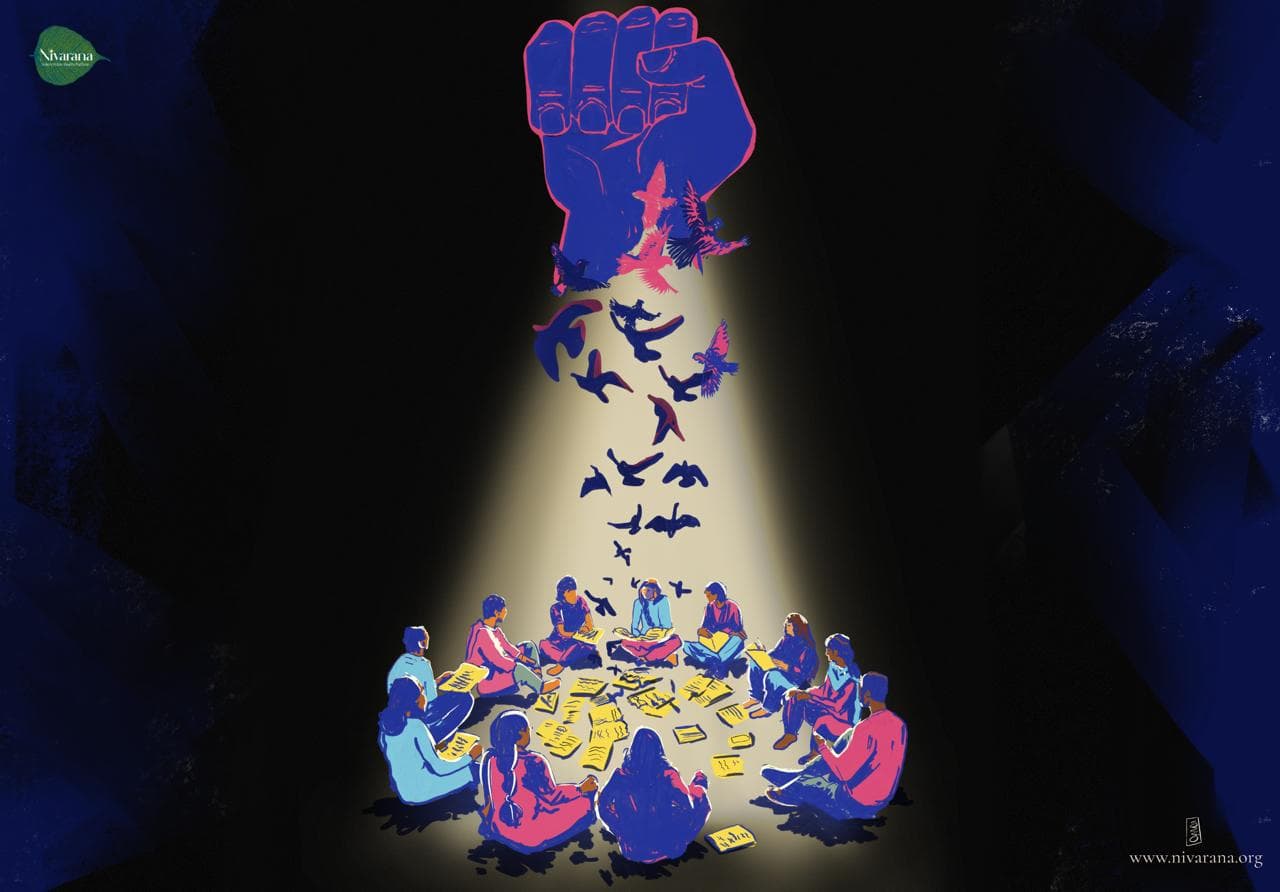
Image by Gayatri