It’s past midnight and I’m still scrolling my phone. 40 odd days now of a sit-in at Jantar Mantar.
A hunger strike that finally broke, not because anyone in power blinked, but because a grieving father, whose own daughter is one of the names on this list now, asked the man fasting to get up and lead a march. An activist carried off mid-strike, admitted to hospital against his will, his people calling it what it plainly looks like: an abduction with better paperwork. His wife in court the next morning just to get him moved somewhere the state didn’t have a hand in. Tear gas near Shastri Bhawan. This is what an exam has done to a city, again.
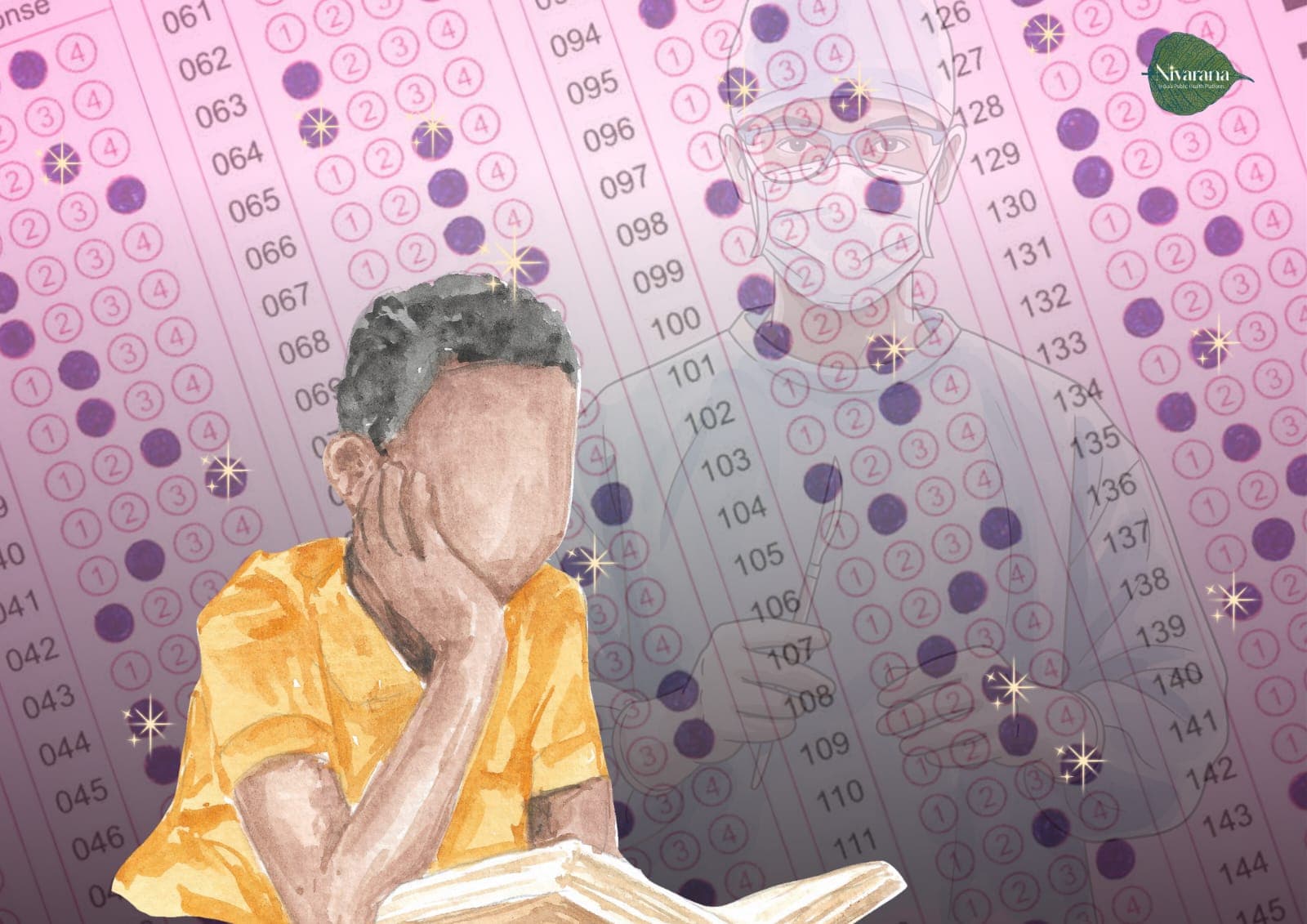
Not just any exam- NEET, the one entrance test that decides who gets to become a doctor in this country, which is a fairly enormous thing in itself. This year, like several years before it, the paper leaked. The exam was compromised, then repeated, then contested again over irregularities in scoring. And somewhere in the arithmetic of re-tests and revised results and government statements, the fact that gets buried every single time is this: children die over this exam. Not metaphorically, many times. Overwork, despair, the crushing arithmetic of a life spent preparing for one shot that gets stolen from you by someone else’s cheating, and then it’s filed away as an unfortunate statistic, suicides, a name in a list that a father has to carry to a protest site because no one else will carry it for him.
Here’s the asymmetry I can’t get past, and I’ve turned it over enough times now that it’s stopped feeling like an insight and started feeling like a bruise: this exam is treated as far too sacred to be casual about. Fair enough, you can’t let just anybody near a scalpel. But the moment the conduct of the exam that’s corrupted, leaked, resold, and mismarked, nobody’s in a hurry to be serious about consequences. Years of sleeplessness, hunger, quiet dissociation and the actual physical toll of trying to qualify, become disposable exactly when the system is the one that failed. You only get to matter here if you’re dying. Actually, not even then.
I’ve stood in enough of these to recognise the shape before it fully arrives. Calcutta– years back, over violence against students and against women, over what a fair price for an education should even look like, over the plain absence of jobs at the end of all that studying. Delhi– when the CAB was being read into law and protesters filled the streets in front of Parliament night after night, and then Shaheen Bagh, which stopped being a protest site and became its own stubborn city.
I still know exactly what tear gas does to your eyes hours after you’ve washed them out. I know the friends who didn’t come out the other side of those years whole. I know what it’s like when the people who haven’t yet been touched by any of it, not by the police, not by a rigged exam, not by a law that erases you on paper, go about their week like it isn’t their problem yet. And I know what it costs when your own family can’t see what you’ve seen, can’t understand what the last decade has taught you about how this country treats the people who ask it to be better.
So no, I don’t buy it when a movement like this gets waved off as one bad exam, one unlucky cohort, one overreaction. It’s a continuation. It’s always a continuation, and the people showing up for each other at Jantar Mantar right now are doing exactly what we were all doing back then: refusing to let the system make this a private grief.
Here’s where my own history with this gets complicated, though, in a way I think is worth sitting with rather than smoothing over. I grew up nowhere near any of this. No doctors in the family, no frequent visit to the hospital, not one classmate I was close to who was chasing medicine. Except for one memory that’s stayed lodged in me because we remember laughing because it was so ridiculous: a diligent Bengali classmate, rumoured to be denied rice for lunch so he wouldn’t get drowsy and lose study hours, because medicine was the plan and the plan required a body that didn’t need rest. I didn’t understand it then. I understand it a little better now. Some of my school friends are doctors now, but we lost touch along the way. I only found out what that actually cost people years later, when I ended up working in the healthcare sector myself and living on a hospital campus, surrounded day and night by resident doctors. Everywhere I went, the story from my doctor friends have been pretty much the same in this country. That was its own education, and a considerably less gentle one.
I remember asking few surgical residents, in my first month there, what they did for their mental health when a patient they’ve treated for weeks, or months, dies anyway. Because the illness was too advanced. I got a blank look back, not defensive, not evasive, genuinely confused, like the question hadn’t parsed in the language they were currently living in. Because who has the time and luxury of these thoughts really?!
I remember a phone ringing at 3 in the morning and a voice, seconds out of sleep, reciting drug names and test values with total fluency, then going straight back to sleep mid-breath like nothing had happened. I still don’t understand how a brain does that on command, night after night, for years, and keeps doing it without visibly breaking. Except it does break. It just doesn’t get to look like breaking, because the next patient is already there and the ward doesn’t pause so anyone can feel something.
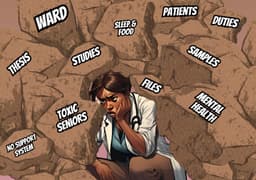
The vocabulary changes, the relationship with time changes, sleep changes, body weight changes, the whole texture of a person changes. It’s one of the most demanding, most necessary professions there is, and also one where you can be spoken to like you’re nothing by seniors, sometimes by the very families you’re trying to help, while the popular imagination flattens your entire life into “must be earning well.” Pilots and truck drivers get mandated rest between shifts because everyone, without needing convincing, accepts that an exhausted brain carrying so many passengers or driving through the road with a heavy vehicle is a dangerous one. Doctors run 36 hours straight and the safety conversation somehow never makes it to their door. I’ve stopped believing this was ever really about patient care. If it were, the arithmetic would look nothing like it does. The “leaves” on paper is about as real as most promises this country makes every election season: beautifully documented, practically fictional.
I think of one friend in particular tonight, someone I’ve watched change over months in a way that genuinely unsettles me. Sharp, attentive, observant, and caring once. Now, just looks like he’s given up. Tired in a way sleep stopped touching a while ago, quieter, stranger, uninterested in things he used to properly love, his attention scattering in ways it never used to. 24-36 hour duties, multiple times a week, until there wasn’t room left in him for anything except the next dressing that needed changing, the next flap that needed monitoring, the fear of a senior who wouldn’t understand if he so much as asked to sit down. He didn’t get to opt out of any of it on his own terms, his body did that for him, after a bad accident left him at home now for a week with his legs elevated, off the wards for the first time in years. And in that stillness, reading the same headlines the rest of us are reading, he’s started saying out loud what he probably couldn’t afford to think before: that perhaps none of it: the stipend, the years, the way people speak in medical colleges, the anxiety of getting beaten up by families, feels like it was worth what it took out of him. He’s even started asking, half to himself, whether he’d let anyone he actually loved walk into this the way he did.
And the exam is only the entry point to a system that keeps extracting well past it. The absurd working hours that don’t taper off with seniority so much as compound. Stipends that don’t reflect the hours or the responsibility. The MCC counselling process that so many describe as a slow-motion scam. Security deposits, money some families had to take loans to arrange, sitting frozen in the system for years after the exam is long over. Medical council asking for payments after payments for a degree certificate, or an NOC, or officals expecting students to leave their duties and hover around for days for a registration certificate, with some bribes on the side. And at the far end of all that investment, sometimes: no job waiting. This is not a system failing quietly at the edges. It is failing loudly, in the open, in a country that keeps finding new ways to look past it right up until a child’s death makes the papers for a week, and then doesn’t
The protest at Jantar Mantar isn’t really about a single leaked paper. It’s about how many times this exact thing has to happen, the same demand for accountability, the same stone-walling, the same batons, before something in the structure itself is forced to give.
There’s an argument sitting underneath all of this that I don’t think anyone’s fully reckoned with yet, how much of this is the state’s failure, and how much is a wider rot: an economy that can’t absorb its own graduates, a job market thin enough that cheating starts to look almost rational to a frightened eighteen-year-old. Both are true at once. A government doesn’t own every individual choice made under pressure, but it owns the pressure, the exam bodies it fails to secure, the economy that manufactures the exact desperation it later punishes. Blaming an abstract “system” lets everyone off too easily. So does pretending this was ever only about one leaked paper.
What keeps catching me, even after everything, is how much of the actual care around this movement is improvised: peer to peer, off the books, nobody’s official job. First-aid guides passed hand to hand for people who’ve never had to protect their own bodies at a protest site before. Someone quietly offering their number to a stranger who might need to talk at 2AM. People finding out mid-protest that their own families have turned against them for showing up at all, and other protesters stepping in to be the family that does show up: a phone call, a hot meal, somewhere to sit for an hour without being made to explain yourself. Support isn’t agreement, someone in one of these circles said; it’s staying next to a person regardless of how things turn out. That’s not a small thing to build from nothing, in real time, while also being tear-gassed.
In times like these, I keep thinking of all things, of Satyajit Ray’s Hirak Rajar Deshe - “Dori dhore maaro taan, raja hobe khaan khaan.”
The scene where the schoolmaster and the children finally pull on the rope tied to the emperor’s own statue, and the whole gilded thing comes apart in pieces, because it turns out it was never as solid as it looked. It just needed enough hands pulling in the same direction at the same time. I think about that more than is probably healthy, watching thousands of people show up at a barricade they already know ends in tear gas, again, for a fight that isn’t only theirs personally, again. No single hero in that story. Just rope, and rage, and enough people refusing to let go together.
I don’t have a tidy way to end this, and I’m suspicious of anyone who claims they do. Some of us are still holding the rope, in one way or another.
Edited by Radhikaa Sharma
Image by Janvi Bokoliya