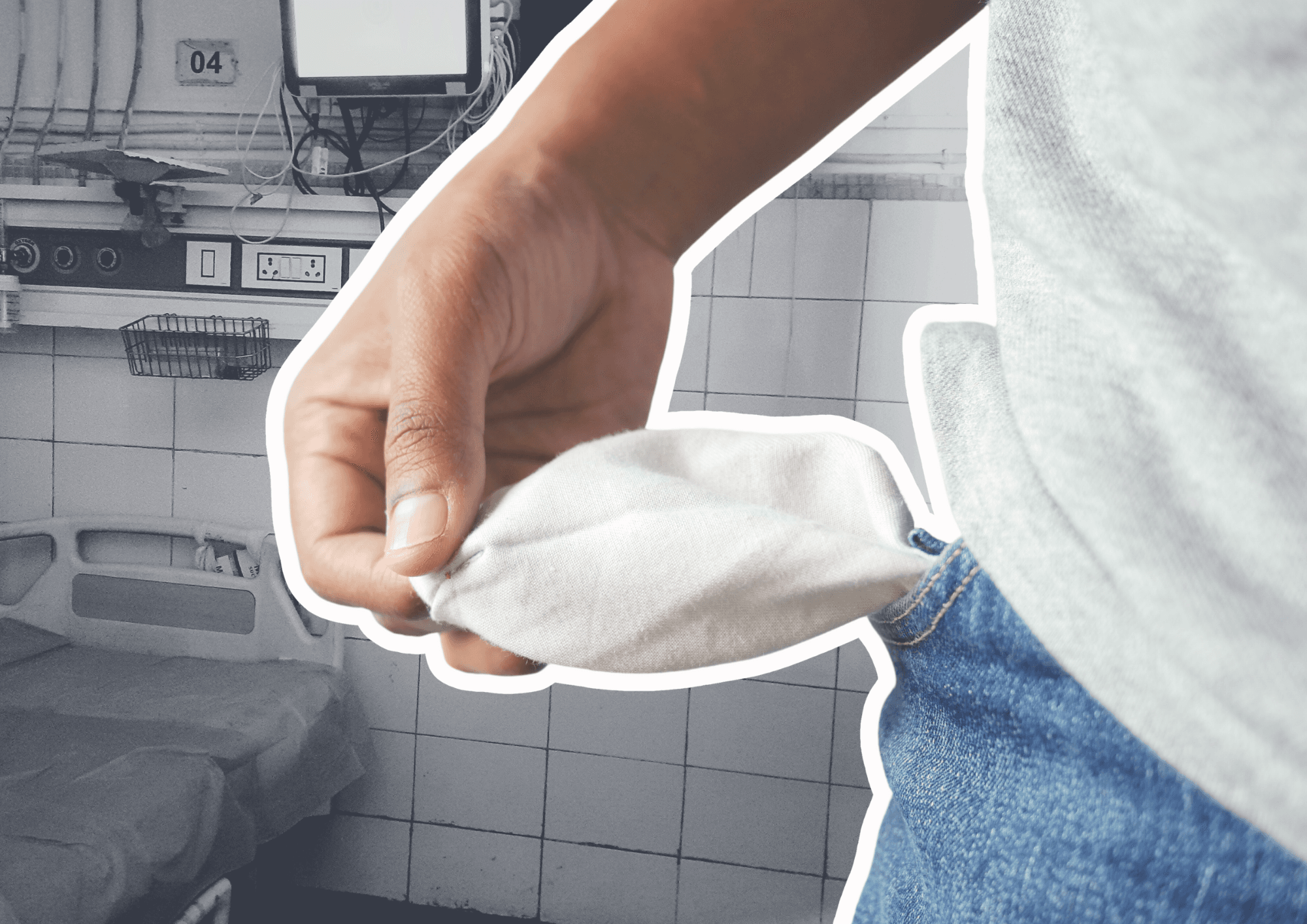
A report by the World Health Organization estimated that 55 million (5.5 crore) Indians fall below the poverty line every year due to health expenditure. It is safe to assume that the private healthcare provision plays a significant role in this. But will providing entirely government-funded healthcare solve this problem? Will converting all hospitals to government hospitals make seeking healthcare free?
Over the past few days interacting with a lot of patients at a tertiary care public hospital in Delhi has made me realize how financially challenging seeking healthcare is for the majority. How often have you heard people say, “If they can not afford private care they should visit a government hospital where treatment is free. Nobody is forcing them to go to a private hospital to seek care”? Let’s keep aside the argument around the waiting times, systemic violence, and quality of care provided in government and private hospitals, and only try to answer one question - is seeking healthcare in government hospitals really free?
“I had to borrow 100 rupees from my neighbor today to come for my appointment,” said Mr Ramesh (name changed), a 45-year-old cab driver receiving radiation therapy for oral cancer. “I earn 200-300 rupees per day. Due to my cancer treatment, I haven’t been able to work regularly for the past few months. I am the sole earner of the family and I have two kids. I live 25km away and there are days when I do not have money to even buy the bus ticket,” Ramesh said, as he broke down into tears.
This is known as out-of-pocket expenditure (OOPE) - that is, the money people spend from their pocket to seek health care. When spent directly on seeking healthcare it is known as direct OOPE. Direct OOPE can be either due to medical expenses like doctor’s consultation fees, and the cost of drugs and medical procedures or non-medical expenses like the cost of travel, accommodation, and food for people relocating to larger cities for treatment. When the source of income or productive hours are lost due to absence from work for treatment, it is known as indirect OOPE. As healthcare providers, we often think of expenditure on health as the money spent on direct medical care. Since this is free in government hospitals, it is easy to assume that seeking healthcare is free in these hospitals.
However, direct non-medical expenses - money spent on travel, accommodation, and food - and indirect expenses - loss of day’s wages or productive hours due to leave from work - contribute significantly to the financial burden, which is often neglected. Therefore, the farther the hospital is from the person’s house, the more the out-of-pocket expenditure to seek healthcare, even if the drugs and consultation fees are free. As treatment for cancer is mostly localized to major cities in India, cancer patients have to spend large amounts to seek care, even in government hospitals.
Even though tertiary care government hospitals are often equipped with state-of-the-art laboratories, patients still have to get investigations done from private laboratories. “The blood collection time is 9 am to 11 am and it takes 1 week to get the report. We therefore advise (cancer) patients to get tests done outside to avoid delays in treatment,” told a healthcare worker from a leading tertiary public health center in north India. This, however, is not feasible for a majority of the patients seeking treatment in government facilities.