Life, Death, and Deposits: Rethinking Emergency Care In Private Hospitals
When emergency care is denied due to financial demands, lives are lost. This article highlights urgent stories and calls for stronger policy enforcement and regulations to ensure no one is turned away in a crisis.
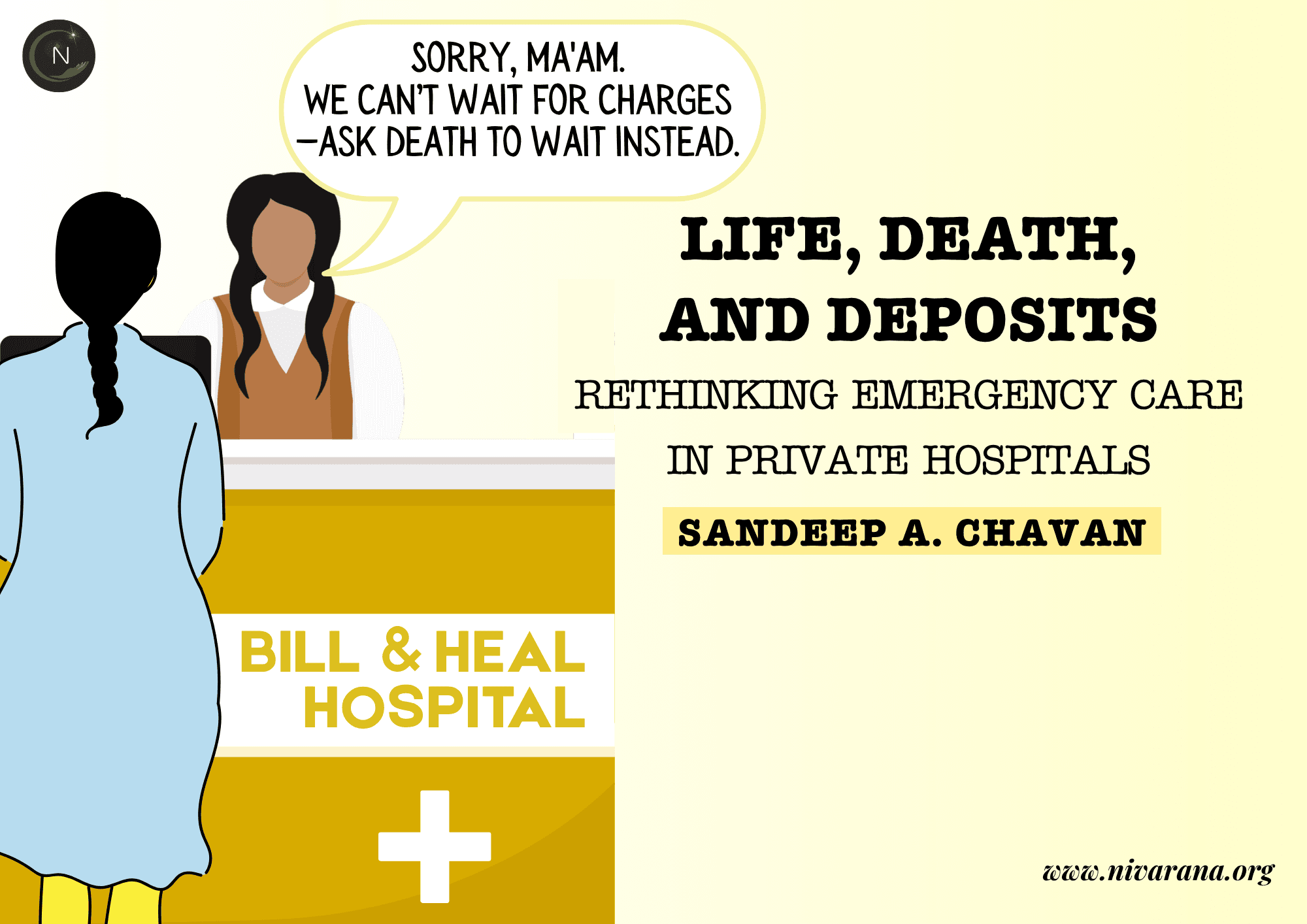
A month ago, a deeply distressing incident occurred in Pune. A pregnant woman, already identified as a high-risk case carrying premature twin babies, was taken to the prestigious Deenanath Mangeshkar Hospital in Pune. Despite the critical nature of her condition, the hospital allegedly demanded an upfront deposit of ₹10 lakh for admission.
Her family pleaded for immediate medical attention, assuring that the amount would be arranged shortly. However, the hospital refused to initiate treatment without the deposit. Precious hours were lost, and the woman had to be shifted to another facility. Although she eventually delivered twin girls, she tragically passed away.
An Unnecessary Delay
In the field of public health, when we think about preventing maternal deaths, the framework of the ‘Three Delay Model’ is often used to explain delays at critical junctures, which cost mothers their lives.
The first delay occurs at the household level, when families take time to decide whether to seek care. The second delay involves reaching a health facility, often impacted by geographical and infrastructural barriers. The third delay takes place after the patient reaches a facility but fails to receive timely care due to staff shortages, the unavailability of resources, or systemic inefficiencies.
And while this model is mainly applied to maternity care, it can also be used to any emergency where a patient dies because they did not receive the appropriate care on time.
In our country, a large proportion of deaths due to third delays are typically observed in rural settings where there are no health centres or staff. However, this particular case reveals a disturbing urban variant of the third delay—one not caused by a lack of personnel or infrastructure, but by the corporatized rigidity of private healthcare.
Despite being a high-risk emergency, the hospital denied care to the woman purely due to financial considerations. Therefore, it is crucial to highlight how corporate hospitals, which receive substantial government subsidies and benefits, behave when patients in need reach out in an emergency and how financial interests often take precedence over patient care and safety.
A Personal Brush With The System
In light of the above news, I feel compelled to share my own recent experience with a private hospital, which further highlights the urgent need for policy reform and accountability in the private healthcare sector.
My wife was diagnosed with ectopic pregnancy, which is a well-known emergency in the medical sector. She had to be admitted for an emergency surgery. Since we had health insurance coverage, the cashless facility was available. I promptly submitted all the required documents. I was informed that the claim intimation process had been initiated, that it would take three hours for approval, and hence, I would need to pay ₹25,000 immediately for the surgery as an advance.
Paying the deposit amount wasn’t a problem for me at that moment. However, I still asked if the cashless process could be approved, and if so, could the hospital not wait for three hours? I was then told that the surgery would only proceed after the approval of the cashless claim. I mentioned that it was an emergency case, but the billing department had no other response. I paid the money upfront, the surgery was performed, and as expected, the cashless claim got approved. The amount I had paid was refunded the day after my wife’s discharge.
However, this left me with a few questions.
What if, for any reason, I didn’t have ₹25,000 at that time? Would the emergency surgery have been delayed, even though I had submitted all the necessary documents for a cashless claim? And if so, who would have been responsible if that had harmed my wife’s health?
In emergencies, why can't hospitals prioritize treatment over procedure? A patient needing surgery or any critical treatment will remain hospitalized for 2–3 days, and a deposit amount like ₹25,000 isn't substantial, especially when the hospital is empanelled for cashless claims, which may cover the cost. So why the rigid insistence on upfront payment before initiating critical care? The bill can be settled before discharge, but a delay in treatment can cost lives. Isn’t a more compassionate and cooperative approach the need of the hour?
In emergencies, relatives are often in a state of panic, and sometimes the economic crisis is tricky. Without considering this, why should the hospital adopt a harsh stance that demands upfront payment, disregarding the priority of patient care? Who gave private hospitals the right to gamble with a patient’s life under such conditions?
From a practical standpoint, the cashless approval was granted. The amount I had paid was refunded the next day, though not immediately, as I cannot insist on an immediate refund, because I’m expected to cooperate with the hospital’s internal processes as a customer. However, shouldn’t hospitals also relax the rule of immediate payment of deposit money, at least in emergencies, so that treatment can begin without delay? Isn’t it reasonable for a patient’s relatives to expect such flexibility?
There is a definite power imbalance in the way the patient is expected to respect the hospital's way of functioning, while the hospital neglects the patient's needs.
Of course, considering the hospital administration’s point of view, there may be a worry that the patients might trick the hospital by not paying the bill. Nevertheless, especially in emergencies, the hospital should prioritize treatment and temporarily set aside procedural and financial formalities.
Piecemeal Fixes
Now, after much agitation post the death of a pregnant woman, at Deenanath Mangeshkar hospital, the hospital leadership has taken a decision that patients reaching the hospital in an emergency would not be asked to deposit any amount, but the treatment will be initiated on priority.
Further, the chief minister has declared that he will take a series of actions to prevent such incidents in the future. Also, the Pune Municipal Corporation (PMC) has issued a letter to all private hospitals, nursing homes, and medical establishments within its jurisdiction. The letter issued on Monday reminds all healthcare facilities of their legal obligation to adhere to the provisions outlined in the Bombay Nursing Homes Registration Act, 1949, as well as the Maharashtra Government’s notification dated January 14, 2021.
In India, preventing maternal deaths is one of the topmost public health concerns. Because of this, the death made headlines and invited immediate critique and political and bureaucratic attention. But there is a high chance that similar non- pregnancy related emergencies are also treated in such a callous manner by private institutions.
Anecdotal evidence from the COVID-19 pandemic indicates that patients' rights to emergency care were frequently compromised, particularly due to various practices and constraints within private hospitals.
While there is no epidemiological data available on the denial of emergency care due to demands for deposit money by private hospitals, frequent reports in print media provide sufficient evidence to suggest that such denials are occurring across various parts of the country. A couple of other examples where access to emergency care was denied include a case in Pune where a patient with a heart attack was turned away, and a patient in Uttar Pradesh died in transit after being denied care by four hospitals.
The Legal Framework Exists — But Isn’t Enforced
Emergency care is not just a public health imperative, but it is a constitutional right of a patient. If private hospitals continue to fail to display empathy and sensitivity, then there should be strict government policies and legal enforcement to ensure emergency healthcare at private healthcare facilities.
The Supreme Court of India has held that all hospitals, both in the government and private sectors, are duty-bound to provide basic Emergency Medical Care, and injured persons have a right to receive emergency medical care. Such care must be initiated without demanding payment or advance, and basic care should be provided to the patient irrespective of their ability to pay. The Supreme Court clarifies that emergency medical care is a fundamental right under Article 21 of the Constitution.
The Clinical Establishments (Registration and Regulation) Act, 2010 mandates the provision of emergency care. Further, the National Medical Commission has released the Code of Medical Ethics Regulation 2002 (Amended in 2016), as per which in case of emergency, a physician must treat the patient.
Many state governments also have their policies. The Assam state government has made it mandatory for all private hospitals to provide free treatment in case of emergency for the first 24 hours. This benefit is part of the Assam Public Health Bill, 2010, passed by the state assembly, a watershed legislation in the country. Some other examples are encouraging in Karnataka and Punjab, where at least road traffic accidents receive free emergency care treatment from private hospitals.
However, the recent case at Deenanath Hospital and several other cases reported by the press, where emergency care is denied due to the non-payment of a deposit or for any other reason, serve as classic examples that the enforcement of Supreme Court guidelines and the Clinical Establishments Act remains inconsistent. This gap between policy and practice often results in patients being denied timely and necessary medical interventions, which becomes more critical in the case of an emergency.
A Call for Data, Reporting, and Reform
The need of the hour is to establish a systematic mechanism to capture data related to the denial of emergency care by private hospitals for any reason in India. This would essentially require a multi-pronged approach involving regulatory mandates, most importantly, community reporting, and oversight.
Such a community reporting platform example can be seen in Croatia, where patients can submit complaints about healthcare services, including denial of emergency care, to the Ministry of Health. Between 2017 and 2018, 289 complaints were recorded in Croatia, highlighting issues in secondary and tertiary healthcare institutions.
This type of data can potentially provide further insights and evidence about various causes related to the denial of emergency care in both public and private hospitals, including financial demands, and can serve as critical evidence to inform and strengthen corrective actions.
All healthcare workers — including non-medical staff such as receptionists, billing clerks, and security guards — must undergo mandatory training on the ethical and legal obligations of emergency care. This will help prevent harmful delays caused by administrative gatekeeping.
A graded penalty structure must be enforced for hospitals that violate emergency care norms, ranging from fines and license suspension to de-enrollment from government health schemes.
Finally, a real-time grievance redressal mechanism — such as a 24/7 toll-free helpline and a state-level portal — should be established, allowing patients and caregivers to report refusals or delays immediately. This must be backed by a district-level medical administrator empowered to investigate complaints and take swift action. Together, these steps can create a culture of compliance, restore public trust, and truly make emergency healthcare accessible to all.
In the spirit of humanity, every life in crisis deserves a lifeline. Access to free emergency care must transcend all barriers and boundaries, becoming a universal promise across public, charitable, and private healthcare institutions.